The 8-Step Model from Leading Change (With Quotes for John P. Kotter)
Kotter’s 8-Step Change Model Explained: A Guide to Successful Organisational Change
Kotter’s Theory of Leadership
Change is constant, but arguably, the rate of change for organisations is increasing, and they must continually adapt to remain competitive. This is why change leadership is so important.
“The one constant in life is change.” – Heraclitus
Whether implementing new technology, restructuring teams, or transforming company culture, change is inevitable. One of the most widely used frameworks for managing change effectively is Kotter’s 8-Step Change Model, a leadership theory developed by leadership expert John Kotter. This model provides a structured approach that helps organisations implement change while minimising resistance and increasing long-term success.
Change initiatives are often delegated to middle management, but, without the leadership and direction, these are likely to fail. Senior and strategic leadership is required for effective change, and this leadership starts at the very top of an organisation.
“Major change is often said to be impossible unless the head of the organisation is an active supporter.” ― John P. Kotter
In this article, we explain Kotter’s 8-Step Change Model, how it works, and why it is important for successful organisational transformation.
What is Kotter’s 8-Step Change Model and When Was it Developed?
Kotter’s 8-Step Change Model is a change management framework designed to help organisations implement change in a structured and sustainable way. Introduced by Harvard Business School professor John Kotter in 1996, the model focuses on preparing employees for change, building momentum, and embedding new practices into company culture. He further expanded the explanation of the principles in his book Leading Change.
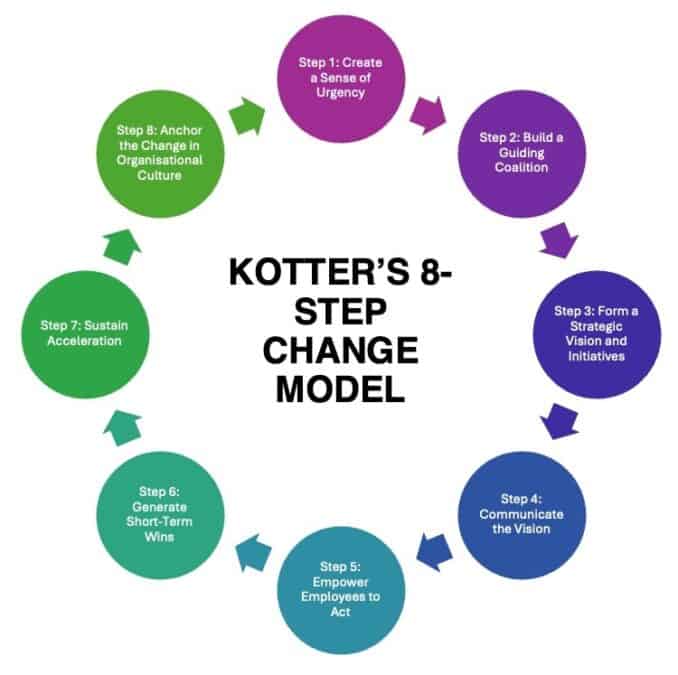
The model outlines eight sequential steps that leaders should follow to ensure change initiatives succeed. He summarises them in this way:
“The steps are: establishing a sense of urgency, creating the guiding coalition, developing a vision and strategy, communicating the change vision, empowering a broad base of people to take action, generating short-term wins, consolidating gains and producing even more change, and institutionalising new approaches in the culture.” ― John P. Kotter
The first step in Kotter’s model is helping people understand why change is necessary. Leaders must communicate the risks of maintaining the status quo and highlight the opportunities that change can bring.
Creating urgency motivates employees to move beyond their comfort zones and support transformation efforts. Leaders can build urgency by sharing market trends, competitor insights, or internal performance data that emphasise the need for change.
“The typical goal that binds individuals together on guiding change coalitions is a commitment to excellence, a real desire to make their organizations perform to the very highest levels possible. Reengineering, acquisitions, and cultural change efforts often fail because that desire is missing. Instead, one finds people committed to their own departments, divisions, friends, or careers.” ― John P. Kotter
Step 2: Build a Guiding Coalition
Successful change cannot be led by one individual alone. Kotter emphasises the importance of forming a strong team of influential leaders and stakeholders who support the change initiative.
This guiding coalition should include individuals with leadership authority, expertise, credibility, and strong communication skills. Their role is to drive the change effort, motivate employees, and maintain momentum throughout the process.
“A guiding coalition made up only of managers—even superb managers who are wonderful people—will cause major change efforts to fail.” ― John P. Kotter
Step 3: Form a Strategic Vision and Initiatives
Once the leadership team is established, the next step is to develop a clear vision for change. This vision should describe what the future will look like after the change has been implemented.
A strong vision helps employees understand the direction of the organisation and align their efforts with long-term goals. Leaders should also outline key initiatives that will support the achievement of this vision.
“If you cannot describe your vision to someone in five minutes and get their interest, you have more work to do in this phase of a transformation process.” ― John P. Kotter
Step 4: Communicate the Vision
Even the most well-developed vision will fail if employees do not understand it. Leaders must communicate the vision consistently and clearly across the organisation.
Communication should occur through multiple channels such as meetings, internal newsletters, and presentations. Leaders should also demonstrate behaviours that support the change, reinforcing the message through both actions and words.
“Communication comes in both words and deeds. The latter is generally the most powerful form. Nothing undermines change more than behaviour by important individuals that is inconsistent with the verbal communication.” ― John P. Kotter
Step 5: Empower Employees to Act
At this stage, organisations must remove barriers that prevent employees from supporting the change. Obstacles may include outdated processes, insufficient training, or resistance from management.
Empowering employees involves providing the necessary tools, training, and authority to make decisions that support the change initiative. When employees feel empowered, they are more likely to take ownership of the transformation.
“If employees have a shared sense of purpose, it will be easier to initiate actions to achieve that purpose.” ― John P. Kotter
Large change initiatives often take time, which can cause employees to lose motivation. Kotter recommends creating short-term wins that demonstrate visible progress.
These wins might include achieving project milestones, improving performance metrics, or successfully launching new systems. Celebrating these achievements helps build confidence and encourages continued effort.
“Without short-term wins, too many employees give up or actively join the resistance.” ― John P. Kotter
Step 7: Sustain Acceleration
After early successes, organisations must continue driving change rather than declaring victory too soon. Leaders should use the credibility gained from short-term wins to tackle bigger challenges and deepen transformation.
This stage involves continuously improving processes, introducing new initiatives, and encouraging innovation throughout the organisation.
“Speed of change is the driving force. Leading change competently is the only answer.” – John Kotter
Step 8: Anchor the Change in Organisational Culture
The final step is ensuring that the change becomes part of the organisation’s culture. New behaviours, processes, and values must be embedded into everyday operations.
Leaders can anchor change by aligning recruitment, training, performance management, and leadership development with the new ways of working. When change becomes part of the culture, it is far more likely to be sustained in the long term.
“Transformation is a process, not an event” ― John P. Kotter
Benefits of Kotter’s 8-Step Change Model
Organisations around the world use Kotter’s framework, and many still view it as the best, because it offers several advantages:
Provides a clear roadmap for managing change
Encourages employee engagement and participation
Helps reduce resistance to change
Builds momentum through measurable progress
Supports long-term cultural transformation
Why Kotter’s Model is Still Important
Kotter’s 8-Step Change Model remains one of the most effective frameworks for managing organisational change. By creating urgency, building strong leadership support, communicating a clear vision, and embedding change into organisational culture, businesses can successfully navigate transformation.
For organisations facing digital transformation, market disruption (e.g. with Artificial Intelligence), or internal restructuring, applying Kotter’s model can significantly increase the likelihood of achieving effective and sustainable change. And, with change being so constant, Kotter’s model can help imbue a culture of change that remains beyond a single initiative, gearing an organisation for long-term success.
“Change is inevitable. Change is constant.” – Benjamin Disraeli
If you want the right answers you have to start with the right questions
About The Right Questions
The Right Questions is for people who want to lead better and make better decisions. We are all leaders as we all have influence, no matter how much or how little. So, how are you maximising your influence?
If you are unsure, just drop me a line. I would love to help!
Do you want to lead better? Would you like to make better decisions? Want support in achieving your goals? Get in touch and let me know how I can help!