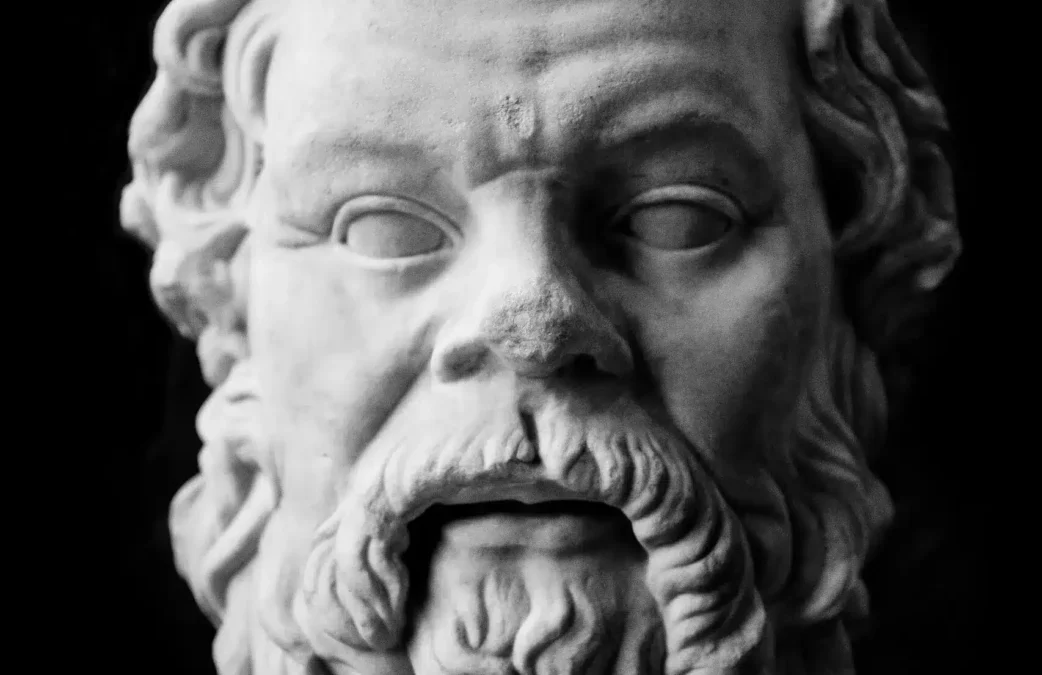
People, and particularly philosophers, have always been interested in knowing the best questions to ask. Socrates, Aristotle and Hermagoras of Temnos all played a part in the development of the 5Ws questioning technique. Understanding their approach can help us ask better questions, too.
Get him to the Greek (a philosophical decision)
I majored in Civil Engineering at Edinburgh University for my four years there. But when I arrived, due to my A-Level grades, I was offered direct entry into the second year. These grades were much more of a reflection upon my excellent teachers than upon me (especially when it came to my Maths grade which was frankly miraculous). But I saw an opportunity presented by this offer and therefore immediately leapt at it.
I went into the office of my Director of Studies and duly proposed that instead of starting either year one or two of engineering, I should study Ancient History and Archaeology instead. After all, if I did not need to do the first year of engineering, surely I was free to study other things? It was not a question that he was expecting. My request was so unusual that he did not really know what to say. The moment of confusion created by my question was just enough for me to persuade him that this subject swap was not just possible, but was actually a really good idea to broaden my education.
I have always loved history and at that time I was getting increasingly interested in philosophy too. Therefore, I was excited about getting the chance to delve into the thinking arising from the ancient world, and Greece in particular. After all, the system of thought born in Greece was foundational to the development of culture in Europe and the West.
Free Personal Leadership Action Plan
Just sign up here to receive your free copy
Socrates: The Grandaddy of philosophy
When studying European ancient history there are some larger than life characters that you cannot get around. Visionaries such as Alexander the Great and Julius Caesar reshaped the physical and political landscape. Others, such as Socrates, Plato, and Aristotle redefined the conceptual and intellectual environment.
Socrates was immortalised in the idealistic writings of Plato (The Dialogues) and has become the hero and father of Western Philosophy. His thinking contributed to the fields of ethics, logic, and pedagogy (teaching), to name but a few. I quickly fell in love with Socrates’ simple yet profound approach to life, and particularly his predilection for questions.
“I know you won’t believe me, but the highest form of Human Excellence is to question oneself and others.” – Socrates
The Socratic Method
But perhaps Socrates was most famous for being inquisitive. He developed the elenchus, the Socratic method, a technique that focuses on stimulating critical thinking. Central to the methodology is the idea of refining ideas to get closer to the absolute truth. This involves working towards stating an idea (thesis) clearly, challenging assumptions, and clarifying terminology.
The method is now primarily linked with rhetoric and for use in debates between individuals holding opposing viewpoints. But it was not just about setting out an argument; learning to ask questions was key to its effectiveness.
The Socratic method is often used as a ‘negative’ question technique. In other words, it seeks to undermine or disprove an opposing hypothesis. When the person being questioned has to admit their thinking is flawed, it exposes their wrong assumption and can often embarrass them. Big-shot lawyers in Hollywood courtroom dramas demonstrate the extreme of this when played out dramatically (think A Few Good Men or 12 Angry Men).
Socrates happily asked questions of just about anything and anybody. Socrates’ subtle yet ironic questions often revealed other people’s ignorance. This was helpful in unpicking wrong assumptions but he became known as the ‘Gadfly’ for his persistent interrogation. Unfortunately, his questions eventually goaded so many prominent Athenians that he was sentenced to death.
Thus, he proved that asking effective questions does not necessarily make you popular. You have to be careful not to make people feel or appear stupid. Remember also, people hold dearly to certain assumptions or beliefs. Therefore, it is important to apply emotional intelligence when using this methodology.
My post on Socratic Questioning Technique explains how to practically use this approach.
Aristotle, Hermagoras, and the refinement of the question technique
The Socratic method is a powerful technique but there are situations where one does not start with a hypothesis. Later philosophers can help us here. Others looked into more open methods of asking questions that went beyond just debate and into general inquiry.
Aristotle is attributed with being the first person to define the Septem Circumstantiae or “Seven Circumstances” in Book 3 of his Nicomachean Ethics (Sloan, 2010). These are the core seven questions that are necessary to understand and explain a situation.
Hermagoras of Temnos (with attribution from Augustine) clarified these seven circumstances for use in rhetoric and storytelling. He listed them as: quis, quid, quando, ubi, cur, quem ad modum, quibus adminiculis. These translate as who, what, when, where, why, in what way, by what means (Ballif and Moran 2005).
Cicero is also attributed to using a similar system. This is the basis of what we know today as ‘the 5Ws’ of what, where, when, who, why (and how).
Rudyard Kipling immortalised the concept when he wrote,
“I keep six honest serving-men, (They taught me all I knew); Their names are What and Why and When, And How and Where and Who.”
Leadership Development: Master the Top Leadership and Life Skills
Better lead in life and work to maximise your success. Sign up and access materials for free!
The Five Ws
Journalists in the twentieth century adopted the Five Ws as an interrogative style. It is an approach that is useful for getting the facts of a story. Police officers, researchers, crisis and incident managers, and others have used the same technique. In this context, the 5Ws became more specifically:
- Who is it about (who is involved)?
- What happened (what’s the story)?
- When did it take place?
- Where did it take place?
- How did it happen?
- Why did it happen?
The idea behind this interrogative technique is to ask open questions. Therefore, as far as possible, one can build up an unbiased or uninfluenced statement of the facts. The principle of using open questions, like those captured in the 5Ws, is that you cannot answer any of them with just a yes or a no. The open question invites elaboration and the divulgence of more facts.
When you are trying to look at something holistically and understand a situation it is important to get information (not just the answers you want). This is part of the Observe and Orientate phases of decision making as outlined in the OODA loop. At this stage, it is really helpful to ask open questions. Therefore, a framework such as the 5Ws can help to give a framework to our thinking, improve our planning, problem-solving and decision making.
Beyond the 5Ws question technique
The 5Ws approach is specifically tailored towards information gathering about a past event. It is good at getting a snapshot of the now.
When tackling strategic issues, we are not just trying to get a story; we are also looking to the future so we can establish a plan and develop options. The Right Questions approach takes the 5Ws a step further. By adding the ‘Which?’ question on top of the 5Ws, it is also possible to consider the concept of ‘selection’. This helps us to look at options and risks.
So we find that we go almost full circle and end up with seven basic questions that reflect those asked by Hermagoras over 2000 years ago; a list comprised of the seven most used interrogatives of the English language: what, where, when, who, why, how, and which. It just goes to show that, as Solomon said, “There is nothing new under the sun!”
We will look at these seven interrogatives in more depth in the next post, The Seven Most Important Questions in the English Language.