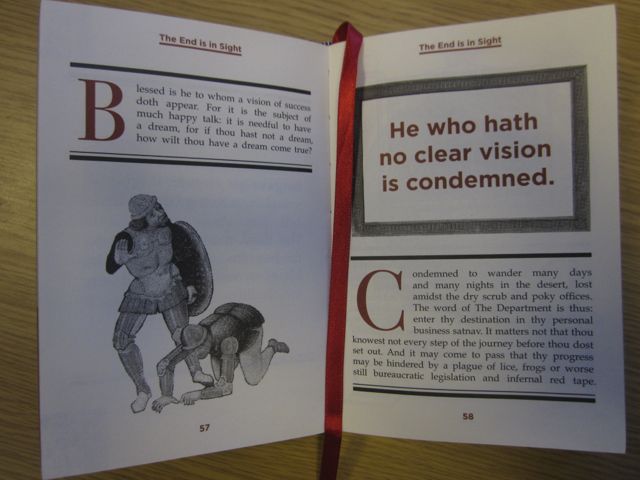
Are you wanting a book to inspire your work this year? Searching for a lovely executive gift? Wondering what pogonophobia is? Then check out the Book of Job by Dale Stafford.
It felt like Christmas all over again – or maybe better – because the package I received, containing a limited edition of The Book of Job, was so lovely I almost did not want to unwrap it. My name and address were handwritten in attractive sweeping strokes, the package was encapsulated in crisp brown paper, and all this was sealed with red wax and tied up with red and white string. I felt special just getting it. And there was more! Inside there was a letter, once again sealed with wax, and the book enclosed in patterned paper. So now I am feeling like it is Christmas and my birthday too. Once inside the wrapping the book’s lavish gold edging glistered at me; beckoning me to open it.
The attention to detail, already evident in the packaging, continues throughout The Book of Job. One example of this is in the language as The Book of Job is written in an Old English style (or perhaps ‘Ye Olde Style’) with lots of ‘thee’ and ‘thou’, ‘hast’ and ‘canst’. I thought this might make the book less accessible (as I am more likely to speed-read business books) but the more I read, the more I was disarmed by the approach.
I was also won over by the subject matter of the first page. The title runs “In the beginning was the word and the word was ‘Where?’ This immediately struck a chord with me, as in The Right Questions this is the first question that I pose too.
The book goes on to draw a parallel between the biblical character of Job and what we experience in our own job. The Bible story of Job is terrifying and inspiring in equal measure but Dale uses it cleverly to frame her book. There is an underlying theme throughout the book about turning challenges into opportunities as summed up in the quote on page 135:
“When a problem doth land on thy doorstep, it is opportunity that doth knock at thy door.”
This principle, underpinning the narrative, gives a very uplifting tone to the book. It is not a preachy how-to book about success, but rather a book of wisdom inspired by successful people. Therefore I feel that – although the book is penned in a fun way – the serious message of reframing the way we think about ourselves, others, life, work and success, is all the more powerful.
For me this meant that as I read through the book I found that Dale was speaking to the converted; I agreed with the points she emphasised and increasingly enjoyed the way she illustrated them.
The Book of Job is full of quotes, anecdotes, humour and insights that make it a pleasure to delve into; whether you chose to read it cover to cover or just dip in from time to time.
This is an excellent gift, especially for your friends in business, but you may not be able to resist treating yourself to a copy! Witty and engaging as well as beautifully constructed and designed, it is a pleasure to receive and to read. Well done to Dale Stafford on creating something so unique.
Oh, and by the way, pogonophobia is the fear of beards. One of the many things I learnt from reading the book!
If you want the right answers you have to start with the right questions
About The Right Questions
The Right Questions is for people who want to lead better and make better decisions. We are all leaders as we all have influence, no matter how much or how little. So, how are you maximising your influence?
If you are unsure, just drop me a line. I would love to help!
Do you want to lead better? Would you like to make better decisions? Want support in achieving your goals? Get in touch and let me know how I can help!
The Importance of Inspiring Stories to Values and Achieving Goals
Britiish Army Values and the Stories That Show Why They Are Important
Logic and emotion are both of great importance to being effective. Sharing inspiring stories that demonstrate our values and highlight success help us to engage with both the logical and emotional sides of what we need to do.
The Psychological Requirement to Connect Logic and Emotions
“Humans are creatures with a two-sided brain: On the left side, there’s nothing right and on the right side, there’s nothing left.” Anon
Scientists have long explored the dual functions of the brain and many people have heard of the idea that the left hemisphere of the brain is for logical functions whereas the right side is more for creative thinking.
Although this lateralisation is an over simplification it does contribute to our understanding of thought processes and personality types. We all have some sort of preference to being either more rational or intuitive in our approach to challenges and psychologists have used this and other measures to help explain personality types.
For example in the Big 5’ personality traits model a preference for being more creative, intuitive and creative in approach would lead someone to have a high ‘openness’ score. Equally, within the same system, someone with a more logical, ordered and detailed approach to life is likely to have a higher ‘conscientiousness’ ranking.
Once again these measures are generalisations but they demonstrate that we all have certain preferences and that any preference to one side or another has certain strengths and weaknesses and therefore we need a balance of the logical and emotional in our approach.
One way we can achieve that balance is through developing a good team and having people who can fulfil different roles and play to their strengths. But even with a well balanced team there are certain functions in an organisation – such as customer service and brand awareness – that everyone has an influence on and therefore, whatever their preference, they need a way to be connected to both the logical and emotional drivers in the business.
It has been demonstrated that one of the most powerful ways of connecting between the logical and emotional is the use of stories. For most people it is shared experiences, the conversations we have, and the life illustrations we hear, that are the lessons we tend to remember. These things become the threads that tie together the logical and emotional aspects of what we do.
This knowledge is very important to organisations, as any team needs to engage their people at the logical level, through things such as goals and measurements, to more emotional issues such as values and purpose. Really successful institutions have ways of capturing and sharing stories that naturally spread through the group; encouraging people and embedding the right strategies and attitudes in people whatever level, role or function they operate in.
The Successful Military Model
Having had a military background I can share a way that the Armed Forces has created a process that enables the sharing of stories that demonstrated the values of the organisation and inspire people to achieve their tasks with the right attitudes.
Even though the values of the British Army are regularly taught to soldiers, if you asked the average private what those values were they would probably struggle to give you more than two of the six core values. The core values of the British Army are:
Courage
Discipline
Respect for others
Integrity
Loyalty
Selfless commitment
These values are the most important aspect of the emotional connection within the Army. The critical issue on the logical side is the concept of mission. The military operates within an approach called mission command and the importance of achieving the mission is drummed into every service man and woman.
Because a mission in the Army frequently requires hardship or threat to life it is vital that the values are effectively understood and adhered to. Otherwise the deeper purpose and motivation would be lost. How then is this done when the average soldier cannot recall what the values are? The answer is that they all know stories that link the achievement of a mission with the values that underpin that success.
Many stories are passed on informally in the bars and barrack rooms of the military but there is also a formal process for capturing and celebrating the best of these stories. This is done through citations and the awarding of medals.
In the British Commonwealth the most famous medal of all is the Victoria Cross; the highest commendation that can be awarded for valour in the face of the enemy. Introduced by Queen Victoria in 1856 the Victoria Cross (VC) has only been awarded 1356 times, and only 13 times since the Second World War.
The stories that surround VC winners are legendary; VC winners are the heroes of the Armed Forces and the stories permeate the culture of the organisation. Their history is taught during training, pictures of their heroic deeds hang on the walls of offices and messes; teams and places are even named after them.
Lieutenant John Chard – A Hero of Rorke’s Drift
For me, being a Royal Engineer Officer, one story I have been steeped in is that of Lieutenant John Chard, the Royal Engineer Officer who led the defence of Rorke’s Drift during the Zulu War in 1878.
Chard was sent to Rorke’s Drift (a small garrison at a mission station) to build a bridge but the location became the site of a decisive battle.
A Zulu impi (an Army of 3000-4000 men) descended upon Rorke’s Drift fresh from subjecting the British to a terrible defeat at Isandlwana where they had annihilated 1350 British and Native troops.
There were only 139 soldiers (including 30 sick and wounded) and a handful of local and colonial troops (making about 150 in total) at Rorke’s Drift but John Chard led the successful defence of the station. The desperate fighting, often fought hand to hand, went on through an afternoon and an entire night but the defence held. The battle cost 17 of the defenders lives. The Zulus suffered several hundred mortalities and withdrew from the attack the following morning.
The incredible valour by the defenders led to the awarding on 11 VCs and 4 DCMs (Distinguished Conduct Medals). The story is particularly well known as it was made famous by the film ‘Zulu’ where John Chard was played by Stanley Baker and Lieutenant Gonville Bromhead – his fellow officer and VC recipient – was played by Michael Caine.
John Chard’s actions demonstrated his deep commitment to his mission and an exemplary illustration of the values of the Army. The leadership that Chard demonstrated at Rorke’s Drift has inspired generations of young officers, such as myself, and this is just one of many incredible stories that could be told of brave service men and women.
Inspiring Stories for Making the Connection
A recipient of the Victoria Cross is an extreme example of a story, and certainly not an everyday occurrence, but shows the power of stories to inspire people. Stories have the power to connect people to the logical and emotional requirements that an organisation expects of them and it is important that any team or business looks at ways of capturing and spreading stories that equip, inspire and release employees to take new levels of ownership in their work.
If you want the right answers you have to start with the right questions
About The Right Questions
The Right Questions is for people who want to lead better and make better decisions. We are all leaders as we all have influence, no matter how much or how little. So, how are you maximising your influence?
If you are unsure, just drop me a line. I would love to help!
Do you want to lead better? Would you like to make better decisions? Want support in achieving your goals? Get in touch and let me know how I can help!
Trying to come up with a short pithy mission statement that encompasses everything you are about in life is not an easy task! Do not worry – the concept of mission statements is bigger than just one individual phrase, as I will try to explain. Mission statements exist in the context of lots of interlocking levels, generally not just as some isolated goal that stands totally alone.
Different mission statements within a single company
Imagine a company, a company that makes toilet rolls. The vision of the company is that every posterior in the world should be blessed by the ultra-soft ‘Cushionette’ produced by the business. They have defined their mission, their measure of success as: ‘to have a roll of Cushionette available in every lavatory in the world’. It is a bold and audacious mission.
Different departments, different mission statements?
There are many departments within the company to allow it to function properly. There are Sales; the guys in sales have a mission statement that is almost exactly the same as the company mission because they are trying to sell the product into as many spaces ‘in the world’ as possible. For the Quality Control team, the mission statement is easy too, they need to make sure each roll of Cushionette is ‘ultra soft’.
How about the Finance team? Defining the mission for the Finance team is somewhat harder. It is harder still at an individual level: how do you create a mission statement that applies to the person who does the photocopying for the Finance team? Yet, if they are going to be effective they need a mission that connects them to the greater vision and shows them how they can make a tangible difference in achieving the bigger goal.
So the Reprographic Officer (photocopier person) will have their personal mission statement. Let’s say in this case their mission statement is “to always produce copies that are timely, accurate and cost-efficient” but that mission is a sub-set of the Finance team mission, which is, in turn, a subset of the company mission.
This is important as the more productive each individual and team is the more productive the overall effect is. Also, one failure of the smallest element can bring down the whole thing. If the ‘Vice President of Printed Communications’ (another photocopier person) fails to copy the company accounts on time, the company is put at risk. All right, so this is stretching the point somewhat but on a serious note, any communications process can have a major effect on the effectiveness of a team or company.
So from the example above we can see that within an organisation there will be various missions that all need to interlock vertically across the company. It’s like those Russian dolls that fit inside one another. Not clear yet? Let’s investigate this from another angle; here is some background to the theory.
Mission Command
The military has probably spent more time and effort on developing the idea of a mission than anyone else, and in the British military this overlapping hierarchy of mission statements is referred to as ‘mission command’. This decentralised approach is to some extent based on the lessons learned from the effectiveness of German Stormtroopers and the ‘manoeuvrist’ approach of Blitzkrieg warfare, but again don’t worry if this means nothing to you, you do not need to be an expert in military history to understand the basic principles.
The idea behind mission command is to allow maximum freedom of movement, coordination and support at every level of the organisation by having interconnected mission statements. It requires a highly trained and motivated force but when it works it is referred to as a force multiplier, in other words, it is highly effective and greater than the sum of its parts. In business, this is sometimes referred to as ‘synergy’.
So maximum effectiveness is the aim; your main responsibility is to make sure you and/or your workforce are highly trained and motivated, and then to make sure the mission is clear and connected both up and down the organisation.
How to craft a mission statement
In the military, the mission statement actually comes in two parts. There is both a ‘to’ and an ‘in order to’ phrase in the statement. For example, I said earlier a mission might be ‘to capture the position on hill 321’ but it will also have a second half that says something like ‘in order to allow the battalion to advance’. In other words, one mission is connected to another mission in a hierarchy. In this case, the battalion cannot achieve its mission of advancing unless the enemy position on the hill is captured. The battalion in turn will have a mission that connects to its higher command and so on up the chain. These go up from the tactical to operational, strategic and grand-strategic levels. That one mission to engage with the enemy on hill 321 will be part of a much larger picture such as a war between two sovereign states. Who knows, the whole campaign could pivot on that one action: that is why the mission is so important.
Mission statements work up and down and side to side
So just like the toilet roll company, all the missions interlock up and down the organisation. So that is the hierarchy – the up and down bit, but there is more. There is a horizontal plane of mission as well as a vertical one. Every department in a company or every person in a team will have a slightly different mission but they need to complement each other. Crafting mission statements is likely correctly harnessing horses. You are trying to get people to pull together in the same direction.
As an individual you are likely to have a mission in your workplace that interconnects vertically and horizontally within that organisation but your career mission statement may have very little to do with other parts of your life. Most of us have a range of responsibilities and wear a variety of different hats. Therefore we can expect to have different missions that are relevant to the various roles we play. For example what is your contribution or role within your community? What is your mission in terms of your family and relationships?
These personal mission statements have a hierarchy too as all the goals we set are effectively part of the mission and they only exist (or should only exist) to support the greater mission. Confused? Don’t worry! Take a look at how to make an action plan.
If you want the right answers you have to start with the right questions
About The Right Questions
The Right Questions is for people who want to lead better and make better decisions. We are all leaders as we all have influence, no matter how much or how little. So, how are you maximising your influence?
If you are unsure, just drop me a line. I would love to help!
Do you want to lead better? Would you like to make better decisions? Want support in achieving your goals? Get in touch and let me know how I can help!
We know that building a team is not all about ‘trust falls’, away days and retreats. Therefore, how can managers build lasting bonds and the kind of trust that makes teamwork a breeze?
I started off my career as a Bomb Disposal Officer in the Army, working in situations where working well together as a team was potentially a life or death situation. Since then, as a consultant and leadership coach, I have worked within and alongside organisations in the commercial, governmental and voluntary sectors, equipping teams with the skills they need to be more effective in working together. The bulk of my work revolves around facilitating strategy, giving people the tools they need to make good decisions, and through this building teams that are resilient to change and uncertainty.
There is not always the luxury of having time out and fun activities to build a team. Fortunately, these things are not actually necessary. You can build a successful team in the harshest of environments if you understand certain fundamentals. Here are the things that I have found are most effective in turning a bunch of individuals into a high performing team.
“Great things in business are never done by one person. They’re done by a team of people.”
A well-functioning team is dependent upon good leadership. If a team is failing in some way, then the manager has to make the assumption that they have to shoulder the bulk of the blame and take responsibility for finding a solution.
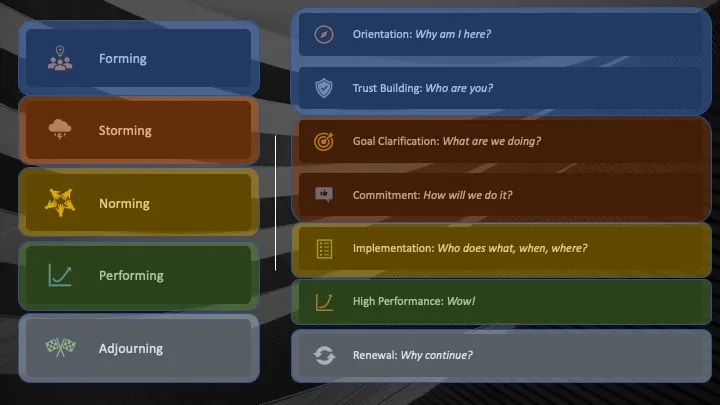
One thing that can really help a leader build and manage a team is understanding the natural evolution that a group goes through on the way to becoming an effective team. One great model of this that I have found particularly helpful (and memorable) is the Tuckman Cycle. Bruce Tuckman did research that demonstrated that every team goes through stages of:
Forming
Storming
Norming
Performing and
Ajourning
A manager can do things to speed the process through these steps to the performing stage. It is especially important to get through the painful ‘storming’ phase but you cannot completely short circuit the system to get straight to performance. There has to be some pain to get to the gain.
Another model, the Drexler-Sibbet model of Team Performance, is a helpful complement to the Tuckman model. The Drexler-Sibbet model poses a set of questions that a team needs to work through in order to progress through each level of performance. As a leader, this is invaluable in working out how to support the team best.
You can see how the two models combine in the picture below.
The stages of team development and the questions that need to be answered
All teams experience a level of change and you can progress or regress through these models. Therefore a leader needs to assess which stage their team is at and how to answer the key questions. A good leader thinks of strategies to facilitate progress towards peak performance. These can be planned from the beginning.
Gather people to a common vision and set of values
One thing that can help people quickly form as a team and work through initial ‘storming’ challenges is to have a visionfor people to gather to and for them to share a common set of values. People need to know where they are going and how they are going to get there. A clear mission gives people the definition of success they need to make progress, while shared values and principles provide the guidelines for behaviour and decision-making that will shape the journey. If these are established early on it will help attract the right team members and then engage people effectively so they can quickly get to the settled ‘norming’ phase.
Stephen Covey wisely said: “Seek first to understand, then to be understood.” This is vitally important for the leader and manager. It is very easy to plough into a team environment and start pushing people to do things in a particular way but investing in individuals first can save a lot of time, effort and heartache.
Listening to your team members and understanding the needs and desires of your employees (as well as their skills and experience) will contribute to the effective management and working of the team. Giving time to individuals builds up capital in the relational bank account; an investment you can then draw upon when challenges hit, but hopefully with less chance of going overdrawn.
Give people clear roles and responsibilities
Team members, as well as needing to know where they are going, also need to know their part in the plan. Their roles and responsibilities need to be clearly laid out in such a way that they should be stretched but be able to play to their strengths. One of the most successful tools for establishing the roles within a team is the Belbin Team Roles model.
Meredith Belbin did extensive research into how effective teams function and worked out that there are nine functions or roles that need to be fulfilled for a team to work properly. Some people may take on more than one role but all the following bases need to be covered:
Plants are highly creative and good at solving problems
Resource Investigators connect with the world outside the team, bringing in external views on opportunities and competition
Monitor Evaluators provide a logical, impartial view and help to weigh up options
Co-ordinators focus on the objective and delegating tasks to team members
Implementers plan and implement a workable strategy
Completer Finishers bring high standards, see errors and add polish to the final solution
Team workershelp the team gel and identify things that need doing to help the team
Shapers challenge and provide momentum by driving the team forward
Specialists provide in-depth knowledge within a key area
The approach is explained more fully in his book Team Roles at Work (2010).
Overcoming challenges together
When people know where they are going, how they are getting there and what their role is then work starts getting done efficiently. At this point, the team can grow together as they face and overcome challenges together. Successfully tackling a work problem can bring more progress than a plethora of away-days. Helping someone through a problem is far more productive than catching someone in a ‘trust fall’ exercise. The important thing for the manager to remember at this point is that they need to be playing their part in the team, bringing leadership, keeping up good communication, supporting individuals and helping the team to make decisions.
Celebrating success
Finally, when something is done well it should be celebrated. This does not mean popping the champagne (although there are times for that), it could be as simple as praising a team member for a job well done. This should be done in a team or public setting so that people can share in the success and be encouraged to press forward in what they are doing. Then, at the end of a project, throw a party.
Congratulations, you have a fully functioning team!
If you want the right answers you have to start with the right questions
About The Right Questions
The Right Questions is for people who want to lead better and make better decisions. We are all leaders as we all have influence, no matter how much or how little. So, how are you maximising your influence?
If you are unsure, just drop me a line. I would love to help!
Do you want to lead better? Would you like to make better decisions? Want support in achieving your goals? Get in touch and let me know how I can help!
How to Estimate The Resources You Need to Achieve Your Plan
What resources do you need to achieve your goal? How do you estimate those resources for your plan? Which ways can you get the resources you need?
Quite often we limit ourselves and our plan to our present resources. After all, it is reasonable to ask ‘Which holiday can I afford?’ before going and booking one. Budgeting is good stewardship and I would certainly not recommend getting into debt on a whim.
But we will never be able to dream big or make macro leaps forward if we limit our goals to what we can achieve with the resources we have now. It is better to first ask what we are passionate about doing, working out the resources required, and then thinking creatively of ways to get what we need. That is why this question comes some way down the planning process.
The importance of logistics
An army needs logistics. A large portion of every military is concerned with delivering the right resources to the right people in the right places. In fact, there are many more logisticians than infantry soldiers in the average army. But the army does not exist for logistics. It has a mission to achieve. That aim is very rarely just to do with just moving men and equipment from one place to another. Logistics is a large and essential part of achieving your aim. But it is there to support the mission, not to drive it. History testifies to the fact that an army will beg, borrow and steal if necessary to get the job done if (or rather when) logistics fail. You can still achieve your aim when resources are difficult to come by if you remain focussed; as the United States Marine Corps would say: you just need to ‘improvise, adapt and overcome!’
This is because there are very few times when finances and resources are fixed. A compelling vision inspires us to innovate and save. It motivates us to earn and raise the funding that we need and find the tools to get the job done.
Why is it that many people who win the lottery often struggle. Why do they end up having spent their money within a few years? The gambling industry sells winning as the dream; it does not provide a vision for what comes beyond that. Many people who win do not have a clear idea of what they want to do with the money. They might take a nice holiday and pay off the mortgage but that is not a grand vision. Anyway, these things can be done without playing the lottery or the roulette wheel.
People who make (and keep) large amounts of money use it productively. Resources that continue to grow are usually driven by a vision beyond that of just making cash. Bill Gates, the richest man in the world for most of the last decade, was not motivated primarily by money. When he started Microsoft with Paul Allen they had a vision of a computer in every home. This dream, of how computing could transform the world, drove Microsoft. It became the most successful software business in the world and made Bill Gates a multi-billionaire.
Money, Manpower and Materiel
So we start with the dream and then work out what we need to make it a reality. When we need to make something happen it generally comes down to the three ‘M’s:
Money
Manning
Materiel
Cash, workers and equipment are all important but it is usually the first element, the money, which drives others; so this is the primary consideration here (we will look at the people issue more under the Who question).
Estimating the cost
When we have our dream or our goal, we can start to put a cost against it. If it is hard to assess the cost for a whole goal we can break it down, as we have done previously, and cost each constituent task or step.
Remember to put a cost against the time you invest in achieving the goal. When doing something yourself you can feel you are getting it done for free but that is not actually true. Our time is worth something, even if it is just the opportunity-cost of not being able to do something else while we are engaged with a task we have decided upon.
Often it will turn out cheaper to pay someone else to do a task that can be delegated as this leaves you just the things that no-one else can do and you will achieve your goal all the sooner. We will look at delegation some more under the ‘Who’, but having broken down tasks and now putting costs to them will help you make decisions on the team you might need.
Once you have estimated a cost for each individual task you will get an idea of the budget for the whole project. Once this has been done you can start to think creatively about how to reduce the costs. Or you can seek further resources in more inventive ways (and no I am not talking about stealing here!).
For example, instead of paying for a qualified professional, could you get someone to do the work voluntarily? Perhaps you could offer them experience as an intern? If someone is still in training or education they may value the experience more than pay. Alternatively, think about what service or product you might be able to offer someone in return. Bartering is as old as trade itself but sometimes people forget it. I have used this sort of transaction in building my business. For example I have coached people in return for help with my website.
I used this method when I employed someone to develop my website. They worked on the website in return provided some coaching to help them further their career. It was an easy win for both of us, and no cash changed hands.
Fuel the dream
Considering the resources we need and how we are going to get them is an important aspect of how we make our dreams real. An idea becomes a lot more tangible as we think about and assess the tools and materials we need for the job. It can take some time, and may not be as liberating as some of the big picture thinking, but it is important so stick with it!
“First, have a definite, clear practical ideal; a goal, an objective. Second, have the necessary means to achieve your ends; wisdom, money, materials, and methods. Third, adjust all your means to that end.” Aristotle
If you want the right answers you have to start with the right questions
About The Right Questions
The Right Questions is for people who want to lead better and make better decisions. We are all leaders as we all have influence, no matter how much or how little. So, how are you maximising your influence?
If you are unsure, just drop me a line. I would love to help!
Do you want to lead better? Would you like to make better decisions? Want support in achieving your goals? Get in touch and let me know how I can help!
How should we delegate work effectively? What is a SMART or SMARTER task, and how can they help?
When we set ourselves a goal, we want to stick to it. Equally, as a leader or manager, you have to effectively delegate tasks in order for your team to perform well and to achieve your aim. Setting clear goals also helps to motivate teams and individuals because they understand what they need to do.
But this is simpler in theory than in practice. Often a leader’s’ experience is that – even when you think you have delegated something effectively – you still encounter problems. People may keep coming back and bugging you with questions, or alternatively the task is not done on time, or the job is not completed to the right standard.
To help avoid these issues we can use the acronym ‘SMART’ when delegating work. SMART stands for:
Specific,
Measurable,
Attainable,
Relevant and
Time-bound.
This method is accredited to George T. Doran (who first described a version of the acronym in the November 1981 edition of Management Review) and since then the method has evolved to encompass various adaptations of the acronym including having an E (for evaluate) and an extra R (for re-evaluate) to create ‘SMARTER’ goals.
When you give someone a goal it needs to be specific. It needs to be clearly defined and unambiguous. Whether it is a large mission or a smaller task you need to express what success looks like.
Specific is the most useful word here but you could also substitute ‘significant’ or ‘stretching’ in here if you want to make a task more aspirational (such as a ‘BHAG’ – Big Hairy Audacious Goal – promoted by Jim Collins in Good to Great) or use it as a reminder to keep things ‘simple’ or ‘sustainable’.
M – Measurable
Next, the task needs to be measureable. In other words, it needs to be possible to track the progress of completion of the goal. If the task is a big one you might need to break it down into separate activities and set milestones to help monitor progress.
Having specified the goal and broken it down to measure it you have the fundamentals of a plan.
A – Attainable
It is good for goals to stretch us but the ‘A’ here makes us ensure that the task is attainable. We can be bold but the task needs to be achievable. A task can stretch a person or a team (this is healthy) but if you are asking the impossible of someone, it will quickly become de-motivational. As a leader, you set goals to help people grow, not to set them up for failure.
Therefore by asking this question we also consider whether the person in question is properly equipped and supported to achieve the task. If it is our goal then we need to reflect upon our readiness. As a manager, we should be checking that whoever we delegate to has the right training and resources to complete their work.
R – Relevant
The task needs to be relevant to the vision of the team or organisation. Ask yourself, does this piece of work take you a step closer to achieving your overall mission? It is in line with your values? If not you may need to redefine the task.
The work also needs to be relevant to the person you are delegating to. Are they the best person for the job? Is it part of their role and job description? Do they have the relevant skills and experience? Will they be developed by this task?
T – Time Dependent
Having to create a timeline makes you properly assess how long a piece of work should take. Considering time also makes you evaluate your priorities and any dependencies that one task may have upon another.
Deadlines also help to keep people accountable for finishing and stop a piece of work dragging on endlessly. The time element, as with everything else, should be set in agreement with the person you are delegating to so that you all ‘contract in’ to the parameters for the work.
E – Evaluate
Adding in the ‘E’ of ‘Evaluate’ is useful as it brings in the discipline of reviewing how well work has been done. It gives the opportunity for feedback; praise, constructive criticism and learning on behalf of the manager and worker.
For a larger goal you might want to consider these evaluation steps and plan them in along with your overall deadline. Make evaluation time dependent too.
R – Re-evaluate
Decision making and learning happen in a cycle. We recognise this by adding the re-evaluation step here. Re-evaluation is a continuation of the learning from the ‘Evaluate’ phase. Once you have identified lessons at the evaluation phase these should be incorporated in the next stage of the activity. This gives the opportunity to learn and improve as the task progresses.
For example, the first time around the deadline might not have been achieved or the person may have needed more support to achieve the goal. Once the task has been re-set and re-started then the results can be re-evaluated to identify improvement.
How to set SMART goals video – YouTube
Set SMART goals and SMARTER tasks
Setting SMART goals helps us ensure that goals are actually achieved. It helps take the goal from an idea to a plan that we have committed to.
Equally the SMARTER approach provides a useful checklist and process by which both a manager and employee can agree upon the parameters for a task and be accountable for its outcome. Setting SMARTER tasks helps to build in the reviewing and learning from goals that if often forgotten or neglected.
So what is your next goal or task? Apply the SMART or model and make sure it happens!
If you want the right answers you have to start with the right questions
About The Right Questions
The Right Questions is for people who want to lead better and make better decisions. We are all leaders as we all have influence, no matter how much or how little. So, how are you maximising your influence?
If you are unsure, just drop me a line. I would love to help!
Do you want to lead better? Would you like to make better decisions? Want support in achieving your goals? Get in touch and let me know how I can help!
Start with Why (How Great Leaders Inspire Everyone to Take Action) is the title of Simon Sinek’s book, website and TED talk.
Simon Sinek focusses on the fact that for a team to operate effectively everyone needs to be motivated and to feel that they belong. This is the reason leaders need to start with the ‘why’, in other words the purpose, values and inspiration behind any business or project. People are more productive and engaged if they want to do something rather than because they have to do something.
For a customer or client the ‘why’ is also more compelling and alluring as Simon points out in his example about Apple computers. The ‘what’ would express:
“We make great computers. They are beautiful designed, simple to use and user-friendly. Want to buy one?”
Whereas the ‘why’ communicates:
“Everything we do, we believe in challenging the status quo. We believe in thinking differently. The way we challenge the status quo is by making our products beautifully designed, simple to use and user-friendly. And we happen to make great computers. Want to buy one?”
The ‘why’ is therefore the reason and the belief. The ‘how’ and the ‘what’ are the results that confirm that you are holding fast to these values.
If you want to find out more I recommend that you check out his TED talk here:
If you like that and want more then you will love his book. Check it out by clicking on the link here:
You may notice that Simon Sinek has a slightly different approach to applying the words ‘why’, ‘how’ and ‘what’ to that in The Right Questions, which is of course totally fine! Actually you should see that when you get beyond the definitions the key lessons between the Start with Why methodology and The Right Questions are actually broadly the same and I would agree that overall our actions and decisions are based on our values therefore it is incredible important to understand our ‘why’ before we get into the planning and doing stages.
If you want the right answers you have to start with the right questions
About The Right Questions
The Right Questions is for people who want to lead better and make better decisions. We are all leaders as we all have influence, no matter how much or how little. So, how are you maximising your influence?
If you are unsure, just drop me a line. I would love to help!
Do you want to lead better? Would you like to make better decisions? Want support in achieving your goals? Get in touch and let me know how I can help!
“Pride goeth before destruction, and an haughty spirit before a fall.” Proverbs 16:18 (KJV)
The idea of ‘pride going before a fall’ is one of the best known quotes (or misquotes) from the Bible and never is the saying more true than in the context of leadership. The new Star Wars film, provides some interesting lessons regarding haughtiness and in this post we will examine three characters from The Last Jedi who suffered consequences from pride effecting their leadership.
Beware! Spoiler alert! This post discusses plot detail from the new Star Wars film, The Last Jedi.
The Tirant: Snoke
The Supreme Leader of the First Order is the terrifying Snoke, a Master of the Dark Side and someone who built their power base on fear.
History clearly demonstrates that fear is a powerful tool to control people and has been used many times by leaders to consolidate and hold onto power. But fear does not set the foundation for lasting success or a positive legacy. Fear is a powerful short-term motivator but people will take the opportunity to be free of fear given the opportunity, and empires built on fear will eventually fall. Absolute power corrupts absolutely and fear is a poor leadership strategy.
A climate of fear creates an atmosphere where those surrounding the leader cannot speak the truth – especially when sharing bad news – as they want to avoid becoming the object of wrath. This lack of honesty can result in a leader becoming overconfident and for them to look down and underappreciate those around them. It makes the person at the top believe in their own myth of infallibility and makes them blind to genuine threats, both to them and their organisation.
It was this hubris, blindness and condescension that led to Snoke’s downfall. He misjudged Kylo Ren and could not see the threat from Kylo Ren when Snoke believed he was totally under his influence.
Leadership top tip:
If you are prefer a leader who prefers a more directive approach, make sure you have people around you who are empowered to give you feedback, however challenging it may be.
Movie recommendations:
Downfall (2004) and The Death of Stalin (2017) are two other powerful stories that illustrate the paranoia and eventual demise of regimes that are led through fear.
The Maverick – Poe Dameron
Poe Dameron is a self-confident fighter pilot who is most comfortable when leading from the front and taking action. He is a talented tactical commander with a reputation for courageous deeds. His attitude is best summed up when he asks General Leia Organa for “permission to jump into an X-wing and blow something up.”
This focus on direct and immediate effect means Poe is a great tactical leader but often lacks the vision for longer-term strategy. His head-strong pursuing of tactical gains, against orders, leads to a demotion early on in the film. Poe also feels entitled to know the plans of his superiors and his strong opinions soon create friction with his new commander. His superior, Vice Admiral Holdo, is a different type of leader both in appearance (as Poe comments upon) and style, and this creates further distance and misunderstanding.
Poe has the best of intentions but allows his errors of judgement to compound. He makes some very risky decisions that result in division among the Rebels and internal conflict during a time of crisis. Heroic and daring as he is, his plans fail and it is late in the day before he understands his commander’s intent and value. It is a costly path he treads to learn more self-awareness and humility.
Leadership Top Tips:
To be a good leader you also have to be a good follower; it is important to be loyal to those that lead you and learn from them. You may have much to contribute but as Steven Covey says, “seek first to understand, then to be understood.” If you like to lead from the front make sure you take time to step back regularly and see the bigger picture.
Movie recommendations:
For more maverick fighter pilots who need some humility you don’t need to look any further than Top Gun (1986). Patton (1970) is a good case study of a strong willed commander, with excellent tactical ability, who had a character that made him divisive.
The Mentor – Luke Skywalker
At the beginning of the film Rey has finally found Luke Skywalker on a remote island, on an even remoter planet, where he has been hiding away. Luke has been in retreat ever since he failed as a leader and this disaster meant Luke cut himself off from the Force.
Luke feared failing again. He could see the vanity that had come from believing in his own legend. He had seen the fallout of his arrogance but the lesson he took from this was that he should never lead again. He thought he was disqualified by his mistakes.
Fear is poor leadership tool and it is an equally poor driver when it comes to making decisions. When we make decisions from poor assumptions or defeater beliefs we rob ourselves (and potentially others) of positive ways to progress.
Luke is a Jedi Master, but it takes his own mentor, Yoda, to help Luke to put his past mistakes into context. Yoda eloquently states, “The greatest teacher, failure is”. In other words we should learn from our errors in order to be a better leader.
Rey is the other person that helps Luke to reassess his position. She demonstrates the need and desire for Luke’s leadership, despite what has happened in the past.
When Luke accepts the past, brutal as it is, with peace and forgiveness, then he ignites a new resolve and is able to bring leadership in a new, dramatic and incisive way.
Leadership Top Tips:
Even when we are experienced leaders we still need mentors and coaches of our own. We should always be open to learning and that means learning and gaining inspiration from those who look to us as their teachers as well.
Movie recommendations:
Aragorn in The Lord of the Rings: The Return of the King (2003) has to face and overcome the fear of his heritage in order to fulfil his destiny.
If you would like access to some bonus content and get updates then please do sign up for my email list.
And hello to Jason Isaacs!
If you want the right answers you have to start with the right questions
About The Right Questions
The Right Questions is for people who want to lead better and make better decisions. We are all leaders as we all have influence, no matter how much or how little. So, how are you maximising your influence?
If you are unsure, just drop me a line. I would love to help!
Do you want to lead better? Would you like to make better decisions? Want support in achieving your goals? Get in touch and let me know how I can help!
When was the last time you failed as a leader? How long ago was it; weeks, days, (hours)? I certainly don’t have to think very far back to find failure.
I was listening to Brené Brown’s excellent book ‘Dare to Lead’ and thought I would take a few minutes to pause and reflect on when my practice of leadership has not lived up to my theoretical ideal. Within minutes I had a scary number of examples. So, in the spirit of writing what you need to read, here as some of my failures.
I have led in various professional contexts for more decades than I care to mention. My experiences as a leader have been some of the most rewarding and enriching in my life, but my time as a leader is also littered with mistakes.
If you want to be a leader, get used to failure! Let me amend that: As a leader get used to failure, and get good at learning from it.
Failing to achieve a task is one thing but I have also frequently failed to maintain my own standards and values. These are the most painful failures of all. So I thought I would start there in terms of sharing.
I have failed through anger, shame, faking it, lack of courage and basically trying to be something I am not. Insecurity has haunted me, in one form or another, the whole time.
So, I’m here to air my dirty washing (that’s what you are waiting for right?) I have started with some from earlier in life and progressed (or regressed) from there. My genuine hope is that by sharing this you can learn from my mistakes and avoid a few yourself. And, if you can’t avoid the mistakes, hopefully we can just learn better together.
“It’s fine to celebrate success but it’s more important to heed the lessons of failure”
Bill Gates
Failure to develop others
Were you in Scouts or Guides when you were younger? I loved being in the Scouts (the Guides would not have me) and it gave me one of my earliest opportunities to lead. As a Cub Scout I rose to the lofty height of ‘Sixer’ with responsibility to lead our team of six (or so) fellow cubs.
So how did I do this? My memories are that my main leadership technique at the time involved the threat of violence. Shocking I know, on so many different levels!
And when I think back I simply ask myself, why on earth did I pick such an approach?
I was not big or strong. Violence was certainly not the approach taken by the leaders and role models around me. Thinking back I have to put it down to my own insecurity. For one reason or another I wanted to appear strong, to be something I was not; so I used the little strength I had in the wrong way. I used it to instil fear, rather than to protect.
I got compliance, but I missed out on the opportunity to create an environment where people felt safe to grow and learn. So much of leadership is about seeing the potential in others and creating the space for them to reach that potential. That is how I should have used my strength.
Failure to discipline others
Anyone else have a position of responsibility at school? One of other early opportunities I had to lead and to learn was as a prefect. In my final year of school, before university, I was one of the top tier prefects with the power to discipline (or punish) fellow pupils. What could possibly go wrong!
There was one particular group of boys in the year below mine who were always giving me (and others) trouble. One day they were walking along with their hands in their pockets, which at that school was practically a capital offence. Yes, it was a strict school. I said something, probably not in the most graceful manner, and I got a less than graceful reply.
I immediately told the group that they would receive a punishment, to be done later that day, which involved re-painting some school equipment.
The punishment did not really fit the crime. There was no real benefit from it for anyone – it wasted all our time. In my eagerness to punish I also did not properly set them up to do the job so I failed in my delegation of the task too.
Looking back I realise that I should not have punished them, I should have disciplined them. And there lies the subtle difference.
I could have done something clever such as tasking them to do the prefect job and for them to have responsibility to set the standards. I could have worked alongside them, setting an example and maybe even winning them around.
A lost opportunity but a lesson learned, by me at least. Discipline and punishment are not necessarily the same. Punishment often happens out of anger and the desire for retribution. Instead, a good leader disciplines people. Not only to maintain standards, but also to help people to develop in character and be disciplined by themselves. I think it took me becoming a parent to truly understand the need to discipline out of love.
Failure to practice what I preach
I have always enjoyed adventurous activities and alongside my more corporate roles I have worked as an expedition leader and outdoor instructor.
One time I was with some friends and instructing them in rock climbing. I was known for being the ‘outdoor guy’ and so was happy to show off my skills. As they were my friends I took a casual approach and did not think to prepare the session or work through what I was going to teach.
Realising I needed to do some basic rope work before we started ascending I decided to demonstrate how to secure yourself to the rock. I did not go through the procedure properly, I just casually clipped in, not paying attention to what I was connecting to and the next second I was falling off the rock and bouncing off the boulders below.
Fortunately it was not a big fall and, apart from a few bruises, the biggest damage was to my pride. All my friends were having a good laugh at my expense.
It is easy to cut corners and tell people to ‘do what I say not what I do’ but in the end this catches you out. I have always aspired to be someone of integrity who ‘walks the talk’ but this is just one case of how I failed to live up to my own standards. I have learned that you can’t take on the role of leader without taking on the responsibility too, even if you are taking the lead among friends or in a more informal setting.
Failure to take criticism
At the start of my professional career I was an Officer in the British Army. My first role was as a Bomb Disposal Officer in the Royal Engineers.
This of course is a fact that I am very proud to share. What I am less proud to share is that I failed one part of my bomb disposal course.
As well as all the theory, to get qualified, we had to conduct bomb disposal tasks under exercise conditions with non-explosive ordnance. We took it in turns to take the lead and after completing a task the instructors would de-brief us on our performance.
I failed on my first task, mainly due to the actions of one of my team members who was under my command. I was told in the de-briefing that I had failed due to my lack of leadership.
That really stung, especially as the instructor for my task happened to be of a more junior rank than me. I was fuming that this person could critique my leadership when I had obviously had more training and practice in leading than they had!
The anger and resentment I felt was carried into further tasks and I ended up failing and having to re-take that aspect of the course.
I have always been sensitive to criticism but I hope I have a more mature way of dealing with it now. Looking back the instructor was not saying I could not lead, just that I could – and should – have led better in that situation. We may have had different preferred styles of leadership but in the end they were right, and even if they weren’t, I should have responded better to the criticism. I acted petulantly and in the end the only person it really hurt was myself.
You need correct data to make effective decisions. The same is true for improving ourselves; we have to get honest feedback if we are going to know how to change for the better. As leaders we must genuinely seek constructive criticism and reflect on how we can do better.
Failure to reflect
To lead requires courage: courage to go, to fail, to learn and to go again.
“Success is not final, failure is not fatal: it is the courage to continue that counts.”
Winston Churchill
If you do not take the time to reflect and learn you are at risk of making the same mistakes. Then, even if we do keep going, we do so at the risk of not achieving our goal or failing the members of our team, and ourselves.
Through much of my time in leadership I have failed to properly reflect and learn from my failures. But I am getting better at it, slowly. The process of writing has really improved this discipline for me.
So, if you are a leader too – in whatever context – I would encourage you to write. Capture some thoughts on what and how you have done; whether it is a private journal, a slightly less private blog, or writing an article like this for the whole world to see!
When I started drafting this I had a long list of examples and I have only expanded on the first few. There are many more! If this post is helpful then I am very happy to continue on and share some more experiences so do let me know.
If you want the right answers you have to start with the right questions
About The Right Questions
The Right Questions is for people who want to lead better and make better decisions. We are all leaders as we all have influence, no matter how much or how little. So, how are you maximising your influence?
If you are unsure, just drop me a line. I would love to help!
Do you want to lead better? Would you like to make better decisions? Want support in achieving your goals? Get in touch and let me know how I can help!
It was my pleasure this week to speak to around 40 CEOs, founders of charities and other socially driven organisations, about leading in crisis. Everyone present was grappling with maintaining essential services in the light of COVID-19. The question we were discussing was:
“How do I help myself and my senior colleagues cope and prepare the organisation for what’s to come?”
Leading in crisis and making decisions under pressure are areas of real interest to me, particularly as I started my career as a Bomb Disposal Officer in the British Army and have subsequently led teams on operations around the world.
That experience has been formative in developing the planning and decision making approaches that I have used in further jobs within the commercial, charity and public sector. As well as continuing to have leadership responsibilities within various organisations, I now seek to share the knowledge I have through my work as a leadership coach and strategy consultant.
With government responses to COVID-19 resembling a wartime mentality, the immediate picture that comes to my mind is the poster ‘Keep calm and carry on’ and this theme prompted me to think of how we should ‘be’ in a crisis, particularly as a leader.
So here are ten things to think about that hopefully will be an encouragement to you and your team, particularly in this time of rapid change and uncertainty.
1. Be the best leader you can be
Good leadership is always important, but it is critical in a time of crisis. People will look for direction.
But this is not just for those who have ‘leader’ or ‘executive’ in our titles. Leadership is needed at every level and from everyone, to some degree. For example, some people will have to take on further responsibility as events stress existing structures or team members become ill. Equally, as teams are dispersed and communications strained, people need to be empowered to take the initiative and lead in their spheres of influence, even if that is just leading themselves effectively, having a good routine and remaining productive.
Therefore everyone should be ready to step up. As a leader, encourage your team to step up and empower them to do so.
You never know when you might have to take responsibility. I once had a situation when climbing in Alps, in a party of four, where someone else had been leading our team up a route. As we summited the mountain the weather changed and we found ourselves in the middle of a thunderstorm. As lightening started to strike the peaks around us the person who had been leading the team was tired and became uncertain and I realised that I had energy and a plan, and therefore it was now an opportunity for me to step up and lead the team to safety.
We often think of leadership as a position but it actually more of a role. At different times we are called on to lead, no matter what our title. One of the key functions of a leader is developing the people around them, so here is an opportunity. Have a think; who around you can help and take on more leadership responsibility?
2. Be the calm
In the words of the Hitchhikers Guide to the Galaxy: Don’t panic!
A crisis can throw us off balance, particularly if we have been dropped into a situation with new responsibilities. We can quickly feel way out of our depth. At those times start small and try to create calm in yourself so you can pass that to others. At times like these I remember the advice of Winston Churchill from his time leading in the trenches during the First World War:
“War is a game that is played with a smile. If you can’t smile, grin. If you can’t grin, keep out of the way till you can.”
Winston Churchill
Work on the smile but then aspire to do more than that; don’t just be calm, be the calm. Create the right atmosphere. Composing yourself and exuding calm will have a massively positive effect on those around you. Think about what people want of a leader in times of trouble. Be certainty in chaos. Be clarity in uncertainty. Be calm in the storm.
Fear is infectious. The panic buying of loo roll during the COVID-19 outbreak is a classic example of this. It defies logic. As a leader, your psychological state will have a massive effect on those around you. Find techniques to help you find that calm on a daily basis.
A couple of things that really help me are going for walks and writing notes or a journal. You can read further tips on these here:
There are loads of other approaches you can use, from breathing techniques to mindfulness or talking regularly to a person you trust (yes, lean on your coach or mentor). Experiment and find out what works best for you.
3. Be a strategist
A strategy is a coherent approach to overcoming a challenge. You need an effective overarching strategy within which the detailed planning can be worked out.
For example the UK government strategy for COVID 19 is: CONTAIN, DELAY, RESEARCH, MITIGATE – very simple on the surface but with lots of complexity below that.
What is the strategy for how you are dealing with the crisis?
If you are wanting to develop a strategy you will need to do some good thinking and answer some key questions. There are lots of approaches to developing strategies and plans, and having a process to help you think coherently can be really useful. You may well already have systems or processes in your organisation but if not then I have developed a simple system dubbed ‘The Right Questions’ that can help you. You can read more about this here;
4. Be flexible
There is a military saying that “no plan survives contact with the enemy” meaning that no matter how well you plan, there will also be circumstances outside your control and outcomes that you wont be able to foresee.
Therefore have a plan but remain flexible. Make sure your strategy is robust so that you can adjust the detail below it. The thinking that goes into the planning is at least as important as the plan itself, which leads onto another famous military saying:
“The importance is in the planning, not the plan.”
General
5. Be a decision maker.
I used to think that making good decisions was all about having a good process. I now know that having a good decision making process is important, but the most important thing is knowing your values. That is because is it essentially our values that drive our actions and behaviours, our conscious and unconscious decisions.
Times of crisis are times when our values are truly tested. When people feel insecure or threatened, their deepest priorities and ideals are laid bare. How are you and your team holding up? If you are seeing behaviours in yourself or your team that do not reflect your stated values then there is either something wrong with your actions or you have not correctly identified your core values.
Your values encompass your principles, priorities and passions. Once identified, it is best to communicate values as verbs or actions. Simon Sinek highlights this idea in his book ‘Start with Why’. He notes that if the value is ‘integrity’ then the behaviour is ‘doing the right thing’. Similarly the value of ‘innovation’ could be stated as ‘looking at a problem from a different angle’.
With values correctly articulated you can start to then build out your processes – your decision criteria, routines and protocols. Ray Dalio, founder of Bridgewater and author of Principles has perhaps gone the furthest, as a leader and with his organisation, in systematically laying out his values and connecting his processes to them. If you have not read Principles then I highly recommend it.
6. Be a delegator
As a leader you cannot do everything or make every decision, particularly when the situation is fast moving. Therefore it is vital to give the key direction (strategy) and planning principles so that decision making can cascade down.
In the military this concept is called ‘mission command’. The commander emphasises the specific mission to subordinates, communicates the desired end state and specifies any key tasks and constraints. Once this is done this allows the detailed planning and management of tasks to happen at the appropriate level.
As a starting point, as well as communicating our overall strategy, we can all make sure that we delegate effectively by using simple approaches such as the SMART tasks format, developed by George T Doran. You can read more about this tool with the following link:
7. Be a communicator
In a crisis people want direction. Therefore communicate clear and frequently but also be succinct. There is a balance to strike too. Even in normal times we can be drowning in information so if you over communicate then people may miss the key message you wish to convey.
Even if you don’t have much to say, still communicate on a regular basis, be honest about what you don’t know but also be positive and encouraging. As we know in our personal lives, we don’t always want or need the answers, but we do want to feel supported and know that people care. Good messaging provides this assurance.
The COVID outbreak is forcing us to work and communicate in new ways. Here is an opportunity to find out what works best. Get suggestions from your team on how to communicate (think beyond email) and get feedback on your content. You can then refine your communication accordingly.
Be creative and play to your strengths. Do you prefer speaking in person? Try recording a short video to share. Do you prefer something written? Craft something succinct that can be disseminated widely and easily shared on multiple platforms.
8. Be open to opportunity
It sounds counterintuitive, or maybe even crass, but don’t waste a good crisis. Any time of change brings opportunity and a crisis is a time of rapid, significant change.
As mentioned in the section on communication, a crisis forces changes in our work practice. This is an opportunity for innovation, for delegation, and new forms of collaboration. Even those once seen as competitors may become colleagues. If ‘my enemy’s enemy is my friend’ then this is certainly the case with the COVID response. We are all in this together.
The SWOT Analysis is probably the best know tool for quickly and effectively doing some situational analysis. In the SWOT tool you consider your personal or organisational Strengths and Weaknesses (internal factors) as well as Opportunities and Threats (external factors). The reason why this is so effective is that these factors often mirror one another and by looking at the negatives you can gain insight into the positives. If you want to find out more about using the SWOT approach then you can use the link below:
Another military phrase for you: “Always have a reserve.”
That holds true, be that In regard to money, supplies, people or your own personal energy supplies. If you are continuously running close to 100% on these things (and we can often be way beyond 100% when finance is involved) then you put yourself at risk when a crisis strikes.
You have to work out the right level of reserves to provide resilience in your organisation for each of these things but as a leader, resilience starts with you.
Here, a little bit of self-care can go a long way. Getting enough sleep, eating healthily and getting some exercise. And of all of these sleep is the most important, as it underpins our wellbeing. If you think you can get away with less than 7 hours sleep a night for long periods then I recommend you read ‘Why we sleep’ by Matthew Walker.
I like to visual these aspects of my life, along with relationships and other things that feed into my wellbeing, as a dashboard where I monitor levels.
Which gauges are on your dashboard and which ones are in the red?
Don’t let yourself burn out. I have been there and learnt lessons the hard way. You can read more of my lessons on this subject via the link below:
Finally, be reflective. In a fast moving situation you have to speed up your decision making cycle (think OODA loop) learn quickly from your mistakes, and make changes. That means taking the time to pause and reflect long enough to identify problems and implement improvements.
There will of course be time after the event for further reflection too. When a crisis dies down it is very easy to breathe a sigh of relief and then just get back to how things were before. We can all soon be consumed in busyness and lessons can be lost.
Therefore be proactive. Find ways of recording lessons now that you can return too when things calm down. Assign someone to champion this process and think ahead to a time that can be set in the diary to review what you have learnt.
Be encouraged!
Finally, please be encouraged! Leading in a crisis is tough, but you are not alone. Keep up the good work; keep calm and carry on!
If you would like to watch the recording of the original talk I gave then you can see it on YouTube here:
If you want the right answers you have to start with the right questions
About The Right Questions
The Right Questions is for people who want to lead better and make better decisions. We are all leaders as we all have influence, no matter how much or how little. So, how are you maximising your influence?
If you are unsure, just drop me a line. I would love to help!
Do you want to lead better? Would you like to make better decisions? Want support in achieving your goals? Get in touch and let me know how I can help!