Why Socrates is the Father of Leadership Development

I have had a fascination with philosophy, and particularly with Socrates, ever since winning the book, A History of Western Philosophy by Bertrand Russell, as a prize at school. As someone passionate about personal development, and as a professional coach, it continues to amaze me how many important themes, such as self-inquiry, question technique and ethical decision-making, can be traced back to the thinking of Socrates, Plato, and Aristotle.

Socrates and the importance of self-improvement

Arguably, Socrates was the father of personal development as well as Western philosophy. He is most associated with the Greek aphorism, “know thyself” and is quoted as saying,

“To know thyself is the beginning of wisdom”

Socrates

This premise is echoed in personal development literature, such as Stephen Covey’s The 7 Habits of Highly Effective People, which starts with mastery of self before moving onto success in the public field or in the leadership of others.

It is somewhat tautological to say that self-improvement should start with self, but it is a point that is often overlooked. All too often, when setting goals, we choose to focus on people around us. This might be in making unhealthy comparisons (a particular problem in the age of social media), blaming our situation on others, or endlessly seeking to fix everything around us, without doing any home maintenance.

To know that we have progressed – in whatever field we want to develop – we need to be able to manage a process of improvement. As the adage goes, “you can only manage what you can measure.” That being the case, when setting a goal, you need to define the start-state as well as the end-state. Self-examination should therefore be the first step of productive personal development. We start by working out where we are now. And the most important aspect of this self-examination is to identify the motivations, beliefs and ideals that inform our behaviours.

Socratic ethics, virtues, and values

Socrates, in his dialogues, sought to seek out and test the foundations on which people based their ideas and actions. He also believed there were right and wrong actions, good and bad decisions. In other words, he sought virtuous behaviour and ethical decision-making.

Socrates believed in an objective good, a standard of right and wrong. This contrasted with the Sophists who treated truth as relative. The Sophists were more concerned with eloquent debates and winning arguments; it was less important whether what they were arguing for was true or not. Today a Sophist might be compared to an unprincipled lawyer who is willing to defend anyone for the right price, or a rotten politician who is willing to say anything to bolster their position. Few of us would claim to know objective truth but fewer still are comfortable with such extremes of relativism. Most people prefer to have principles to live by.

Are there immutable and irrefutable principles? It is an excellent philosophical question and one that is still being asked. Socrates did not claim to know, or presume to dictate, the standard of absolute truth, but he always strove to find it. I think that is a great place to start. We can imitate the likes of Socrates by having the humility to admit we may not know the truth and that we are imperfect people. Add to this a curiosity to seek out the good and a determination to change, and we find ourselves describing what today we call a growth mindset.

We might not have thought of it in these terms before, but this search for truth is – in philosophical terms – about ethics. It is about making the right choices. If these choices are about acting beyond pure self-interest, then we are also talking about virtues. And there is the rub. A lot of what we desire might be purely selfish; it may even be base or wrong. Self-examination can require us to be brutally honest with ourselves about what we value and why.

Integrity and leadership

Leadership also starts with self. If you cannot lead yourself well, how can you expect others to follow you? That is why leadership itself is a development journey akin to broader self-improvement; it is a path of learning much more than it is a role or title. Which ones again leads us back to the need for self-inquiry and the need to ask some questions.

If you compare lists of leadership traits, probably the most common trait you will come across is integrity. In my military career, it was certainly considered the most important of leadership traits as a failure of integrity was the quickest way to lose credibility as a commander.

Integrity is about walking the talk; about acting in accordance with the standards that you set. But this begs the question, what is the right standard? In theory, a bad boss could have integrity of a sort if they acted in accordance with their ideals, even if bad ones. So, integrity must be coupled with the idea of good leadership, not just effective management. And hence we find ourselves back in the realms of ethics, virtues, and values again; as we need to know our principles to act in alignment with them, and the precepts we follow should be good ones.

Socratic questioning

Similarly, to Confucius and Buddha, Socrates’ style of pedagogy was through inquiry. In other words, he taught by asking questions. In this way, I like to think that Socrates is the grandfather of coaching as well as philosophy and self-improvement!

Socrates developed the elenchus or Socratic question technique. The aim of this technique was to clarify someone’s position on a subject and then question the foundational assumptions of the idea to test its logic. The technique has been adapted and used in diverse fields such as debating, legal cross-examination and coaching. If you are curious about the world and like to understand ideas and test beliefs, then it is an important tool – even if just to use in everyday conversation.

“The highest form of Human Excellence is to question oneself and others.” 

Socrates

In this context, we can use the same process to question ourselves. If we do not have someone to help us, such as a coach or counsellor, we can do some self-reflection. Using a journal or taking notes can be helpful in this process. Here is a simplified way to use the Socratic method when using it for self-examination:

Reflect

Reflect upon a statement or a decision that you have made. Some of the most insightful statements and decisions to investigate are the more negative ones. For example, we might choose not to do something, saying “I can’t do that!” Hold that thought or write it down.

Refine

The next step is to refine. Here the context of the word refine is like that of refining precious metal; the aim here is to expose our thinking to the flame, to burn away untruths and remove the impurities from our thinking.

To do this we must examine the assumptions that have informed our words and actions. If we don’t think we can do something, why is that? What is the belief or feeling that underpins this? Some assumptions are reasonable, some are simply false. The purpose of this stage is to sift what is true from what is not.

Re-state

Once we have examined the thinking behind our statement or decision, we can re-state it, bringing in our new knowledge. If there was a false assumption identified, it might be we can turn the statement on its head. We might be saying “I can” instead of “I can’t”.

Repeat

The next step is to further examine the new statement. Are there further assumptions that need to be identified and tested? In this way the process is like the 5 Whys interrogative technique; we keep on asking the questions until we get to the fundamental issue. As we delve ever further into our thinking, we should be able to identify the core beliefs that shape our thinking, the standards that drive our behaviour and the values that inform our decisions.


Know thyself

Socrates commitment to enquiry, truth and ethics got him into trouble. He was nicknamed the gadfly; an annoying biting insect, by self-important and self-proclaimed wise people. They did not like to be exposed by Socrates as his questioning revealed their fallacies and undermined their position. He so challenged the beliefs and norms of his day that he was sentenced to death. His integrity was amply demonstrated in his unwillingness to back down in his search for truth.

Revealing the truth can be uncomfortable and maintaining our integrity often comes at personal cost. Self-inquiry can be a humbling process, but it is a vital one if we truly want to be happy in who we are and successful in what we do.

So, be prepared to be confronted with some brutal facts as you begin your self-examination. And don’t just make it a one-off, instead, develop a habit of challenging your own thinking. For all of us, whether in leadership positions or not, this process of reflection is a vital part of self-improvement.

Be like Socrates and seek to know thyself.

If you want the right answers you have to start with the right questions

About The Right Questions

The Right Questions is for people who want to lead better, whether you are taking your first step or stepping up in leadership. We are all leaders (whether we know it or not) as we all have influence. So the question is, what are you doing with your influence?

Wherever you are on your leadership journey, I hope that you find resources on this site to help you on the next leg of your quest. Even if that is just the inspiration to take one small step in the right direction, then that is a success. If you can take pleasure in learning and travelling as you go, then so much the better.

Need help navigating your journey to success?

I love to serve people, helping them unlock their values, develop their leadership, and achieve their goals, through coaching, facilitation and courses. Please get in touch and let me know how I can support you.

Why Culture Will Eat Your New Strategy For Breakfast

Management guru Peter Druker reportedly said “culture eats strategy for breakfast”, but other leaders and strategists express similar sentiments. The underlying message is, it does not matter how good a plan you have, if you don’t consider the human element then your strategy is unlikely to succeed.

Having worked with numerous companies on developing a strategy it can be all too obvious when grand plans are doomed to failure. One key metric is the delta between a company’s stated values and the behaviour of the people within the organisation. But to address this gap you first need to understand the organisational culture.

Why strategy fails

A strategy is a plan of action to achieve a long-term goal. As Richard Rumelt notes in his book Good Strategy Bad Strategy, a good strategy must diagnose the challenge to overcome, create a guiding policy to address that challenge, and then produce coherent actions that ensure that the policy is carried out.

Most people get the essentials of what strategy is. Where it generally fails is in the third element, the implementation; ensuring people carry out the actions is where things go wrong. This is often because the board level strategists fail to take culture and values into consideration. Actions are just behaviours, but real change is not brought about by one single action. It is the compounding effect of multiple actions over time. If you want to shift the way you want people to act you need to change their normal routines.

Routines are just one element of organisational culture. Changing our personal habits can be difficult, so why – do leaders – expect to change a whole organisation and the habits of hundreds, if not thousands of people, just because they say so? Making this sort of transformation requires careful consideration and to make a change in behaviour you first need to understand all the facets of the culture of a given group.

The importance of understanding organisational culture

Every group of humans has a culture of some sort. Every family, company, and sports team – let alone a country or nation-state – has its own culture. The problem is when we live within these tribes the culture is so ingrained, we often don’t think about it or can struggle to express it.

Therefore, it is useful to have a model to examine and explain a culture. The Cultural Web, the tool developed by Johnson and Scholes, is a simple and effective lens to use in this context. Johnson and Scholes break down culture into six component parts: storiessymbols rituals and routinespower structuresorganisational structure, and controls.

The Cultural Web

The Cultural Web comprises of the following components:

Stories

These are the past events people talk about. The shouted successes and the whispered failures. The discussions around the water cooler. These narratives carry important messages about the underlying values of a people group. The language used to express these stories – the jargon, acronyms, and lingo of a group – are just as important. Every tribe has its own dialect.

Symbols

These are not just flags, badges, and company logos. Symbols are also expressed in how people dress, office décor, even in a preferred brand of software and technology! Every item you see around you is the result of a choice influenced by a principle. For example, why have that type of coffee? Because it’s the highest quality, a trusted brand, or the best value? Understanding the decision can reveal a value judgement.

Rituals and routines

Every tribe has its own rituals and routines. The time when people start and finish work, what people do for lunch, even how (if at all) people celebrate birthdays and successes are all cultural rituals. Meetings are one fascinating way of examining culture. The routines of how a meeting is conducted, who sits where, who speaks when, and the language people use, all speak volumes about the culture and values of a group.

Organisational structure

There are always formal and informal structures in any group. Both need to be understood. An organisational chart may capture the official structure but what are the networks that exist, the webs hidden below those regimented lines? Look to see the tribes that gather; the smokers and the lunch-time runners as well as the project or function-based teams.

Power structures

Power derives from people and particularly the individuals who are decision-makers. These power structures do not always follow the official hierarchy either. For example, the personal assistant who manages access to an executive can wield power that outweighs their perceived grade in any management structure. Think: who are the internal influencers?

Controls

Controls are the systems, processes, and regulations that an organisation develops. These controls assist the conduct of work but also regulate behaviours. These can include things like financial controls, contracts, and company articles but there are also a host of unwritten rules and ways of working in any group. If you don’t think that is true, then just ask the newest member of the team about what they had to learn to be accepted into the clan.


Culture is manifest in behaviour

Once a culture is understood you can start to identify potential levers of change. But that still does not mean it is easy, if you don’t believe me just try changing the dress regulations for any given team!

We are all creatures of habit and therefore change at any level requires overcoming inertia. We all know this. Habits can be changed but think back to the last bad habit you tried to modify. It is not easy, even when you do identify the cues, routines and rewards in a habit loop.

Therefore, even if the intellectual argument for change is compelling, there is a huge work to be undertaken once a strategy is agreed upon. As John P. Kotter shows in Leading Change, you must have leadership and a plan to take people through the change, not just set the target. To develop a plan, you need to understand the psychology of influencing groups of people and gently motivate them to act in the right way. This is the essence of nudge theory; people need subtle cues, personal incentives, and positive reinforcement to change.


How values should be expressed to inspire action

One way to engage a whole team or organisation in the change process is through a discussion of values. Values are symbiotic with culture, as it is our shared principles and corporate beliefs that are expressed in the symbols, structures, and stories that we share in an organisation.

The problem is the behaviour of many individuals and teams are not aligned to the stated values of their organisation. This is often due to one of these three problems:

The wrong values

Sometimes a company just picks the wrong values. The values are generally not bad in themselves – virtues such as creativity, inclusivity or productivity are all good – but that does not mean they are the right values for that given group or capture the drivers for change in a strategy.

Corporate values need to express the key beliefs of that given group. They express how that team makes decisions, how they are different and most importantly why they behave that way. If you want to change the priorities of an organisation, as happens in strategy implementation, then the values need to align with that strategy.

If this is the problem – and values do not express either the current situation or strategy – then it is worth starting again, examining culture, and engaging as many team members as possible to identify the true values of the organisation and the core principles of the new strategy.

Poorly expressed values

Expressing values poorly is the next common problem. This is often the case when companies choose single virtue words to communicate their principles. Take the word creativity. I have seen creativity stated as a value for schools, legal teams, and accountancy firms, not just the obvious ones such as advertising teams, tech firms and artists.

So, if you pick a term like creativity, the question is, what does that mean within your given context? One simple way to improve the expression of a specific virtue is by coupling it with another word. Creativity could become continual creativity, collaborative creativity, playful creativity, or something else. But suddenly, with just adding one (or two) extra words that value statement becomes more personal to the group and can better express the way that value informs choices and behaviours.

Misunderstood values

And that thought on behaviours brings us nicely to the third point – misunderstood values. Even if a value is expressed succinctly it may still need further explanation to describe how that value informs the actions of that group.

Therefore, when considering corporate principles (or personal values for that matter), once the value has been identified and expressed, the next step is to define its meaning in terms of how it informs action. Every value needs a paragraph of explanation that unpacks how a value should inform the thought processes and behaviours of the team.


Expressing organisational culture through shared values 

So, don’t let your organisational culture eat your shiny new strategy for breakfast. If you want a strategy to succeed, having a good strategic plan is not enough. You need to bring strategy, culture, and values together. To do this you must:

  • Understand the organisational culture
  • Identify values that align that culture with the strategy
  • Explain and demonstrate how those values should be expressed in behaviour and decision-making

This may not be a quick or easy process, but it is better to go slow than to race towards the strategy car-crash that is likely to happen if you try to enforce a change without following these steps. It is a thankless task – for managers and workers alike – to have to continually prod people to change direction.

But if a company’s strategy and values are aligned, and the team behaves according to those principles, then it is like a flywheel starting to turn. It builds up momentum to a point where the positive inertia pulls the organisation towards its goal. Then, as the boss, you can stop thinking about prodding and start thinking about what new ritual you might introduce to celebrate the success of the team!


If you want the right answers you have to start with the right questions

About The Right Questions

The Right Questions is for people who want to lead better, whether you are taking your first step or stepping up in leadership. We are all leaders (whether we know it or not) as we all have influence. So the question is, what are you doing with your influence?

Wherever you are on your leadership journey, I hope that you find resources on this site to help you on the next leg of your quest. Even if that is just the inspiration to take one small step in the right direction, then that is a success. If you can take pleasure in learning and travelling as you go, then so much the better.

Need help navigating your journey to success?

I love to serve people, helping them unlock their values, develop their leadership, and achieve their goals, through coaching, facilitation and courses. Please get in touch and let me know how I can support you.

How to Use The Iceberg Model of Organisational Culture

What is the Iceberg Model of culture? Why is organisational culture important, and how can leaders improve the culture of their teams? How can the Iceberg Model help?

Let’s start by asking a tangential question: Have you ever asked for directions in Nepal? If you have then you might have become confused or frustrated if you are not aware of the cultural differences that affect this simple interaction.

For example, if you ask how far it is to the next village, it is unlikely that the person will point or give you a numerical estimate of the time or distance. In remote areas, it is more common to hear something such as “not far” and have the friendly local indicate the direction with a slight jutting of the chin. Half a day later, when you still have not arrived at the village, you might get annoyed.

But here the behaviour displayed reflects certain cultural differences. In areas where it might take several days to get to the nearest road – let alone the next town – it is a true belief that less than a day’s walk is not far. Also, because of the social rules, they would not want to be rude by pointing with a finger. And due to the values of hospitality and honour, they would not want to be discouraging (or assume that you cannot walk far) by saying it was a long way.

Free Personal Leadership Action Plan

Just sign up here to receive your free copy

What is the cultural iceberg model?

So, as in the example above, behaviour can point towards deeper cultural meaning. The iceberg helps to visualise this. The iceberg model is a simple metaphor for describing organisational culture. An iceberg has less mass above the water (this visible part) as compared to the greater mass that lies below the surface (which is generally unseen). The main idea behind the iceberg model is that, in the same way as a physical iceberg, with any culture, there are obvious things such as behaviours that are visible, but there are lots of things hidden below the surface within a group or organisation driving these behaviours.

Who came up with the iceberg model? 

The iceberg analogy is first accredited to Edward T. Hall, an American anthropologist who specialised in intercultural communication and is best known for his book Beyond Culture published in 1976.

Gary R. Weaver, a professor of management, further developed the concept and started to apply this to corporate culture, ethics and values.

Why is culture described as an iceberg?

As mentioned previously, the iceberg analogy is useful as it helps us to remember that any behaviour we observe, can be due to various hidden factors. Within any team, the visible behaviours of individuals are driven by unseen beliefs, values, and mindsets.

The Iceberg Model

What is culture?

In a larger, social context, Ting-Toomey (1999) defines culture as:

“A complex frame of reference that consists of patterns or traditions, beliefs, values, norms, and meanings that are shared in varying degrees by interacting members of a community.”

Or by Haggett (1975):

“Culture describes patterns of behaviour that form a durable template by which ideas and images can be transferred from one generation to another, or from one group to another.”

What is organisational culture?

Even though the definitions above are rooted in social geography they can be easily translated into the corporate world. Any group of people, even one that gathers for work, becomes a community. This vocational tribe will develop its own unique culture and that is what we generally mean by organisational culture.

One useful model of organisational culture is the Cultural Web. The Cultural Web (Johnson and Scholes 2001) incorporates aspects that have particular significance within the business and describes culture as being made up of storiessymbolsrituals and routinesorganisational structurespower structures, and controls.

Cultures within cultures and cultural change

It is worth pointing out though that there be cultures within cultures. Not only does a specific company reflect the culture of its host country (and the makeup of its workforce), but even within a single organisation, there can be various sub-cultures.  For example, anyone who has experienced the divides between the front-of-house functions (e.g. sales, marketing, communications) and the more operational and less customer-facing areas (such as logistics, I.T. or finance) will know that there can be considerable differences (and rivalries) between these different teams.

Furthermore, culture is fluid. As with Haggett’s definition, culture is used to pass down ideas and norms between people, but with each generation or team, the culture evolves. One simple example of this is language, particularly the English language. Language is one of the most useful tools to understand a culture, but it constantly changes. There are about 800-1000 new words added to English dictionaries a year – that is about 15 new words every day. Suffice to say, no culture is static.

What is an example of organisational culture?

Whichever model or definition we use, we can see that culture becomes manifest in the visible and the tangible, namely language and behaviour. Every company, business or team demonstrates these, some in more obvious ways than others.

One culture I have a lot of experience with is the British Army. Militaries can be insightful examples of organisational culture. That is not to say that these cultures are necessarily good but that they are often obvious because militaries often have long histories and have developed aspects of their cultures in very visible ways.

Just take one aspect of the Cultural Web – symbols – by way of example.  Militaries love symbols! Few other organisations have such a love for flags, badges, uniforms, logos, and other symbology. And all of these symbols have some deeper story or meaning that is not necessarily obvious to the casual observer. Historically symbols have been highly visible as military symbols are used to project the idea of strength and power, as well as having other more subtle connections.

But every group has symbols to some degree, even if they are to portray different values. Even not having a uniform becomes a uniform. For example, I have worked with start-ups where if you are not wearing something ultra-casual you would be seen as ab-normal! This counter-cultural statement can start to reveal something about the beliefs of the organisation. Not wearing a uniform might communicate wanting to be seen as relaxed, non-corporate, cool, or cutting edge. It is only by exploring the other aspects of culture that you can reveal what these hidden values are.

Why does the iceberg model of culture matter?

This is why the iceberg model matters. The iceberg analogy helps us keep in mind that there are hidden beliefs and values below the surface and that what we experience on the surface – the behaviours, symbols, or language – all have some deeper meaning.

For leaders and managers, this knowledge is particularly useful when it comes to change leadership or management. Leading a team through any change programme will inevitably impact, or be affected by, the culture of an organisation.

Mergers fail when cultures are not integrated. I have even seen a new I.T. initiative fail – something as simple as introducing new software – because people underestimated (or ignored) the impacts of culture on the changes that people were expected to make. People need to understand why change is good or necessary. The why question is addressed primarily by the hidden aspects of culture: beliefs, values, and principles.

Leadership Development: Master the Top Leadership and Life Skills

Better lead in life and work to maximise your success. Sign up and access materials for free!

What is below the surface in your organisation?

So, to put the iceberg model into practice think about the team that you are in. Even if you work on your own, as a freelancer or self-employed, think about the organisation(s) you work with, your network, or even your own family; they all have their own culture. Ask yourself:

  • What are the beliefs that drive visible behaviours?
  • Which values inform decision-making?
  • What are the principles that define how people lead, manage, or work together?

Understanding your own culture is the first step in effective cross-cultural communication. In other words, if you want to work with other organisations, or bring change within your own, then this self-examination and awareness are key. And if you want to find out more, there is more on this topic in the post How to stop culture eating your strategy for breakfast.

If you want the right answers you have to start with the right questions

About The Right Questions

The Right Questions is for people who want to lead better, whether you are taking your first step or stepping up in leadership. We are all leaders (whether we know it or not) as we all have influence. So the question is, what are you doing with your influence?

Wherever you are on your leadership journey, I hope that you find resources on this site to help you on the next leg of your quest. Even if that is just the inspiration to take one small step in the right direction, then that is a success. If you can take pleasure in learning and travelling as you go, then so much the better.

Need help navigating your journey to success?

I love to serve people, helping them unlock their values, develop their leadership, and achieve their goals, through coaching, facilitation and courses. Please get in touch and let me know how I can support you.

Why Personal, Corporate and Universal Values Are Important

Individual, Group and Global Values Explained

I am fascinated by the concept of values and their different types; particularly how they affect our character, decision-making and leadership. The more I explore this topic and implement the lessons, the more I am convinced of the importance of understanding principles at every level, from the individual to the global.

In my own learning journey, I have discovered the impact of knowing my core values and applying that to my life choices. As a coach, I have witnessed the transformation that exploring personal values can have; seeing people gain a deeper understanding of themselves and others.  As a leader, I have seen the impact of leading authentically, by my principles, and the transformation of groups into high-performing teams, when they properly understand and behave according to their shared values.

I have also witnessed first-hand the friction when people breach universal values on the international stage and the terrible conflict that results. Now, as we live through yet another terrible war in Ukraine, it is important to reflect on what these values are and how we should respond. Not only that, there are other crises, such as environmental change – wicked problems – that require a principled approach if we are ever going to tackle them.

Free Personal Leadership Action Plan

Just sign up here to receive your free copy

An overview of what values are

This specific post looks at the different levels of values and brings together the differing perspectives, paradigms, and insights that I have shared in the most recent ten articles in my Leadership Unlocked column. This post provides an overview of the topic as well as embedded hyperlinks to help you explore in more depth any area that particularly piques your interest.

The different types of values

Firstly, we should ask the question, what are values? Among other things, values are principles, standards, judgements, beliefs, and priorities. They are things we give worth, a concept that is explored in How We All Worship Something (and Why That’s Important).

Broadly, values can be categorised into three types:

  • Personal values
  • Corporate values
  • Universal values

These different types of values tend to overlap and have some commonalities but the way these values are expressed and prioritised is often subtly different at each level. These can be visualised as overlapping spheres or ellipses, as in the diagram below.

Different typoes of values and how they overlap

Let’s look at each type of value in turn:

Personal values

Personal values are the specific combination of values that best reflect our character and preferences. For example, these could be compassion, courage, honesty, or any number of other virtues. For me, adventure and inquisitiveness are core personal values.

Finding your personal values is an important part of self-awareness. As the Greek philosophers said, the starting point of wisdom is to know thyself. Self-inquiry is the start of self-improvement, as explained in Why Socrates is the Father of Self Improvement.

Our values reflect our sense of identity. If we are not true to our values we become inauthentic – an imposter – as explored in How to Smash Imposter Syndrome: Don’t Be a Job Title.

Understanding our personal values is also important in terms of mental health and physical wellbeing. Our values help us to gauge our performance and energy levels, as seen in Burnout Prevention: How to Monitor the Essentials.

And once we find our personal values, we become better at achieving things; we align ourselves to our values to achieve our targets. In other words, to achieve your aim you need to know and apply your principles.

But it does not stop there. We need to constantly re-examine our values. We change and our situation changes. These changes can cause misalignments between ourselves and these actions. This can lead to feelings of frustration and unhappiness, as I have experienced and shared in My Mid-life Crisis and How to Re-find Happiness.

Corporate values

Corporate values are the precepts we hold in common within a family, team, organisation, or people group. These are the principles that bind a group of people together for a particular purpose.

Many organisations have statements that include values such as integrity, creativity, and collaboration. These values should be visible in the behaviour of an organisation, as explained by the Iceberg Model of culture.

If organisations don’t take their values and culture into account then things can go very wrong, especially when they are implementing change programmes, as explained in How to Stop Culture Eating Your Strategy for Breakfast.

Universal values

Universal values are core virtues that transcend individuals, organisations, and national borders. Examples of these would include those enshrined in the United Nations Charter, such as peace, freedom, equal rights, and human dignity.

We often examine values through a very personal lens, and this is important, but this can often limit our ideas of success, both in time and level of impact. Values or virtues should help us define what achievement really means. This success goes beyond just us as individuals as none of us can live a life without interacting with and influencing others. Therefore, we cannot examine values in isolation. Personal values are nothing without the context of corporate and universal values.

There can often be a difference between how we try to sell ourselves – through our CV or on social media – and what really matters when we consider the perspective of universal values. What does success actually mean in this life? The author David Brooks challenges the question “what do I want from life?” and asks another question, “what does life ask of me?” This challenging idea is explored further in What is the Difference Between Eulogy Virtues and Resume Values.

Leadership Development: Master the Top Leadership and Life Skills

Better lead in life and work to maximise your success. Sign up and access materials for free!

How values can reveal your personal purpose

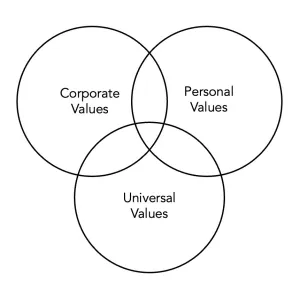
Here is another way to look at the three types of values (personal, corporate, and universal) intersect. This time we have three overlapping circles.

Where values overlap can give us insight to our purpose

Each of us has a unique expression of how and where these circles meet. When you have explored and understood each different sphere you should have a better idea of where and how the values overlap.

Why is that important? Well, this intersection can give us a great insight into the specific role we can play, and the special impact that we can bring to the world. We may not feel we can change the whole world, but we can certainly change our world; the environment and the community we live in. This opportunity, where our values align and can bring the greatest impact, can reveal our personal or life purpose.

So, what is that place for you?

If you want the right answers you have to start with the right questions

About The Right Questions

The Right Questions is for people who want to lead better, whether you are taking your first step or stepping up in leadership. We are all leaders (whether we know it or not) as we all have influence. So the question is, what are you doing with your influence?

Wherever you are on your leadership journey, I hope that you find resources on this site to help you on the next leg of your quest. Even if that is just the inspiration to take one small step in the right direction, then that is a success. If you can take pleasure in learning and travelling as you go, then so much the better.

Need help navigating your journey to success?

I love to serve people, helping them unlock their values, develop their leadership, and achieve their goals, through coaching, facilitation and courses. Please get in touch and let me know how I can support you.

The Value of a Retreat and Why You Should Do One

I have just been away on what I would call a retreat in the Dolomites, the beautiful Italian mountains. There I was surrounded by the glory of nature and removed from the constant demands of work. Sounds a bit like a vacation, doesn’t it?

What is a retreat?

What does it mean to go on a retreat? It is not quite like a holiday, but it is a break from usual work. The difference is in the purpose. The idea of going on a retreat has spiritual origins. It is the physical removal of self from normal life to allow time for contemplation. The idea might be to reflect on character, purpose, values, motivation, or a combination of similar things. A lot of people go on organised retreats at special centres and with groups but it can also be done individually, as I have done.

A retreat is not fleeing in the face of adversity or running away from trouble. The military concept of a retreat (not a rout and fleeing in the face of the enemy) is a good analogy. A retreat, or withdrawal, is a considered action. It is a purposeful stepping back from the front line to allow time to regroup, recuperate and reconsider plans.

So, what is the purpose of my retreat? I was away to recharge my batteries, find space to think creatively and to reflect. I find that when I get some distance I can examine my plans and decisions from a different perspective.

Free Personal Leadership Action Plan

Just sign up here to receive your free copy

Re-energising

Rest is important. It is critical to performance and yet we often neglect our own rest, particularly our sleep. If you are not convinced that you need at least seven hours of sleep per night to be at your best then you need to read Why We Sleep by Dr Matthew Walker.

Therefore, it is important to protect our downtime if we want to maintain our ability to perform well. I have learned that I need to put breaks into my diary – be that daily, weekly, monthly, or yearly – so that they become protected space and don’t get forced out by other needs. For example, this week of retreat has been blocked out in my calendar for months. If it hadn’t been then it would have been swallowed up in work.

Taking time out can feel like a dip in productivity, but actually, the re-energising and other benefits of resting increase our output in the long run. It also helps us avoid burnout.

For me an important part of the re-energising process is exercise. I have never been one for just lying on the beach, even when on vacation, and so on retreat I also like to keep active. This is not just a preference though. As scientists, such as Professor Jeff Edwards have shown, that physical exercise not only increases our energy levels, and improves our stamina, it also invigorates the brain, improves memory and reduces stress. And the exercise does not need to be overly strenuous (not all the time at least); walking is a prime example of an easy exercise that has a host of benefits.

I find it very hard to exercise in the gym for more than an hour. Generally, my workouts average 30-40 minutes. But in the mountains, the hours can slip by. Just walking up a hill can keep me in a constant aerobic state, pushing the body, but at a sustainable pace. It’s a great way to keep in shape. If you want to shed some pounds, then go and pound the trails in the hills!

Creative space

A retreat also gives time to think. The busyness and stresses of everyday life can stifle thought, particularly creativity and effective decision-making. Therefore, we need to make space to think, even to allow our minds to wander. When we give ourselves occasion for our thoughts to drift it allows the subconscious to work and new ideas will surface.

To help this creative process I love to be out in the natural world. And I am not alone here. From Hippocrates to Wordsworth, Newton to Steve Jobs, great thinkers, poets, and leaders down through the years have used the power of walking and the inspiration of nature for this purpose.

I find being out in creation feeds the senses as well as being a balm for the soul. When I walk and I let my thoughts drift my senses then become alive to the external world. The smell of wet grass or meadow flowers. The sound of wind through the trees, of rain drumming on the tent. Feeling the crunch of leaves underfoot or the rock beneath the fingers when climbing. And taste? No food tastes better or a drink sweeter than after an adventure!

So, if you want to think more creatively then take a walk on the wild side; get out of the home or the office and lose yourself for a bit in the great outdoors.

Leadership Development: Master the Top Leadership and Life Skills

Better lead in life and work to maximise your success. Sign up and access materials for free!

Reflecting

With the right environment and activity, that creative thought can be coupled with purposeful reflection. Creativity is not just about artistic endeavour, it is about finding new way ways of thinking about and doing things. We may even find new purpose and direction when we reflect in this way. And here lies some of the deeper power of going on a retreat.

Self-improvement starts with self-awareness, and time away to reflect allows us to consider where we are, what we are doing and why. These wherewhat, and why questions relate to the concepts of vision, mission, and values.

When I am away on a retreat, I think about my personal values and how they align with my decisions. I recall my dreams and reflect on my progress towards that vision. Also, I consider my life’s mission and then reflect upon how I am doing in the pursuit of that purpose. I then think about my goals and assess whether those goals are supporting my vision, values, and mission.

Having gone through this process of reflection you can then be confident that any new goals that you set, or existing goals that you refine, will be in-line with your greater direction.

If you have never considered what your values, vision or mission might be then going on a retreat is the perfect time to do just that. If you are feeling angry, unhappy, or frustrated, there is a good chance that you are out of alignment with one or all of these things. It can be very hard to create the space to even grapple with these ideas, but unless you do you run the risk of remaining trapped in a negative situation. It is very easy to do; I know this as I have personal experience with this sort of challenge or mid-life crisis.

Why not go on a retreat yourself?

So why should you go on a retreat? Going on a retreat will help to re-energise you, and give you space to think creatively, and time to reflect. If you truly want to be productive and effective in what you do (and enjoy doing it) then setting aside time to consider your life’s purpose and your personal values, vision and mission is vital. It might be you want to go on an organised retreat or, like me, to head to the mountains for a while, but have a think about what might work for you.

Worried about getting the time to go on retreat? In time gone by people have gone on retreats for long periods but even a week might seem like a lot. If that is the case, then how about a long weekend or just a weekend? If you are really struggling, then even a day can be helpful. And I can guarantee, if you take that space – however long you can manage – and use the time well, then you will feel the benefit and want to do it again. Chances are that then, the next time, you will find some more time.

If you want help in organising a specialist leadership retreat for you or your team, then please do drop me a line via that Contact Page. I am presently planning some structured walking retreats (using trails such as the Camino de Santiago) if that piques your interest!

If you want the right answers you have to start with the right questions

About The Right Questions

The Right Questions is for people who want to lead better, whether you are taking your first step or stepping up in leadership. We are all leaders (whether we know it or not) as we all have influence. So the question is, what are you doing with your influence?

Wherever you are on your leadership journey, I hope that you find resources on this site to help you on the next leg of your quest. Even if that is just the inspiration to take one small step in the right direction, then that is a success. If you can take pleasure in learning and travelling as you go, then so much the better.

Need help navigating your journey to success?

I love to serve people, helping them unlock their values, develop their leadership, and achieve their goals, through coaching, facilitation and courses. Please get in touch and let me know how I can support you.