A Personal Example of Using the GROW Framework to Achieve a Life Goal
GROWing Up: How the GROW Framework Helped Me Summit Mont Blanc
A Personal Example of Using the GROW Model to Achieve a Life Goal
A lofty goal versus the bitter reality
I was exhausted. I sat in the snow, waiting to ascend the rope up the ice wall just a few metres away. The cold was seeping up from where I was sitting, but I was too tired to care.
I glanced at my watch. It was mid-afternoon. We were supposed to have summited the mountain in the early morning, but conditions had been against us. The snow was deeper than expected and hadn’t frozen, so we had to slog on, sinking with each step, knee- to waist-deep at times.
That annoyance now turned to danger as we were on an exposed slope in the relative warmth of the afternoon. The risk of an avalanche was increasing with every minute we spent in that spot. And now we were slowed by an ice wall that we could only climb, one by wearied one, using a rope the lead climber had fixed in place.
I shut my eyes for a second, then heard someone shouting my name. Looking up, I saw a frustrated face beckoning me to the rope. I wondered why they were annoyed, and was also surprised to see the other climbers had disappeared. I looked at my watch again; I thought I had just blinked, but fifteen minutes had passed.
Obstacles and finding the will to go on
This scared me a bit and helped to wake me up. We were all equally tired, which meant the risk of a miscalculation was also rising. And relatively to some, I was doing ok. Several others in the party were starting to suffer from the altitude and the fact that we were running out of water. We planned to have completed the whole route by now.
I started up the rope, keen to get beyond the obstacle as soon as I could. As I reached the top, I heard some shouts just off to the side of us and looked up to see another group coming down the mountain. They were a local group, and my French wasn’t that good, but it was obvious from the tone and hand gestures that they were unhappy about the fact that we were on the mountain in these conditions.
Our expedition leader had a brief conversation with them and then started up the slope once more. The French party started to ski down. One fact registered with my fatigued brain. They were on skis. In fact, the only other people we saw that whole time were on skis. We were walking, and our crampons were fine for ice, but little help in the deep snow. In actuality, they made things harder at times, as the snow stuck underneath them.
I couldn’t believe it. Could you do this on skis? Even the walk up?
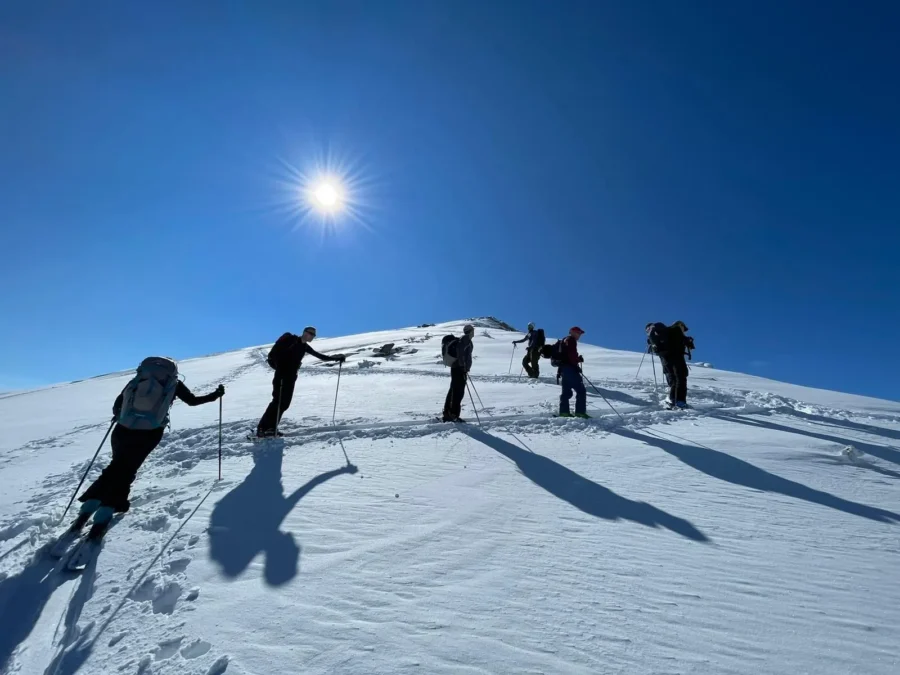
This was my first experience of alpine mountaineering, and I had never even heard of ski-touring before. Seeing people walk up hills on skis was a revelation. I would have traded everything I owned for a pair of skis right then, and I couldn’t even ski!
So, in that moment, I vowed to myself that I would come back to this mountain, but on skis. Unfortunately, I still had to safely get up and back down the mountain before I could give further thought to these dreams.
Fortunately, we did make it, but only just. It took us more than sixteen hours to summit Mont Blanc on a route that should have taken more like six. We then had to overnight in a cramped high-level bivouac (this was not one of the nice alpine refuges; it was just a wooden hut), before wading down the mountain again when it became light.
I was in my late teens and relatively inexperienced, but even I had some inkling of how lucky we had been to come back down the mountain unscathed. Suffice to say, I did not do any further climbs with that particular expedition leader. But the experience did not put me off the mountains. I was keen for more, but now I had a new goal: coming back to conquer the mountain on skis.
Setting and achieving goals with the GROW framework
I did not realise it at the time, but during that first trip to the Alps, I had achieved my aim by following the GROW model.
The GROW framework is a coaching tool, used by coaches, leaders and individuals to help people define a goal and create a simple plan.
GROW is an acronym that stands for four steps:
Goal – The goal is the clearly defined endpoint and definition of success.
Reality – The reality is the present situation, where you are at right now, with its challenges and opportunities.
Options (or Obstacles) – Having identified challenges and opportunities, various options can be explored to help achieve the goal and overcome any obstacles you might foresee.
Will (or Way Forward/Wrap Up) – The Will is the motivation to proceed, and the Way Forward is breaking down the goal into achievable steps.
The simplicity of the process means that it is probably the best-known and most used coaching approach. If you want further details on the history and practical use of the tool, you can read more about the framework in How to Use the GROW Model.
Example of using the four steps of the GROW model
As I mentioned, I had followed the four steps of the GROW framework when I undertook my expedition to the Alps. I have always loved adventure and was always looking for new challenges. When the opportunity came up to go alpine mountaineering for the first time, the steps looked like this:
Goal
The goal was clearly defined. In this case, it was to successfully summit Mont Blanc, the highest peak in Western Europe (4808 metres).
Reality
The reality was that even though I had done plenty of hill-walking and rock climbing, I did not have any alpine experience. Therefore, there were skills I needed to learn before I went. Even then, I could not lead such a climb, and thus I was reliant upon the expedition leaders.
Options and Obstacles
The only realistic option for me to climb Mont Blanc was in summer conditions, but, as I was still in full-time education, the time windows for going to the Alps were limited. So, the expedition target was set for late May, during a holiday period.
We knew the mountain would present plenty of obstacles, both seen and unseen. Many of these could be mitigated with the right training, equipment and acclimatisation. The weather, an ever-changing challenge in mountain environments, was an issue we knew we would have to respond to when we got there.
Will and Way Forward
The expedition leader conducted a selection process to make sure that everyone on the trip had the right motivation (or will) and base-level skills. We all then had to commit time and money to the venture, both for the time in the Alps and the training we needed to complete before getting there.
Transport was booked, equipment was procured, and training began. The way forward was set.
Using the GROW model as a plan evolves
As you will have gathered from the initial story, achieving the goal was not as simple as just the steps outlined with the GROW framework. When we got to the Alps, we had to continually reassess the plan according to the circumstances. Even having identified what we thought was a good weather window, we found ourselves on the mountain in less than favourable conditions.
Here we can see that the GROW model is useful as a problem-solving and situational analysis tool, as well as a planning framework. In this case, as we set out on the route, the four steps informed our decision-making in this way:
Goal
The goal was still to summit Mont Blanc, if possible.
Reality
The reality was that the snow had not frozen over as we had hoped.
Obstacles and Options
The snow was now a much bigger obstacle than expected. The options were then to give up our attempt or to push on, knowing it would take longer to climb the mountain.
Will and Way Forward
Everyone knew that we would not have time to re-attempt the climb if we stopped then. If we went back down, that would be the end of the expedition and any hopes of summitting Mont Blanc.
Therefore, people had the will to push on, but this balance of will versus the reality of the conditions, and the associated obstacles and risks, became a continual tension as we sought a way forward.
Having successfully navigated our way back down the mountain, we went to celebrate in a local bar. I was so thirsty, but I held off picking up the glass just long enough to savour the sight of Mont Blanc in the background as a drop of condensation slipped down the outside of the cool glass. Then I took a sip. Never had a cold beer tasted so good!
We toasted the completion of our successful goal; we had climbed Mont Blanc. We also sent up a prayer of thanks for making it back down.
Then, as often is the way, the completion of one goal led to the creation of a new one. I wanted to come back to the Alps, but with skis, and that was going to need a whole new plan, so I mentally started going through the GROW steps again.
And yes, I did also complete that goal. It took some years to learn to ski and gain the necessary experience, but I did lead a ski-touring expedition back to the Alps and had the satisfaction of skiing over the same terrain that I had struggled with on that first fateful trip.
No, it didn’t end there either! That success led to further dreams, including making some first ski ascents and descents of mountains in Greenland, which you can read about in: How to Create a Personal Success or Mission Statement.
Applying the GROW framework to your goals
But how about you? What is it that you want to achieve?
If you want to use the GROW model to explore your goals (no matter how big or small), you can use these self-coaching questions to lead you through the steps:
Research has shown that the effectiveness of such models is greatly increased when used in conjunction with a coach or mentor, which you can read about in:
If you want the right answers you have to start with the right questions
About The Right Questions
The Right Questions is for people who want to lead better and make better decisions. We are all leaders as we all have influence, no matter how much or how little. So, how are you maximising your influence?
If you are unsure, just drop me a line. I would love to help!
Do you want to lead better? Would you like to make better decisions? Want support in achieving your goals? Get in touch and let me know how I can help!