Are You Like Captain Kirk or Mr Spock (And What Does That Mean?)
Do you relate more to Capt Kirk or Mr Spock from Star Trek? What does that say about your leadership and decision-making?
With the latest runner from the Star Trek stable dashing onto the screens (Star Trek Into Darkness) we are once again exposed to a famous universe and a much-loved movie relationship; that of Captain Kirk and Mr Spock. As well as providing a lot of fun, Star Trek ventures provide an opportunity to reflect upon current affairs from a different angle. They also make us think about what makes us human as well as how we make choices.
Science fiction frees us to think differently
The great thing about good science fiction is that it encourages divergent thinking. By creating alternative realities, that do not conform to the rules we live by, we are able to think differently. We can also address sensitive subjects by removing them from our present reality. When done well, science fiction brings a philosophical distance where we can look at modern-day issues through a different lens. In that way, we can challenge our assumptions. We can visit the future and think about the advantages and disadvantages of scientific advances. Whether that is technological development, for example in ‘I, Robot’, or mind-altering drugs such as in ‘A Scanner Darkly’. We can consider what life might be like if history had turned out differently and explore parallel universes as done in ‘Watchman’.
The original Star Trek series was always very much about social commentary. It looked at the big questions such as imperialism, globalisation, and racism and addressed them while trying to give a glimpse of a better future. The films took up this mantle and the latest outing explores issues such as terrorism. Although, this conversation takes place on a rollercoaster ride of action and can be lost amid the explosions!
But as well as these political and social issues there is an interesting psychological study at the heart of the Star Trek universe. This is reflected in the characters of Captain James T. Kirk and Mr Spock. Captain Kirk is a hotheaded passionate leader who follows his heart and his gut. His approach to diplomatic liaisons or tricky tactical situations is to make quick decisions and if in doubt, to punch his way out of a situation. Mr Spock is the cold face of reason and logic; the counterpoint to Kirk in almost every way. The tension of the relationship poses questions such as who is right? Who makes the best decisions? Who is the best leader?
In some ways, the assumption or conclusion (whichever way you look at it) in the Star Trek universe is that to be truly logical is somewhat alien. In comedy terms, Spock is the ultimate straight man. The humour in Star Trek is frequently displayed in Spock’s inability to think something is funny or to be engaged emotionally. Kirk on the other hand shows us that to be human is to be passionate. He can be somewhat irrational but that this human trait can be a strength as much as a weakness. If leaders have no passion – and therefore no sense of conviction behind their actions – then do we value their decisions? After all, the choices we tend to respect (if we are affected by the decision) are ones that elevate people. And we have to be emotional, we have to care, to make those sorts of choices.
So the Star Trek example of Kirk and Spock is something we should all remember. Logic is very important but it is our emotions that differentiate us as human. Our motivation, values and intuition are critical parts of our decision-making; ones that can be an advantage if they are understood and held in balance. This is true even if we are applying a logical decision-making process; we can never separate ourselves from our passions.
If you want the right answers you have to start with the right questions
About The Right Questions
The Right Questions is for people who want to lead better and make better decisions. We are all leaders as we all have influence, no matter how much or how little. So, how are you maximising your influence?
If you are unsure, just drop me a line. I would love to help!
Do you want to lead better? Would you like to make better decisions? Want support in achieving your goals? Get in touch and let me know how I can help!
Once people understand their roles they next need to know how they interact with other people. Everyone needs to be clear about the lines of communication and decision-making authority. Authority, accountability, reporting and other leadership and management functions all need to be reflected in the organisational structure.
The structure of a team, organisation or company can take many forms. For example, ‘flat’, ‘hierarchical’, or ‘matrix’ are all descriptions of structures. But, there is no single correct structure for every team or circumstance. The type of structure that a team should employ depends on the nature of the task and the nature of the people within the team.
Take a fresh look at what organisational structure you need
You may need to start with a blank piece of paper. Ask some questions related to your task, team and the individuals in that team. For example:
Who needs to communicate with whom to make effective decisions?
Which people have to work closely together to fulfil their responsibilities?
How are individuals kept accountable for what they are doing?
Who needs to be empowered to make decisions?
Who is responsible for their management and supporting their personal development?
What things need to happen for your team to be able to achieve its goal?
Does your present structure support that aim?
The larger the organisation the harder it is to answer all these questions in one go. So, you can start by looking at the individual team level first. Work out how they need to function, and then look at how each team needs to operate and interact.
It might be helpful to do this graphically. One method I find helpful is using names on post-it notes, arranged on a whiteboard so that I can experiment. In this way, you can see how people are best grouped. You can add the different decision and communication lines that are needed in coloured pens and see what works. Get the team involved in the process too. They are likely to have the most detail about how they need to work effectively. It can be a lively team-building exercise in itself!
A structure should support communication and decision-making in the most effective way possible. You need to be organised so that you can achieve the specific goal your team is pursuing. This means that the structure is likely to need to change over time. Organisational growth, replacement staff, new goals or different stages within a project can all spell a need for a change in structure. Don’t shy away from moving things around. But there is a delicate balance to achieve. Too much change can cause instability and will make team members anxious. Too little change, on the other hand, will hamper your progress. In my experience, small businesses and start-ups have to watch out more for the former, while large institutions have to be aware of the latter.
On some tasks, it may be that the roles within a team need to change within the course of a day. That is particularly true within smaller organisations where people have to share more responsibilities. If people are comfortable with their roles, and the responsibilities of others, then they can deal with this change. Very strict, traditional, hierarchical structures can make this sort of fluidity a lot harder.
Most teams won’t have to deal with this speed of change all the time. But the lesson is – as with every other tool in planning – to remain flexible. And remember, the structure is not the end in itself: it is just a tool to achieve our end. Achieving our dream or mission is the most important thing. So, if our structure is hindering us then we need to adapt it and improve it.
If you want the right answers you have to start with the right questions
About The Right Questions
The Right Questions is for people who want to lead better and make better decisions. We are all leaders as we all have influence, no matter how much or how little. So, how are you maximising your influence?
If you are unsure, just drop me a line. I would love to help!
Do you want to lead better? Would you like to make better decisions? Want support in achieving your goals? Get in touch and let me know how I can help!
We do not always think in terms of risk but there is risk in every decision we make. The risk is always balanced against the opportunity to some degree or another. Risk assessment, risk management and risk strategies are processes we can add to our decision-making process. We need some way to consider and manage risk. This is because our decisions and planning are continually influenced by our attitude to risk.
“Great deeds are usually wrought at great risks.” Herodotus
High anxiety
One summer I was mountaineering in the French Alps with a group of friends. We had just spent a few days bagging some routes when someone had the idea of tackling a nearby climb. It was not one we originally planned to do as it was a higher grade than we were generally comfortable with.
That season there had been very little snow and the ridges were more exposed and icy than usual. So, as this route was following a ridge, I argued that it would be in bad condition. It was likely to be even harder than the guidebook suggested. The weather was also set to change for the worse, so as far as I could see, the risks outweighed the opportunity.
I thought my logic was sound but the person who had proposed the climb was very persuasive. He managed to get the other two members of the group to agree with him. They wanted to give the climb a go. It was three against one, and I knew they needed four people to attempt the route. Therefore the pressure was on for me to accept the majority decision. But I genuinely believed it was not a safe option. It was a tough conversation. I then made myself very unpopular when I refused to do the climb. It was a stand-off. They needed a fourth climber and therefore all we could do as a group was head back down the valley.
A good call
Fortunately for them, the other three found another willing climber. I meanwhile, by now feeling somewhat sheepish, decided to go trekking for a couple of days. As I was on my own I decided to stay below the snow line and try and avoid the bad weather.
I spent most of the next few days feeling guilty about being stubborn but when I returned I found that my decision had been justified. The weather had deteriorated and the route proved to be in poor condition, as I had predicted. After a few hours of struggling in dangerous conditions, my old climbing partners were forced to make an emergency descent. The deteriorating weather meant they also had to make a hasty retreat back down the valley.
It turned out that they were the lucky ones; that weekend ten people lost their lives in the Mont Blanc area as high winds whipped people off icy ridges.
Life is full of decisions and intuitively we are assessing risks all the time, even if they are not as obvious as the ones in the previous example. As we pursue our dreams we will be frequently faced with various options of ways to achieve our aims. In order to navigate our course, we have to assess the factors, consider the risks, and make decisions as to the best way to go. Sometimes to help answer the question ‘which way should I go?’ it is prudent to consider ‘which way shouldn’t I go?’ and this particular question is all about risk.
If a venture is suddenly deemed too risky, it is the surest thing that will stop us from acting; no matter how attractive the option first seemed. Therefore, risks need to be identified, assessed, mitigated and managed, so that we are in the best possible place to make our decisions.
Capacity for risk varies between people and situations so it is important to remember that this is an ongoing process of identification and management. At the same time, we don’t want to become defensive, timid or risk-averse. Achieving bold visions means taking risks; we just need to make sure we have counted the cost before we commit ourselves.
You don’t want to start a venture by looking at risk. If you do, the problems could easily become paralysed before you even start. But, if you plan without considering the risk, you could quickly become disillusioned or make a serious mistake that could be hard to recover from. Therefore it is at the point when one has a clear idea of what we need to achieve, and are considering different options to achieve that goal, that we look at risks.
“Take calculated risks. That is quite different from being rash.” General George S Patton
How to manage risk
Unnecessary risks can be avoided by careful planning and this process is part of your risk management process. Your approach to risk – which risks you tolerate and those you treat – becomes your risk management strategy.
This exercise is a helpful aid to decision-making, but remember, that one should never make a decision out of fear. Some risks will be big – you just need to know whether that danger is acceptable to achieve your aim. Effective risk management helps us to achieve our mission, but with the risks considered and reduced as much as possible, not at the exclusion of risk entirely. Remember, it is more important to do the right thing than the safe thing.
As you go into the process of identifying and evaluating the risks I recommend, that if you are part of a larger team, that you go through the following exercise first as an individual and then as a collective. This avoids group-think and other related biases.
Once you all have some ideas you are likely to find that as a team you will have a healthy (frequently robust) discussion about how to categorise risks. This is due to people’s different viewpoints; do not worry, this is a productive process. Diversity of thought will help you all evaluate risks more effectively and help you learn more about how the team thinks and operates. This inclusive process will also allow people to express any fears, find solutions and commit to the final plan.
Video of How to Simply Identify, Assess and Mitigate Risks Using an Easy Risk Management Process
Risk Management Process
Here is a simple risk process. If you follow this exercise you will be able to identify the key risks you face and create a basic risk management strategy:
Play devil’s advocate for a moment: give yourself 5 minutes to try and think of as many things as you can that could put a stop to your venture and list all these threats.
On a scale of 1 to 5 give each risk a score of how probable it is to occur (5 being the most likely).
Now do something similar, scoring 1 to 5 for the severity of the impact of each of the risks. In this case, a ‘1’ might be a minor inconvenience whereas a ‘5’ would be a show-stopper.
For each risk multiply the probability score and the impact score so you get a score of 1-25 for each risk. You can now rank all the risks in a table.
Start at the top with the biggest risks and think about how you can avoid, prevent, limit the damage or otherwise manage the risk. This is called mitigation. Write down the plan for each risk and after the mitigation measures have been applied score the risk again for likelihood and impact to see how it has improved and whether it is acceptable to you (and/or your team).
Now consider whether the opportunities outweigh the risks for the course of action you have chosen. If you are unsure, you can go back and look at the risks in more detail for another course of action that you generated previously.
Once you have identified the most important risks make someone responsible for the management of each risk. They do not carry all the risk (or blame if it goes wrong) but they do have responsibility for tracking the risk on behalf of the team.
Record and review your risks
There are lots of ways you can record the information you get from this process. Most businesses have spreadsheets to capture the key operational or project risks. Find what works for you but my advice is to keep it simple. If the document is too big and complicated people won’t read it.
The other thing is to keep it up to date. Make sure you review the risks on a regular basis. The situation changes; new risks emerge, other risks fade. Make sure you are tracking them.
But don’t get obsessed or paralysed by risk. After all, who dares wins!
If you want the right answers you have to start with the right questions
About The Right Questions
The Right Questions is for people who want to lead better and make better decisions. We are all leaders as we all have influence, no matter how much or how little. So, how are you maximising your influence?
If you are unsure, just drop me a line. I would love to help!
Do you want to lead better? Would you like to make better decisions? Want support in achieving your goals? Get in touch and let me know how I can help!
Why You Should Know The OODA Loop Decision-Making Cycle
Colonel John Boyd, a strategist with the USAF was a fighter pilot who studied decision-making in dogfights. He actually worked at the ‘Top Gun’ school of Tom Cruise fame. He proposed that as a situation evolves we have to observe the changes and orient ourselves to new information. We can then decide on the best course and take action. In other words, decisions are made in a recurring loop of:
Observe,
Orient,
Decide and
Act.
This is the OODA loop.
Sometimes this process is relatively slow and objective and we can pause to consider what we do. At other times the information and situation may be changing so fast that things become subjective. Then we have to work on instinct. This relates to the System 1 (fast) and System 2 (slow) thinking popularised by Daniel Kahneman.
Because the cycle takes place, no matter how fast the situation is unfolding, the specifics of how we orientate ourselves is of key importance. As Boyd notes:
“The second O, orientation – as the repository of our genetic heritage, cultural tradition, and previous experiences – is the most important part of the O-O-D-A loop since it shapes the way we observe, the way we decide, the way we act.”
It stands to reason that as we try and orientate ourselves it is useful to have others providing input. This is because external insight broadens the scope of the ‘repository’ of genetics, culture and experience. So, if time allows, get more quality data from others. When there is no time it is the depth of experience of the person making the decision that really counts. This allows for good intuitive decision-making (see Blink by Malcolm Gladwell).
How to apply the OODA loop
Boyd developed his ideas in a military context. His aim was to help speed up the decision cycle of USAF pilots so that they could get inside the enemy’s decision cycle. To win a dogfight a pilot needs to make better and faster decisions than the adversary. Also, maintaining the initiative creates opportunities that can be further exploited. The same thinking is applied to business and outsmarting the competition in the marketplace.
At first, this may not seem to have a direct application to our situation. But, in our case, the enemy is often ourselves. Equally, it could be our situation or any other challenge we face. We often do not make time to assess a situation and therefore we can fail to orientate ourselves properly. It follows that we then become reactive rather than proactive in response to our circumstances.
A foundation for decision-making
The great thing about this model is how simple it is. Boyd identified the bare essential elements of decision-making. Therefore, the OODA loop is really useful in helping us understand other decision-making tools and frameworks.
‘The Right Questions’ framework is designed in the same way. It follows the same simple cycle but expands the process so that it can be easily used for strategic planning as well as quick decision making.
If you want the right answers you have to start with the right questions
About The Right Questions
The Right Questions is for people who want to lead better and make better decisions. We are all leaders as we all have influence, no matter how much or how little. So, how are you maximising your influence?
If you are unsure, just drop me a line. I would love to help!
Do you want to lead better? Would you like to make better decisions? Want support in achieving your goals? Get in touch and let me know how I can help!
I was just savouring a coffee from my newly purchased coffeemaker when a wide-eyed and out of breath soldier stumbled into my makeshift office. My cup was poised in my hand – the aroma was fantastic – and the thought of drinking it was more alluring than anything I could imagine that this solider might interrupt me with. This had better be good, I thought.
“Sir! The guards think there is a bomb at the gates to the camp!”
I put the cup down; coffee time was over.
How do you make important decisions?
Let’s pause the story for a moment so I can ask you a question:
What is the most important decision you have ever made?
The most important decisions are generally not the critical, life threatening type. More likely it was choosing your school, selecting your career, buying a house, or committing to your life partner. How did you make that decision? Was it the right decision? (If you are sitting next to your spouse don’t feel you need to answer that last one just now).
As well as those big life decisions, how about the myriad of smaller decisions we have to make every day. What about those? What process (if any) did you use to make your choice? Every day we are all expected to make hundreds, if not thousands, of decisions. Research has shown we probably make more than 200 decisions a day relating to food alone (Wansink, Sobal). Yet, weirdly, despite all these decisions, very few people ever receive formal training in decision making.
Crawl, walk, run
For me it’s a bit like running.
Everyone just expects people to know how to run. For those of us blessed with full health and mobility it is a natural progression. We crawl, we walk, we run. Simple right?
But if you really want to improve your running you need to train. It was not until I started running ultra-marathons that I really started taking my running training seriously. As I did, I become more aware of the technical aspects of running such as breathing, foot fall, cadence and pace. It was only then, when I broke down my technique, I realized that I had been doing so many things wrong for so many years.
Such is the way with decision making. If you want to get better at making decisions you need to practice, but you must also understand some of the fundamentals of how choices are made.
The science and art of decision making
I started out my career as a Bomb Disposal Officer in the Army. From there I have gone on to lead in various contexts, often in some of the most challenging and hostile environments on the planet. This knowledge and experience, coupled with my love of learning, has led me to develop decision making tools that I teach, particularly to the leaders that I coach.
This is because a large part of being a leader is about making decisions. Effective leadership is dependent upon making good decisions.
The foundation of all my work is asking questions. Questions unlock understanding and understanding is a foundation of good decision making. One of my favourite quotes by Francis Bacon illustrates this:
“A prudent question is one half of wisdom.”
Francis Bacon
So, what are the right questions? This is a question I have been exploring for my whole career. I want to share with you some of the insights I have discovered on this journey over the past 20 years. My hope is that after reading this I can impart a small gift, a simple tool, to help you. Something that you need never forget and can assist you in your future choices and plans. My promise to you is a guarantee that you will be able to remember the framework. And that is because you already know it. All I am going to do is help you apply that framework.
Sound good?
Why do we need to ask the right questions?
Good questions are essential if we want to get the right information.
If we don’t ask the right questions, we won’t get the answers we need. Without the necessary information, we won’t be able to make good decisions. If we don’t make good decisions, we can lose our direction, fail in our leadership, and can end up ineffective, unhappy or worse.
As I mentioned previously, I found out how important questions are early on in my career as a Bomb Disposal Officer.
Nasty surprises
As I put my coffee down and walked out of the office, I asked my first question:
“What do you mean by a bomb?”
“There is a suspicious package, the guards think it could be a bomb.” was the reply.
It was Bosnia in 2001, and I was a young Lieutenant in the Royal Engineers leading the Explosive Ordnance Disposal (bomb disposal) team in the local region. The conflict in Bosnia had ended some time ago and we were there primarily to clear up the mess that a war leaves behind, namely the mines, mortar bombs and other explosives that littered the countryside. But in the post 9/11 world, the threat of terrorist attack was at the forefront of people’s minds. In this context, an unexplained bag, right up against the front gates of a military camp, was screaming out ‘IED!’ (Improvised Explosive Device) and required immediate and serious attention.
Red wire or blue wire?
Therefore, I went to take control of the scene and do an initial threat assessment. I met the guard commander and asked him some questions such as:
Where exactly was the package?
What did it look like?
Who had seen it first?
When had it been found?
Why was it suspicious?
How had it got there?
Very quickly a picture emerged that put my mind at ease. One of the guards had seen an old and infirm lady dropping off the parcel. Upon questioning the local interpreters, I found out that this lady was well known to them (as she was a little eccentric) and that she had made similar deliveries before. It was more than likely that this was just a gift for the soldiers. A short trip to visit the lady at her house confirmed that yes, she had just dropped off some biscuits for the troops. It just so happened that she thought that dropping off a ‘surprise’ in an unmarked bag, unannounced, at the front gate to a military base was a good thing to do!
After establishing all of this I was able to go back, safely deal with the package (no, I didn’t eat or blow up the biscuits), give the all-clear and return the security levels to normal. I thanked the lady for the kind thought and gift but asked her to refrain from such ‘surprise’ generosity in the future.
So, the right question was not ‘do we cut the red or the blue wire?’ In fact, the right questions were not technical ones at all.
The importance of questions
When you consider your life is under threat then it is very important to properly assess a situation. You have to overcome the ‘fight or flight’ response and use the decision space – the gap between stimulus and response – to work out what to do. In the time given you have to make an assessment. Asking the right questions and getting the right answers is essential before launching into action.
The military, the emergency services and medical services know this and train personnel in decision making. By employing decision making processes and then applying these first in exercises and in real-life situations, personnel can build up experience and become expert decision-makers. A good methodology coupled with experience and can help to make quick, effective decisions even in high-risk environments (Klein).
Outside of careers that deal with life-threatening situations very few people get training in asking questions and making decisions. This is despite the fact that numerous studies show that these competencies are essential to employers, particularly for leaders and managers (Harrell, Barbato). The need for decision making in leaders is often expressed in other terms such as:
The need for analysing and overcoming problems (Zenger, Folkman)
Taking the initiative (Maxwell)
Setting direction and goals (Giles)
Prioritisation (Tracy)
Or having a clear vision and strategy (Kotter)
But all these things are related to, or dependent upon, good decision making.
Do we need decision making tools?
We generally take decision making for granted. After all, we each make thousands of choices every day, some conscious, some unconscious, and rarely need to apply more than our intuition to a decision. But there is a problem. Research, particularly by influential figures such as Daniel Kahneman, has demonstrated that our intuition is amazing, but it has limits.
Therefore, understanding decision making and how to make good decisions is critical to all of us, and good decision making starts with good questions. After all, as John Dewey says:
“A problem well put is half solved.”
John Dewey
The problem with many processes and tools, including those used for decision making, is that they are often non-intuitive and hard to remember. That is why we should start with what we already know and structures that are already embedded.
Start with the questions you already know
When I was training as a Bomb Disposal Officer we were taught a question technique called the ‘Five Ws’ which we used when we approached an incident. The ‘Five Ws’ is an interrogative style employed primarily by journalists and police officers, but it is a framework that can be used by anyone to make an appreciation of a given situation.
The Five Ws are:
What?
Where?
When?
Who?
Why?
To this list ‘how?’ is also usually added. This ‘5Ws and an H’ provides an easy to remember checklist that is a useful starting point towards building a quick but rounded picture of a situation.
The idea is that by using the 5 Ws to construct open questions you are more likely to get factual answers and more information while avoiding presuppositions. This is in contrast to closed questions, that have just yes or no answers, or leading questions that push people down a certain line of thinking.
Using interrogatives
As I have done further research into question technique and applied the principles in my work, I have found that it is also useful to add another ‘W’ – that of ‘which?’ – to the list. The ‘which?’ question covers the concept of selection or choice and therefore helps to inspire options and to consider risk. This helps to complete the decision-making cycle, particularly when we are planning for the future, not just examining an event that has already happened.
This makes seven questions in a total and creates an easily remembered framework. It’s easy to recall as its based upon the most common interrogative words that we use in English. The methodology easily translates into other languages too. Seven is also a handy number as we find it harder to recall lists above seven or eight items (Buzan).
The application of the interrogatives provides a holistic approach to analysing a situation and making an informed decision. The use and application of these seven open questions is a technique I have dubbed ‘The Right Questions’, inspired by the question I had started with.
Applying The Right Questions
Simplicity is a large part of the system’s strength. But, as with any tool or model, the technique is only as good as its application and it is this application of the questions that we will start to look at here.
My experience of working as a coach and consultant has taught me that The Right Questions approach can be applied to everything from life direction and personal vision, to corporate strategy and organisational change.
The table below outlines the purpose and application of each interrogative word in sequence:
Interrogative
Use
Application
Why
Reason
Values, principles, priorities, passions
Where
Place
Situation (past and present), vision
What
Thing
Mission, end-state, success
Which
Selection
Options, courses of action, risks, reflection
How
Manner
Plan, route, tasks, resources
Who
Person
Self, team, network, relationships
When
Time
Timing, programming, prioritisation
Applying The Right Questions
When you learn how to apply the system it is very flexible. My starting point when faced with a challenge – whether it is developing a business case, starting a project, or writing an article – will be to write down the seven Right Questions (often as a mind-map) and start to brainstorm and explore my thoughts under each heading.
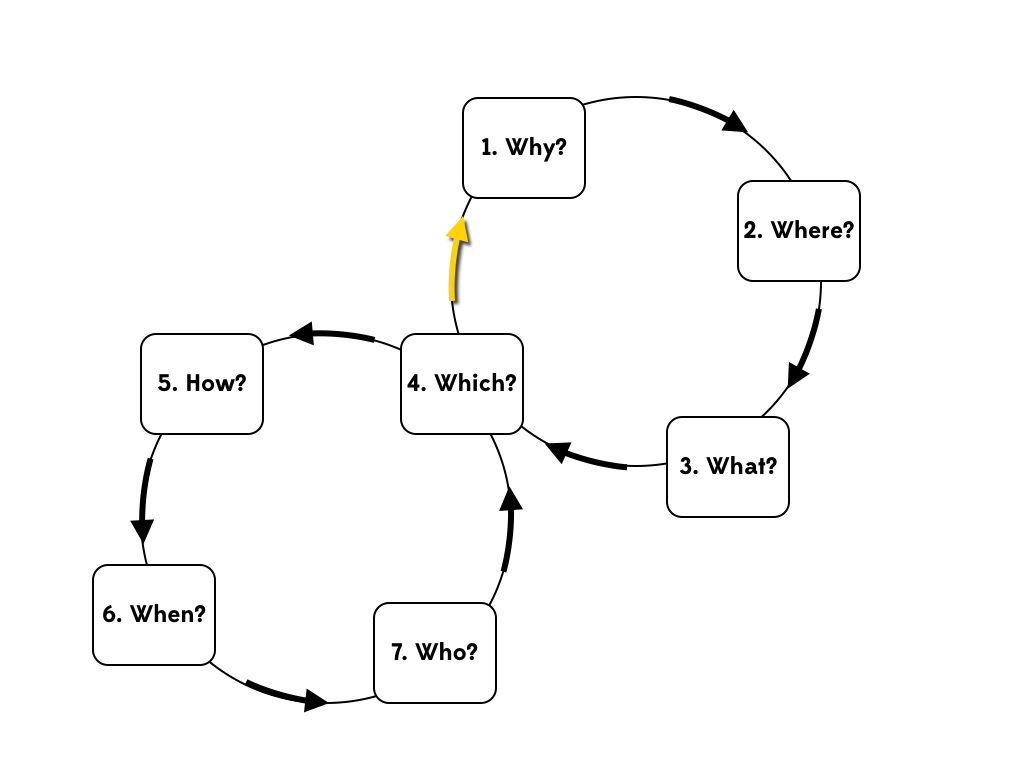
After trying this you can also experiment with using the system as a decision-making cycle. My experience over the years has shown that most effective order is as follows:
I agree with Simon Sinek that we should ‘Start with Why’ when approaching any problem. Asking the ‘where’ and ‘what’ questions then help to frame the problem before moving on to the ‘how’, ‘when’ and ‘who’ elements that are most helpful in developing a plan.
The ‘which’ question then serves as an inflection point between these two loops. Asking the which question helps to identify different courses of actions that can be considered in the planning loop. It may also highlight risks and assumptions that send us back to the framing questions once again.
Putting decision making theory into practice
“Everything should be made as simple as possible, but no simpler.”
Albert Einstein
Having just read this last section you may be thinking that the process no longer seems so simple. Don’t worry! The best thing to do now is immediately put the basics of the process into practice.
Start with something easy. What do you have to do today? Take any one task or decision – be that as simple as composing an email, planning a party or even just going to the shops – and start by writing down the seven interrogative questions. Use these to make sure you understand why you need to achieve the task and then how you are going to do it. I promise it will help!
Done? Congratulations! You have taken the first step to becoming better at making decisions.
Now, as with the running analogy, you need to train regularly. Commit to experimenting with method, perhaps for one task every day for the next week. Once you have used it a couple of times try and apply it to a more complicated issue or more important decision.
If you struggle don’t be disheartened. You don’t go from the couch to running marathons in one week. Instead, enjoy the learning journey. If this has piqued your interest and you want to find out more then, explore some of the links above, or references listed below, in order to delve into more detail.
Happy decision-making!
If you would like access to some bonus content and get updates then please do sign up to my email list.
If you want the right answers you have to start with the right questions
About The Right Questions
The Right Questions is for people who want to lead better and make better decisions. We are all leaders as we all have influence, no matter how much or how little. So, how are you maximising your influence?
If you are unsure, just drop me a line. I would love to help!
Do you want to lead better? Would you like to make better decisions? Want support in achieving your goals? Get in touch and let me know how I can help!
The Cynefin Framework: How to Solve The Four Main Types of Problem
Why do you need a problem typology model or framework such as Cynefin? Well, have you ever had a problem that, in trying to solve it, you have made it worse?
You thought you could fix that device, but it stayed broken. Or you stepped into an argument when the resolution seemed obvious, but your intervention just created further hostility. Or perhaps you were a bit lost, and you thought you had found a route out, but then things got worse. We have all been there, right?
When trying to solve problems we make things worse when we don’t properly understand the problem in the first place. Therefore, one critical step in decision-making is classifying the type of problem that you are trying to solve. This is important as – if you fail to categorise the nature of your challenge – you could end up applying the wrong solution or approach. This might not only fail to solve the issue, but it could also make it worse.
When things go wrong
“It’s the wrong trousers Gromit, and they’ve gone wrong!”
Wallace and Gromit
I got to see this happen on an organisational level when I was asked to help a large local government in the UK. The institution was falling into disorder but no one within the organisation could agree on why. The lower-level managers thought it was a simple problem. They knew how to deliver services; it was just that the demand had gone up and finances had gone down. All they thought they needed was more money. This mindset was pushing the institution further towards the brink of chaos and a crisis for the whole organisation.
The high-level management thought it was a complicated issue, hence bringing in consultant ‘experts’ such as me to analyse and resolve the problem. They assumed that efficiency was the biggest issue and, therefore, wanted to focus (almost exclusively) on finance. We, the outsiders, could see that it was a complex challenge. The situation was changing rapidly and was not going to reverse; the managers at all levels were looking at the problem in the wrong way. So, we introduced models to help change the way everyone – at all levels – viewed the issues and encouraged broad engagement to come up with creative solutions. It was not an easy process, but identifying the nature of the problem was the first step.
The process of identifying the problem typology is the sphere of complexity science. Understanding complexity is a growing academic field that has important implications for leadership and decision-making.
Complexity is, well, complex, but fortunately, some models and frameworks bring the concepts of complexity, leadership and choice together; to help us understand obstacles and assist in choices.
As a leader, I regularly use Keith Grint’s model that classifies problems as either tame, critical or wicked. Understanding the problem then informs the method of influence to use, be that managing tame problems, providing command for critical issues or leadership for wicked issues.
This idea of matching leadership approaches to types of problems is not confined to the Grint model. There is another model that I have also found very insightful, particularly for understanding complex challenges, which is the Cynefin framework.
“Circumstances change, however, and as they become more complex, the simplifications can fail. Good leadership is not a one-size-fits-all proposition.”
Snowden and Boone
The Cynefin framework
This other favoured model is the Cynefin framework. It was created by Dave Snowden and further developed in partnership with Mary E. Boone. The word Cynefin comes from the Welsh language and alludes to a sense of place. In other words, we need a sense of place to understand our challenges.
The framework gained acclaim and awards, particularly after the publication of A Leader’s Framework for Decision Making, in the Harvard Business Review. It has been adopted and used not only by corporations but by governments, for example by the US government in counterterrorism and the National Health Service in the UK.
This model is slightly more complex than Grint’s but the framework allows deep thought into both the classification of problems and how problems can evolve (or crash) from one domain into another, depending on how we address them.
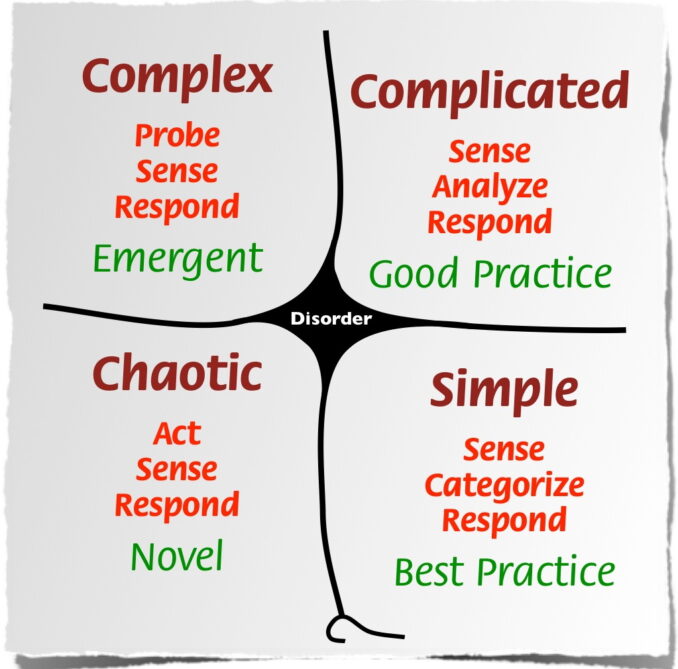
The framework is based upon classifying the complexity of issues into the following four types of problems and five domains:
Clear
Complicated
Complex
Chaotic
Disorder (uncategorised problems)
The Cynefin Framework – wikicommons
Clear problems
The clear domain (also known as either the simple or obvious domain) refers to problems that have known solutions. Here, when it comes to information and assumptions we are in the realm of “known knowns”. Therefore, we identify (sense), categorise, and then respond to these problems with known solutions. Use best practice when the cause-and-effect relationships are obvious.
Clear problems are generally heavily process-driven. The process is clear, measurable, and therefore relatively simple to manage. Examples of these clear problems could be applying for a personal loan or mortgage or manufacturing a common item on a production line. When I worked in the construction industry, most house-building fell into this category. It is easy to get pre-made plans for homes.
The danger with clear problems is complacency. When using a known solution, it is easy to fall into that habit and apply the same practice again and again, but then fail to notice how the situation is changing. If the situation changes too much, then applying the old solution could push the problem into disorder or the chaotic realm. This was what was happening with the local government I mentioned earlier.
This can also happen when people assume a problem has a clear solution, but the known knowns turn out to be wrong assumptions. This sort of mistake is covered in How to Identify and Disarm Wrong Assumptions.
Complicated problems
Complicated problems are the domain of experts. Here the “known unknowns” are sensed but then need to be analysed before any response, because there may be multiple solutions to the given challenge. These solutions, if successful, may then go on to become best practices, and the problem moves from the complicated realm to the clear.
“Complicated” is the realm where the professionals – such as lawyers, engineers, and doctors – earn their living. A deep knowledge of first principles, coupled with the proper experience, allows specialists to find options and solutions. Again, reflecting on my experience as an engineer, house-building per-se was a simple problem but developing new sustainable construction techniques – for example reducing the amount of concrete and steel we rely upon – is a complicated problem.
The danger in this realm is that experts can be blinkered, which can stifle novel approaches. For good solutions, there should be an environment that challenges existing thinking and encourages new ideas, through a diversity of people and inputs.
Complex problems exist in environments that are constantly changing, with multiple factors at play. Here we are in the realm of “unknown unknowns” as things are in flux and there are just too many things to identify or measure. These problems can also be of the “wicked” variety where problems may need least worst solutions as there are no “good” ones.
The complex realm is the land of emergent ideas. Problems in this space require true creativity. Many entrepreneurs and start-ups naturally fall into this sphere, but even large businesses and institutions find themselves in this space due to the increasingly congested, connected and fast-changing world we live in.
Traditional top-down, command and control, management styles fall short in complex situations. Complex problems require a more experimental approach. The problem needs to be probed, then sensed to develop a new response.
New management techniques have emerged to deal with these complex situations. Eric Ries (author of The Lean Start-up) popularised the idea of developing a minimum viable product as the basis for experimentation. Agile project management has also taken over from traditional project management to address fast-changing situations.
Chaotic problems
In chaotic situations, there is no order and therefore no obvious cause and effect relationships. Here a sense of order needs to be imposed and therefore a leader needs to act carefully but decisively. These situations are like the “critical” issues of the Grint model that require a more directive, command leadership approach.
Large crises fall into the chaotic realm, such as the events of September 11, 2001. On a smaller scale, I have experienced these sorts of emergencies while on operations or even when alpine climbing. Here the approach required is to act first, then sense how things change, and then respond with appropriate next steps to lead out of the crisis.
Disorder
The realm of disorder represents the space where it is unclear where a problem exists. If you feel completely lost, then you are likely to be in this realm! Here it is likely that the problem has not been properly understood or that the challenge has aspects that sit in multiple domains.
So, the best approach when facing disorder is to gather data to better understand the issue and then break down the problem into constituent parts so that each element can be dealt with in its relevant domain.
A summary of how to apply the Cynefin framework
The world is more irrational and unpredictable than we would like to admit. It is therefore vital that we properly identify the nature of the problems we face to take the right approach to solve them. This is particularly important for leaders who are responsible for spotting challenges and then flexing their decision-making approach and management style.
Models can help us do just that and the Cynefin framework shows us that:
When the problem is clear and the solution known, find and apply best practices
If the issue is complicated, then expertise can find solutions from first principles
When the environment is complex, emergent ideas can be found through experimentation
In chaotic situations, a rapid response is needed to establish some order
When there is disorder, break down the problem further to assign each part to the realms listed above.
And remember:
“Expect problems and eat them for breakfast.” – Alfred A. Montapert
If you want the right answers you have to start with the right questions
About The Right Questions
The Right Questions is for people who want to lead better and make better decisions. We are all leaders as we all have influence, no matter how much or how little. So, how are you maximising your influence?
If you are unsure, just drop me a line. I would love to help!
Do you want to lead better? Would you like to make better decisions? Want support in achieving your goals? Get in touch and let me know how I can help!
Why Top Gun Pilots and Successful Entrepreneurs Know the OODA Loop
When I grew up, I dreamed of being a fast-jet pilot. So, when I went to a career fair at high school, I went straight to the Royal Air Force to apply to join. Unfortunately for me, due to my age at that instance, they told me to come back in a couple of years. Slightly deflated, I wandered over to the Army stand. The enthusiastic Captain manning the stand bombarded me with leaflets and opportunities. Hence, in one of those small but life-changing quirks of fate (or providence), I ended up in the army, not the air force. However, I still ended up being taught some of the pilot’s decision-making processes; as we shall see shortly.
Since leaving full-time military service I have worked in, and with, start-ups as well as being a creative and entrepreneur in my own right. And what I see is that there are some surprising similarities between the decision-making of fast-jet pilots and savvy entrepreneurs. As well as being highly driven and comfortable with risk, both must make a string of rapid choices as they manoeuvre in rapidly changing circumstances.
So, you may be at the helm of a computer rather than at the controls of a fighter jet, but I will share some lessons that will help you get ahead of the competition and set you up for better, quicker, decisions.
Be a Maverick
My love of fast jets did not die with my change of career direction. It lived on in another passion: movies. I might not have become a pilot, but I still loved films about flying. And which movie comes to mind first when you hear the words “fast jet pilot?” Probably the original Top Gun movie with Tom Cruise.
So, while we wait for the endlessly delayed Top Gun sequel (Top Gun: Maverick) to be released, how about some lessons from the real Top Gun school. Yes, it really exists!
If you have seen the first Top Gun (1986), you will remember the crazy (and cool) manoeuvre that Maverick (Tom Cruise) pulls off. He is trying to shake an enemy MiG plane that is tailing him. Maverick can’t outrun it so he does the unexpected; he applies the air brakes (thereby rapidly slowing the jet) so that the other craft rushes past before the adversary can react. Maverick ends up behind the MiG and can now attack himself.
What did he do? In cognitive terms, he got within his opponent’s decision-making cycle and therefore outmanoeuvred them. This is something that pilots are trained to do, but it was not always the case.
The genesis of Top Gun and rapid decision-making
In 1968 the United States had a problem. They were losing. Putting aside the larger strategic problems of the Vietnam war, they were also losing at a tactical level in the skies over North Vietnam. The most powerful nation on the planet, with their cutting-edge F-4 Phantoms, was losing to MiG fighters. They tried upgrading the F-4, but that did not solve the issue.
They concluded there must also be something about the pilots as well as the hardware, and therefore, in 1969, a new school was established at Miramar to study and teach new tactics. The United States Navy Strike Fighter Tactics Instructor programme (the TOPGUN school) was born. It turned around the kill-to-loss ratio in the skies above Vietnam. The United States started to win there (if not everywhere).
Key to the success of the school was the work of Air Force Colonel John Boyd. He studied pilots in their dogfights, analysing their decision-making processes. The result of his study was something called the OODA loop.
The OODA loop decision-making process model
OODA loop is a decision-making process. It is a 4-step model with OODA standing for: observe, orientate, decide, act.
Remember back to Maverick in the dogfight. He observed the enemy craft on his tail, orientated himself to the options he had available, decided to slam on the brakes, acted quickly, then started over again; observing his new position, orientating himself and acting decisively to bring the other jet into his crosshairs.
But let’s look at each step in more detail:
Observe
Observing is about situational awareness. It is the ability to gather data but, most importantly, to spot important information. This is a challenge at any time but particularly in a fast-moving situation when there are a plethora of inputs clamouring for your attention.
For the entrepreneur, the situation may not evolve as fast as duelling aircraft, but the principles still apply. In the rapidly changing and congested information space of business, it is vital to observe the critical data. That still requires situational awareness and, as with the flying environment, this ability gets better with practice and experience.
Orientate
Once vital information has been observed the next step is to orientate yourself to the factors. In psychological terms, we engage our System 1 (intuitive and fast) and System 2 (rational and slower) cognitive processes.
Neurons flare to process the data and try to make sense of what was observed. The brain seeks to identify the factors that are important and what influence they might have on the situation. Some of this happens automatically and sometimes we need to actively engage our brains.
Our experience, heritage, biases, heuristics, values, and logic all impact the way we consider the information. Not only that, but experience, training and practice make synapses fire faster to provide more, and better, options.
Decide
Having orientated to the relevant factors the next step is to decide on the best course of action.
In contrast to a pilot, an entrepreneur might not have formal training or simulations to help improve their decision-making. Therefore, it is their experience that counts most. But not all experience is equal. To properly learn from our experiences – and to make better choices – we need to reflect on our actions and analyse our decisions. If we do this and seek to understand how we did things right, or wrong, then we turn an activity into what Robert Pool and Anders Ericsson (authors of Peak) call deliberate practice. This is the key to high performance and becoming world-class at something. It is an experimental as well as experiential process but one that requires focus.
Act
Once the best course of action has been decided, it is time to act. It is the action that creates change. Whatever the judgement, the outworking has consequences. The chosen action will prompt changes to the situation. These changes in the environment (be that an enemy, competitor or customer) can then be observedand the loop begins again, prompting new decisions.
It is important to remember that deciding to do nothing is still an action. By doing nothing you cannot avoid consequences. A pilot can choose not to change his course, even if there is an enemy on his tail. Similarly, a business might observe changes in the market but may choose not to update their product or adapt their service. Whether that is the right decision will only be seen in the aftermath.
Faster decision-making
John Boyd’s aim, in developing the OODA loop, was to enable ways of speeding up the decision-making process. Through new training and procedures, it was to enable pilots to operate at a faster tempo than the enemy – to get within their decision-making cycle – and thereby defeat them.
The timeframe might be different – days and weeks for creatives rather than seconds and minutes for a pilot – but for the entrepreneur, it is also important to be ahead of the competition.
Of course, this is not only true for small businesses. It was a big organisation, the USAF, that started to lose out to the ‘small guys’ before they realised they needed to change their approach. In the same way, larger corporations are adopting the lean business techniques of the start-up.
The lean start-up
The lean start-up, a concept popularized by Eric Ries, captures the same spirit of the fast jet pilot. The learn-build-measure cycle of the lean start-up shares the same aim as the OODA loop; to speed up effective decision-making in order to give a competitive edge. This approach also has similarities to deliberate practice; it is a responsive technique, where future actions are dependent upon how they are assessed and how the new knowledge is applied for the next course of action.
This approach has been captured more formally in agile project management, but again the underlying principles are the same: remain flexible, act but then get feedback and prepare to adapt and move again. In this way, it contrasts to traditional project management where the processes to manage change within an existing plan are sluggish.
Avoid the ejector seat
Whether you are a pilot or entrepreneur, you are less likely to need the ejector seat if you can stay ahead of the competition in your decision-making. To do this you need to observe what’s going on, orientate to the circumstances, decide on an option, and then act. And once you have acted the loop starts again as you observe and measure the results of your actions to inform your next choice.
But remember, Top Gun pilots are not made overnight, and neither are successful start-ups. Entrepreneurs keep experimenting and often fail. They might have to even pull the eject handle occasionally; but they keep learning, improving what they do and going again.
So, strap yourself in and power up your computer. It’s time to buzz the tower!
(And hello to Jason Isaacs.)
If you want the right answers you have to start with the right questions
About The Right Questions
The Right Questions is for people who want to lead better and make better decisions. We are all leaders as we all have influence, no matter how much or how little. So, how are you maximising your influence?
If you are unsure, just drop me a line. I would love to help!
Do you want to lead better? Would you like to make better decisions? Want support in achieving your goals? Get in touch and let me know how I can help!
Leading people is all about telling people what to do right? And helping people solve their problems is down to good advice, yes?
Well, no; on both counts actually.
Both research and practice have shown that while instruction and advice can be helpful (in certain circumstances) generally there is a better approach to assisting people to think and make good choices. More than 20 years as a leader and 10 years as an executive coach has certainly taught me that. Not only that, my experience as a parent has also shown the limitations of a purely directive approach to managing and decision-making. These things are not just limited to our business interactions. This is about basic communication skills.
The thing that has helped me most in turning this understanding into adopting a better approach has been the work of Nancy Kline. She has over three decades of research into independent thought and the barriers to quality decision-making. Her book, Time to Think, has impacted me more than anything else I have read in the past 5 years. It is also the book I recommend the most both professionally and personally.
Nancy Kline developed a framework called the Thinking Environment. This is made up of ten components: attention, equality, ease, appreciation, encouragement, information, feelings, diversity, incisive questions,and place. All these elements are important for facilitating quality thinking but, in my experience, there are three things that people struggle with the most and one thing that is more important than all the rest. These are:
Attention – truly listening without interruption
Incisive questions – knowing what to ask and when
Information – sharing facts and experience, not advice
And the most important thing is the first. Attention.
The most empowering thing to assist people’s thinking
How many times have you been challenged with “Hey! Are you listening?” The scary thing is that you are likely to hear that from the people you care about the most. What does that say about how we appreciate the people we love? That is what attention demonstrates. It is an affirmation of our feelings for the other person. And that is because giving attention requires effort.
Sound is going in our ears all the time but that does not mean we are really hearing. That is the difference between passive and active listening. To truly give attention to someone, we must actively focus on that person and what they are saying. That means no distractions and no interruptions. Empathetic listening goes even further. We must engage our emotional intelligence to pick up on non-verbal cues. We need to engage our intuition and feelings to relate to what is being communicated, not just what is being said.
Interrupting people damages quality independent thought on several levels. Firstly, it is rude. Cutting in on someone expresses that you think what you have to say is more important than what they have to say. You may not intend to communicate that but it is what most people will feel. Secondly, an interruption also cuts into someone’s thought flow. At the very least it will cause a break in thinking and very likely whatever is said will push the flow of thoughts in a different direction.
Not saying something is really, really hard to do. I get it; I have been coaching for years and still, every time, I must fight the urge to talk. That is because our brains are not inactive. What we hear from the other person sparks thoughts, ideas, and memories of our own. These thoughts bubble up and we want to share them. We want to because they are brilliant, thoughtful, helpful things to say, or at least we think they are! But that is just an assumption. Trust me. Hold onto those thoughts and don’t say anything.
Sometimes I do a simple mental exercise to help. When a thought comes into my head and I feel myself losing concentration I picture a door closing on my idea, locking it away, so I can focus and listen once again.
Even once the other person goes quiet, do not immediately say something. Not even a question. Many times, when coaching, there has been a long silence and I have been tempted to ask another question. Then suddenly the other person has started speaking again, revealing a new – frequently deeply – cascade of ideas that would have been lost if I had spoken too soon.
So, give people your attention. Listen, and most importantly don’t interrupt them!
The most powerful type of question you can ask
When it does come time to speak don’t share your ideas, don’t even comment on what they have said. Even if they ask, “so what do you think?” you can turn the focus back to them. I often say something like, “I think you are doing a great job thinking this through, what more do you think or feel or want to say?” This generally releases another flow of thoughts and ideas.
If the thoughts do dry up then questions, rather than advice, is most helpful. And the best questions, the ones Kline refers to as incisive questions, are ones that identify assumptions. We all make assumptions in our thinking and decision-making. We make them so often that we often forget to see them for what they are: assumptions, not facts. It often takes someone else to challenge our thinking. Our assumptions might be reasonable but very frequently we feel unable to act because we have a false assumption that is blocking our progress.
These assumptions are often tied to our internal monologues. We often don’t do something because we assume we are not beautiful enough, rich enough, clever enough, brave enough or just not good enough. We all have some negative ideas around how we see ourselves or how we expect other people to judge us.
So, ask questions such as “what are you assuming that is stopping you?” and allow the other person to list their assumptions, as there are likely to be more than one. Then you can ask which assumption is the biggest blocker. Once identified the next question should explore whether the person thinks the assumption is true or not. Quite often, at this stage, people realise that the assumption is not true, or at least not limiting, and suddenly they are free to act.
All the advice in the world is not as powerful as seeing people released from these sorts of limiting beliefs. Seeing people liberated in this way and being part of facilitating that is one of the most wonderful things you can do. Ask any coach, counsellor or psychiatrist.
Provide critical information rather than advice
Once you have listened and – if needed – asked some pertinent questions, it may be that the other person needs some information. The temptation is to provide input too early in the conversation. But there is a difference between helping people think through issues themselves and keeping people in ignorance.
If the other person gets stuck in their thinking, and it is obvious that there is some information that the other person is missing, then it is time to speak. But frame what you say.
The most helpful phrase I use at this stage is to preface what I say with “in my experience” and then go on to share what I have in mind. Just because something has worked or not worked for us does not make it a fact. If there are resources and evidence that you can point people to then great, just hold back from saying something is true when it is just what you think. You run the risk of either undermining the other person’s accountability for their actions or worse, replacing someone else’s wrong assumptions with your own.
So, hold back, but if the other person needs critical information to carry on thinking well then share it. But caveat what you share, don’t tell the person what to do.
Share the gift of creative thinking and decision-making
People are amazing. Our brains are incredible. Individuals – of all ages, educations and backgrounds – can think through their issues and come up with creative solutions of their own.
Even if we (the listener) could have come up with the same solution, empowering people to think through their challenges is much more powerful than just giving advice. When it comes to motivation and taking responsibility for a decision, the self-generated idea is best. Ask any manager, parent, or coach.
All we need to do to help others to think generatively is to provide the environment that releases this creative ability. Most importantly we must:
Give attention: listen and not interrupt
Ask incisive questions, to challenge assumptions
Provide information if it is needed. But only fact or experience, not advice or opinion.
Therefore, three key things, but if you do just one, then give people your undivided attention. This is the gift that will most inspire quality thinking. So, the next conversation you have today, do your very best to not interrupt. Just listen.
If you want the right answers you have to start with the right questions
About The Right Questions
The Right Questions is for people who want to lead better and make better decisions. We are all leaders as we all have influence, no matter how much or how little. So, how are you maximising your influence?
If you are unsure, just drop me a line. I would love to help!
Do you want to lead better? Would you like to make better decisions? Want support in achieving your goals? Get in touch and let me know how I can help!
Today you will make hundreds, maybe thousands of choices. Some of those judgements will be more important than others, but if there is one thing that I have learned, it is that we can all be better at decision-making.
I have spent years studying and teaching decision-making. This has not been a purely academic exercise either; as a leader and entrepreneur, I have had the opportunity to practice and learn from the practical application of the theory. I have not always got it right or made the best choices, but I have improved through the process.
I started this series on decision-making with a post on the things to do to make effective decisions. You can use these as a blueprint for learning how to make better choices, following each stage in turn. Here are the 10 steps:
How to Make Effective Decisions
Take time out
Identify the type of problem
Apply a decision-making process or model
Ask questions
Understand what matters
Assess factors and constraints
Identify assumptions
Consider your options
Think through the consequences
Make your choice and act upon the decision
Here is each step in more detail with the relevant links to previous posts:
Take time out
If you have a big decision to make it is worth taking some time to think about it. If you are facing an important choice, you should invest time and effort proportionate to the scale of the problem. For example, purchasing a house will require more thought than buying a coffee. So be proactive, plan in some thinking time.
My favourite way of getting quality thinking time is taking a walk, preferably in the great outdoors. Walking is not only good for making decisions as you can read about in The Surprising Power of Going for a Walk.
Identify the type of problem
When you start to think about your choice it is worth starting by classifying the sort of challenge you are facing. That is because the solution to the issue is dependent upon the sort of problem that confronts you.
There are two very helpful models to assess the sort of problem and how to deal with them. The first one was developed by Keith Grint and I explain in the post: What Sort of Problem Do I Need to Solve?
Decision-making is a process. Whether or not we are conscious of how we make our choice and whatever the balance of intuition and logic in our decisions, there is always an underlying structure.
If the choice is not an obvious one, then we need to start asking some questions. Good questions lead us to the data needed to inform our decision. When asking questions, it is good to use a framework to ensure as many bases are covered as possible. One simple approach, using interrogative words, is explained in How to Ask The Right Questions from a Bomb Disposal Officer.
Understand what matters
The more I have worked as a leader and coach, the more I appreciate the importance of values in how we make decisions. Values are the moral compass that guides our choices, as I explain in Unlock Your Values to Make Better Choices.
Having asked questions about your situation you will be presented with data to process. These are the factors and constraints that influence your choice. But the way we process data is not necessarily as rational as we might like. Our brains use hacks, and our neurological programming has bugs. These cognitive biases can undermine quality decision-making so you need to be aware of them, as I explain in You are More Biased Than You Think.
Identify assumptions
Another beartrap to be aware of when making decisions is poor assumptions. We frequently don’t have all the information we want when making a judgement and therefore we rely on assumptions. Sometimes these assumptions are reasonable and other times they are harmful fallacies. Learn to work out which is which in How to Identify and Disarm Wrong Assumptions.
Consider your options
Having considered all the factors and avoided the pitfalls of harmful biases and wrong assumptions, the next step is thinking about the different courses of action that you can take. Most choices have multiple options and one of the challenges of decision-making is negotiating these options. There are decision-making models to help do this, but I have found that the most important thing is to first create an environment where people can think to the best of their ability. The critical elements of this thinking environment are laid down in How to Give The Gift of Generative Thinking.
Think through the consequences
Once a preferred option is identified then it is worth considering the consequences of embarking on the course of action. Before fully committing you can try and assess what the obstacles and outcomes are likely to be. Most importantly you can work out whether a decision is reversible and what is the impact of going back once a decision is made. If we fail to do this final check on our decision then we can end up in trouble, as seen in How a Heuristic Nearly Killed Me.
Make your choice and act upon the decision
Finally, we need to act. A decision is only really a decision when we take the first step. That is the first challenge as the first steps are often the hardest. The next issue is keeping going as many choices – such as big life goals or changes – requires determination to see them through. The trick here is to make a discipline of incremental progress. To do this we have to change our behaviours and we do this by building effective habits. One tried and tested way of building habits is explained in How to Build Supreme Habits and Compound Good Decisions.
Putting it all together
So, there you go. You are now equipped with the psychology, steps, and models that you need to make better choices. And as with any other skill, we improve through deliberate practice so apply the knowledge, review what you have learned, and apply those lessons to your next decision.
What choices do you need to make today? Pick one and start to work through the steps. Let me know how you do!
This article was first published on Medium.
If you want the right answers you have to start with the right questions
About The Right Questions
The Right Questions is for people who want to lead better and make better decisions. We are all leaders as we all have influence, no matter how much or how little. So, how are you maximising your influence?
If you are unsure, just drop me a line. I would love to help!
Do you want to lead better? Would you like to make better decisions? Want support in achieving your goals? Get in touch and let me know how I can help!
Why Personal, Corporate and Universal Values Are Important
Individual, Group and Global Values Explained
I am fascinated by the concept of values and their different types; particularly how they affect our character, decision-making and leadership. The more I explore this topic and implement the lessons, the more I am convinced of the importance of understanding principles at every level, from the individual to the global.
In my own learning journey, I have discovered the impact of knowing my core values and applying that to my life choices. As a coach, I have witnessed the transformation that exploring personal values can have; seeing people gain a deeper understanding of themselves and others. As a leader, I have seen the impact of leading authentically, by my principles, and the transformation of groups into high-performing teams, when they properly understand and behave according to their shared values.
I have also witnessed first-hand the friction when people breach universal values on the international stage and the terrible conflict that results. Now, as we live through yet another terrible war in Ukraine, it is important to reflect on what these values are and how we should respond. Not only that, there are other crises, such as environmental change – wicked problems – that require a principled approach if we are ever going to tackle them.
This specific post looks at the different levels of values and brings together the differing perspectives, paradigms, and insights that I have shared in the most recent ten articles in my Leadership Unlocked column. This post provides an overview of the topic as well as embedded hyperlinks to help you explore in more depth any area that particularly piques your interest.
The different types of values
Firstly, we should ask the question, what are values? Among other things, values are principles, standards, judgements, beliefs, and priorities. They are things we give worth, a concept that is explored in How We All Worship Something (and Why That’s Important).
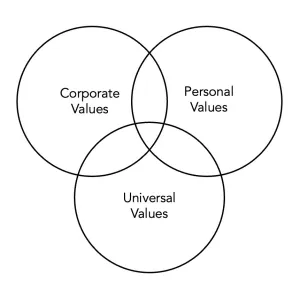
Broadly, values can be categorised into three types:
Personal values
Corporate values
Universal values
These different types of values tend to overlap and have some commonalities but the way these values are expressed and prioritised is often subtly different at each level. These can be visualised as overlapping spheres or ellipses, as in the diagram below.
Different typoes of values and how they overlap
Let’s look at each type of value in turn:
Personal values
Personal values are the specific combination of values that best reflect our character and preferences. For example, these could be compassion, courage, honesty, or any number of other virtues. For me, adventure and inquisitiveness are core personal values.
Finding your personal values is an important part of self-awareness. As the Greek philosophers said, the starting point of wisdom is to know thyself. Self-inquiry is the start of self-improvement, as explained in Why Socrates is the Father of Self Improvement.
Understanding our personal values is also important in terms of mental health and physical wellbeing. Our values help us to gauge our performance and energy levels, as seen in Burnout Prevention: How to Monitor the Essentials.
But it does not stop there. We need to constantly re-examine our values. We change and our situation changes. These changes can cause misalignments between ourselves and these actions. This can lead to feelings of frustration and unhappiness, as I have experienced and shared in My Mid-life Crisis and How to Re-find Happiness.
Corporate values
Corporate values are the precepts we hold in common within a family, team, organisation, or people group. These are the principles that bind a group of people together for a particular purpose.
Many organisations have statements that include values such as integrity, creativity, and collaboration. These values should be visible in the behaviour of an organisation, as explained by the Iceberg Model of culture.
If organisations don’t take their values and culture into account then things can go very wrong, especially when they are implementing change programmes, as explained in How to Stop Culture Eating Your Strategy for Breakfast.
Universal values
Universal values are core virtues that transcend individuals, organisations, and national borders. Examples of these would include those enshrined in the United Nations Charter, such as peace, freedom, equal rights, and human dignity.
We often examine values through a very personal lens, and this is important, but this can often limit our ideas of success, both in time and level of impact. Values or virtues should help us define what achievement really means. This success goes beyond just us as individuals as none of us can live a life without interacting with and influencing others. Therefore, we cannot examine values in isolation. Personal values are nothing without the context of corporate and universal values.
There can often be a difference between how we try to sell ourselves – through our CV or on social media – and what really matters when we consider the perspective of universal values. What does success actually mean in this life? The author David Brooks challenges the question “what do I want from life?” and asks another question, “what does life ask of me?” This challenging idea is explored further in What is the Difference Between Eulogy Virtues and Resume Values.
Here is another way to look at the three types of values (personal, corporate, and universal) intersect. This time we have three overlapping circles.
Where values overlap can give us insight to our purpose
Each of us has a unique expression of how and where these circles meet. When you have explored and understood each different sphere you should have a better idea of where and how the values overlap.
Why is that important? Well, this intersection can give us a great insight into the specific role we can play, and the special impact that we can bring to the world. We may not feel we can change the whole world, but we can certainly change our world; the environment and the community we live in. This opportunity, where our values align and can bring the greatest impact, can reveal our personal or life purpose.
So, what is that place for you?
If you want the right answers you have to start with the right questions
About The Right Questions
The Right Questions is for people who want to lead better and make better decisions. We are all leaders as we all have influence, no matter how much or how little. So, how are you maximising your influence?
If you are unsure, just drop me a line. I would love to help!
Do you want to lead better? Would you like to make better decisions? Want support in achieving your goals? Get in touch and let me know how I can help!