Earlier in my career, when I was working as a project manager, I ended up working on one of the largest building projects in London for one of the most successful property developers in the business. The guy was rich, was the boss of a large team, owned a powerful organisation and achieved big results. He was certainly an effective property developer. I also knew that his methods for achieving this success were questionable and I hated working for him. So was he a good leader?
What makes an effective leader?
If we want to think about what makes a good or effective leader, we must first define what leadership is. W.C.H. Prentice, in his famous HBR article of 1961 defined leadership as:
“The accomplishment of a goal through the direction of human assistants”
But this definition does not quite capture the ideas of some types of leadership such as self-leadership, 360-degree leadership, or even thought-leadership. Therefore, my favourite definition of leadership is that of John Maxwell who says that leadership is, in its essence, influence. Thus, I would define leaders as people who use their influence (or power) to initiate change.
So, by logical extension, we can now define what effective leadership is. An effective leader does the same but can accomplish bigger goals, with more people. They have a greater level of influence and bring about larger change.
But again, here we see that effective leadership is not necessarily identical to good leadership. For example, Stalin led huge numbers of people and Hitler had a massive influence, but few people would describe them as good leaders.
What makes a good leader?
Thus, now we must define what we mean by good, which is a little more tricky. In fact, it is often easier to describe what bad or toxic leadership looks like (particularly if we are working for the leader in question!) As Barbara Kellerman captured in her work identifying the 7 Types of Bad Leaders, we can (hopefully) spot leaders who are incompetent, rigid, intemperate, callous, corrupt, insular, or plain evil.
Kellerman’s model follows the trait theory of leadership and we could come up with an alternative list of positive qualities to reflect a good leader. Qualities such as integrity, confidence and self-awareness are frequently on such lists but these characteristics – positive or negative – can be boiled down to certain behaviours. These behaviours are, in turn, just the outward manifestation of choices. Therefore, we know whether a leader is good or bad by their decisions.
How do you good (or ethical) decisions?
There is a long history of thinking about how to make good decisions. Much of our understanding in this area reaches back to the fathers of philosophy such as Confucius (551–479 BCE) and Socrates (469-399 BCE). In philosophical terms, this field of study is known as ethics. Ethics is the study of right and wrong and the examination of the moral principles that drive good behaviour. Ethical decisions can therefore be thought of as good decisions.
There are various schools of ethics, such as deontology, consequentialism and utilitarianism but I want to focus on virtue ethics, which is most concerned with the values or moral character that drives good behaviour. It is these virtues or tenets that help someone make good decisions.
Virtues are positive values. By contrast, we would label negative values as vices. The idea is that these principles drive good behaviour and build healthy habits. For example, the virtue of temperance (one of the virtues championed by Aristotle) informs the decision to moderate what we eat, which leads to healthier lifestyles.
Values-based decision-making
The great thing about virtues or values-based decision-making is that, in psychological terms, it informs both our system 1 (intuitive) and system 2 (rational) decision-making. In other words, the values we choose to live by help our conscious and unconscious decision-making because the more we actively decide to behave according to a value, the more second nature that becomes. Proactive decision-making using virtues builds useful heuristics and habits.
But this is reliant upon knowing the right values, or virtues, upon which to act. Here things do become more subjective as there have been many lists or interpretations of virtue from Plato to Hume and Aristotle to Nietzsche. More recently, research shows differences in values from the male and female perspectives (Gilligan, 1982).
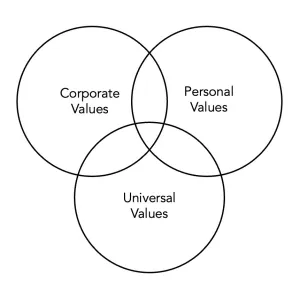
Whichever list we construct, the principles we live by are a mixture of social values (ones that we share with others due to our birthplace, culture, or workplace) and individual values (the precepts that we prioritise personally). If you have not done so already, it is worth identifying and reflecting upon both these corporate and personal values and how they inform your decisions.
How to become a good leader
Identifying your personal values is just one step on the road to becoming of good character and a good leader. There are other ways we develop good character in addition to knowing our values. Fortunately, psychological research at Oxford University has identified seven key strategies that reinforce this development, as outlined below:
The Oxford Character Project: 7 Strategies for Character Development:
- Role models
- Reflection
- Language
- Systems
- Reminders
- Friendships
- Practice
By employing these strategies we can accelerate and reinforce the development of good character. For example:
Role models
Role models are exemplars, people whom we look up to because of something we value in that person. It is therefore important to pick the right role models as we will become like whomever we choose to follow.
Reflection
If we are going to improve our character and leadership then we need time for personal reflection. We might achieve this in various ways (for example finding a place with no distractions or going for a walk) but whatever our preferred method it requires an investment of time to do it properly. Self-reflection is a critical stage of experiential learning – we cannot develop effectively without it.
Language
How we talk about things is important. Words are the outward expression of our inner thoughts. Our language indicates what is going on beneath the surface in the iceberg of our character, revealing our beliefs, values and fears. So, we need to be mindful of what we say. Also, when we learn new terms and language, we open ourselves to new opportunities and ideas.
Systems
A lot of our behaviour is driven by systems or processes. Many of these we are barely aware of most of the time as they are sub-conscious heuristics. Reflection can help us identify these systems and also help us put new systems in place. When we want to develop a new habit (especially something that doesn’t come naturally) we need to put new systems in place to help embed behaviour.
Reminders
We all need reminders, and our brains react to reminders (as app developers well know!) Reminders help us stay the course, keeping us consistent on the way to developing new habits and better character.
Friendships
Friendships provide us with support and accountability on the road to good character. A true friend will challenge us as well as give us the encouragement we need.
Practice
Practice allows us to experiment and learn. As we refine our knowledge through this experience, we also build habits that reinforce that learning and good behaviour. In the end, we become what we repeatedly do.
Even good leaders make mistakes
It is worth noting that even good leaders make mistakes. We all have to accept, that on our journey of character development, we will at times fail. We will mess up frequently, but that is just part of learning.
Our mistakes can also empower others in their journey. As Brené Brown points out in her excellent book Dare to Lead, if we dare to be vulnerable and admit our mistakes that makes us more accessible as leaders, gives others a chance to learn from our mishaps, and creates an environment of phycological safety where people feel they can take risks too.
Taking a step towards becoming a good leader
I strongly believe that we are all leaders because we all have a measure of influence. We can develop that leadership to become ever more effective (and powerful) but that is of less importance than making sure we are good leaders.
“Whatever you are, be a good one.”
Abraham Lincoln
To be a good leader we need to make good or ethical decisions. Therefore, we need to know the values that we live by.
If we want to make good decisions, we need to build good character, and that can be done through having good role models, taking time for self-reflection, using language, building systems, creating reminders, fostering friendships and deliberate practice.
We will make mistakes, but these are just part of the learning journey. We will trip, so we just need to ensure that we fall forward, towards our goal.
And why is this important? Because our character and where we end up is the cumulation of the decisions we make. If we want to end up in a good place, we need to make good decisions. As legendary Chinese philosopher Lao Tzu observed:
“Watch your thoughts, they become your words; watch your words, they become your actions; watch your actions, they become your habits; watch your habits, they become your character; watch your character, it becomes your destiny.”
Lao Tzu