Simple Leadership Styles: The Action-Centred Leader
The action-centred leader style is a leadership model proposed by John Adair. It was the first conceptual leadership theory I remember being taught. I still recall the lesson I had on this in school and can picture the three interlocking circles, projected onto a screen, of ‘task, team and individual’ that sum up the model.
You may well already know this tool and if so, here is a refresher. If you have not come across this before then read on, it is a theory I highly recommend and still use as it is one you can easily apply in the workplace.
Adair’s place in leadership theory
The action-centred leadership approach is born of the skills and behavioural trends of management theory as it is based on the assumptions that leadership can be taught.
This means that an action-centred leadership style is closely linked to contingency and behavioural leadership theories that propose that what a leader does is more important than who they are. This contrasts with much earlier theories that supposed you needed to be born to leadership. Adair wrote before the idea of transformational leadership became popular, but that does not mean you should ignore his model.
The tool has served me well through my whole career and I love it because it is simple – and therefore easy to remember and apply – without being overly simplistic.
“Everything should be made as simple as possible, but no simpler.”
Albert Einstein
The most important lesson it has helped me with is balancing the needs of the following three core management responsibilities:
The Task – the defined goal or mission
The Team – managing the defined group selected to achieve the task
The Individual – making sure that each person who makes up the team and every role is considered and supported
The three circles
These three elements are best known in their Venn diagram form where they become interlocking circles.
This model demonstrates the need for a leader has to have an intimate understanding of each element in order to achieve success. Success is more than just the task. Achieving a project is much more of a journey of ups and downs as compared to what a simple plan might suggest.
There will be times, to ensure the final success of the task, you might need to prioritise support to one individual if they are struggling. At another time, if working to a tight deadline, the task will take precedent and the team may suffer a bit to get the project over the line. Knowing this helps the leader manage the balance over time.
To complement these core responsibilities Adair also set out the core functions of a leader which can be remembered by the acronym ‘PICSIE’. These stand for:
Plan – to define the goal, make a plan and assign resources
Initiate – to communicate and start the task
Control – to manage the team and measure progress
Support – to support individuals and the team, through maintain morale,
Inform – maintaining good communications internally and externally, providing insight
Evaluate – assessing progress and success against the defined aims of the task
The astute among you will also see that this set of core functions also serves as a decision-making process. The process is effectively a loop where evaluation naturally leads back to another round of planning and so on.
The Action-Centred Leadership Model
Action-Centred Leadership: Keep it simple stupid
In the military people often used the acronym KISS: Keep It Simple Stupid. In other words, don’t overcomplicate things.
John Adair really did create a useful but simple model. The action-centred leader style is one I put to good use even at school and went from the quietest person in my year to the dizzy heights of college prefect! That was just the start of my leadership journey.
Having this tool really helped me to start to grow as a leader, so, remember: “Who Adairs Wins!” No? Ok, but hopefully, you will remember the key elements of task, team and individual and use this tool!
If you want the right answers you have to start with the right questions
About The Right Questions
The Right Questions is for people who want to lead better and make better decisions. We are all leaders as we all have influence, no matter how much or how little. So, how are you maximising your influence?
If you are unsure, just drop me a line. I would love to help!
Do you want to lead better? Would you like to make better decisions? Want support in achieving your goals? Get in touch and let me know how I can help!
How to Use Situational Leadership to Adapt Your Leadership Style
What is Situational Leadership?
In this series on leadership theories, we have already looked at early ideas such as the Great Man theory, Control and Domination and Leadership Traits. As research into leadership developed, studying leadership skills led to looking at the behaviours (behavioural leadership) and actions of leaders. (Action-Centred Leadership).
It was now recognised that leadership can take different forms. Therefore, studies were made into which situations certain leaders thrived in. This led to various theories of situationalleadership.
For example, Fiedler (1967), argued that there was no one right way to lead, but rather that the type of leader and style of leadership needed to suit the situation. Sometime later on, Paul Hersey and Ken Blanchard (author of The One Minute Manager) developed a model situational leadership that many people will be familiar with.
Blanchard and Hersey’s Situational Leadership Model
This model helps to show the most appropriate form of leadership, depending upon the nature of the task and the competency and commitment of the team. In simple terms it breaks down into four key leadership approaches:
Directive – telling people what to do, usually used for enthusiastic novices
Delegating – giving over whole tasks to people who are experienced and able to take responsibility. This is a more hands-off leadership approach
Supporting – this is when there is a high level of trust in the team and individuals can manage themselves independently. But the leader has higher participation than in pure delegation, by providing moral support, encouraging and communicating proactively
Coaching – this involves selling the task to the individual and helping them grow to take on more responsibility. This works particularly well with individuals who may have lost confidence in what they need to do
The following diagram summarises the Blanchard model:
Ken Blanchard’s Situational Leadership Model
Team Member Development and Maturity Levels
As well as the four leadership styles in the model there are also four development levels that relate to the maturity and capability of the team members. In the model these progress from D1, at the low end of maturity and development, to D4, where the person is highly capable to deal with the task.
It is important to remember that someone could be very experienced generally but, faced with a new task, they could find themselves out of their depth. Therefore, as a manager, it is important to think about someone’s ability to do the specific task and how to lead them in that situation rather than just the usual default approach.
For example, I have worked with CEOs who are incredibly experienced and gifted but who have required coaching support as their roles and organisations have evolved. It is an important lesson in humility for all leaders as well as team members. It does not matter how capable we are (or think we are), there will always be times where we are learners and need people to support us.
Situational Leadership Examples
I have found this situational leadership model useful in helping to understand how I can adapt my leadership style, depending on the situation. It has also assisted me in identifying my preferred approaches.
Delegating and Supporting
It has been my privilege to work with and lead some really experienced and capable teams. Therefore, a much as possible, I like to adopt a more non-directive leadership approach. I also like to be led this way and generally be left to get on with things (S4). Because I tend towards being a hands-off leader, I have learned to communicate this to teams early. I let them know that they can ask questions and, if necessary, demand more support from me (S3).
Coaching
When I see an individual who needs help, I trend towards a coaching style (S2). I really enjoy going with people on their learning journey. Seeing people confident and empowered is hugely motivating for me and that is a big reason why I actively coach leaders alongside my other leadership responsibilities.
Directing and Commanding
I keep the more directive approach (S1) for times of real crisis. Generally, I don’t tend to stay in this mode for long. My children might argue and say, “Daddy, you are always ordering me around!” But, in my defence, I would argue that if you visited our house around bedtime, it is a crisis zone!
I have used this command style of leadership at times in the military, which might be an obvious example. But it has also been critical to other situations. I have used this style when leading teams off mountains in bad weather and when reacting quickly to bad news in a business context. This directive style can be a reassuring approach in a crisis. However, it quickly becomes overbearing if used all the time, particular with an able team.
No matter where we are on our journey we can all discover something new about leadership. It does not even matter how much responsibility we have (or don’t have). Everyone can learn to lead better and flex their leadership style for different situations. The best leaders are not stuck in one mode of management all the time.
So think about your team and their tasks today. As a manager, do you need to direct, delegate, support or coach them through their next piece of work?
If you want the right answers you have to start with the right questions
About The Right Questions
The Right Questions is for people who want to lead better and make better decisions. We are all leaders as we all have influence, no matter how much or how little. So, how are you maximising your influence?
If you are unsure, just drop me a line. I would love to help!
Do you want to lead better? Would you like to make better decisions? Want support in achieving your goals? Get in touch and let me know how I can help!
What Traits or Characteristics Does a Leader Need?
What does a leader look like? What qualities or traits should they have? Commonly, people will say a leader should be tall, attractive, confident, charismatic, and intelligent. But if this is the case, it makes us all wonder: do we have what it takes to be a leader?
Unhealthy Leadership Comparisons
I found this stereotype of leadership very troubling when I was younger, particularly when I directly compared myself to this list and some leaders that ticked all the boxes.
Handsome Alexander the Great had unified (subdued) Greece by the age of 20 and the charismatic Joan of Arc led the relief of Orleans aged 17. How did I measure up in my teens?
Well, I was just over average height, mildly intelligent, but gawky, introverted and softly spoken. I struggled with huge self-esteem and confidence issues surrounding whether I was attractive. It did not help that I was your classic spotty and greasy-haired teenager. But this was exacerbated by suffering years of orthodontic dental work. To get an idea of how much metalwork I was displaying, let’s just say that I could set off the detectors in airport security while still at check-in!
Basically, I fell well short of the mark on pretty much every populist leader trait as listed above. But hey, Alexander the Great had achieved a lot by the age of 20, but he was born into a royal family, and he never had to deal with my dentist!
Most of us are not born into privilege or are so naturally gifted that we can just switch on cruise control for the rest of our lives. So where does that leave us if we were not born leaders?
The debate around nature or nurture is one of the longest-running in the field of psychology. It basically comes down to whether one places more importance on our genetic inheritance, or on how environmental factors influence us. Nowhere has this been more hotly contested than in the field of leadership.
Initial leadership theories tended towards the idea that leaders were born, that we were sent “Great Men” to lead us in times of crisis. This Great Man theory then evolved as people tried to identify the common traits these leaders were born with.
As we have seen, these supposed leadership qualities were not ones I could readily associate with. I was at best an ugly duckling of a leader and there was no promise of great genes suddenly turning me into some great swan. That left me furiously paddling about, trying to live up to this supposed ideal of a leader.
In this desperation, I was tempted to pursue other negative leadership stereotypes and try to dominatepeople to make up for my lack of natural charisma.
The trap of toxic leadership
This view of leadership can entrap us. It can lead to unrealistic expectations and disappointment, or the rise of hubristic and toxic leaders.
If we hold up an unrealistic view of leaders, such as the list above, we preserve an unachievable ideal. What we are effectively after is a superhero rather than a manager. This leads to one of two outcomes, either all the people will encounter fall short of our ideal or we put people on a pedestal only to watch them fall off it. They are only human after all.
Putting people on a pedestal can lead to hubristic or toxic leadership. Even if a leader does not start out as arrogant and self-centred they can quickly become so given power and adulation. Stories of raising up such charismatic but flawed leaders go back at least as far as King Saul in the Old Testament. But, looking at the rise of populist leaders today, it seems we may not have learned that much in the last 3000 years.
Breaking the old leadership mould
Despite the perpetuation of this flawed ideal, and my fumbling start, I was surprised to find that people did continue to give me responsibility. What’s more, I could certainly influence people, even if it was just in some small way. These people were generally few in number, and among my school friends or sports-buddies, but it was something!
Therefore, I was able to lead in some contexts despite not living up to the leadership stereotype; why was that? When I looked around me, I could see plenty of other examples of leaders who did not fit this early leadership stereotype either. In fact, most of the people I knew in leadership positions did not exactly fit this mould.
Some well-known historical figures have also had a huge influence despite not having all these traits. Mother Teresa comes to mind as someone who did not fit this typecast, yet she had a profound effect on the world. She did this from a position of genuine humility. Her view was not to worry about the power she lacked; but rather concentrate on the change, however small, she could affect:
“Not all of us can do great things. But we can do small things with great love.”
Mother Teresa
She was literally the antithesis of the “Great Man”, but she will be remembered far longer than most of the populist world leaders of today. If leadership is influence, then her legacy proves that she was indeed a great leader.
What makes a good leader?
So, there must be other important and useful leadership attributes. More recent research has identified and used other traits to assess good leaders. Common among these are:
Personal Integrity
Drive and Determination
Emotional Stability or Maturity
Self-confidence
These are certainly more instructive than earlier traits and I am sure we can all think of a lot more leaders who show a larger measure of these characteristics, as compared to the earlier list. But even with a new list of attributes, one big question is still unanswered.
Are Leaders Born or Bred?
In the middle of the twentieth century, the emphasis shifted from nature (innate) to nurture (learned) aspects of leadership. In other words, people started to believe that leadership could be taught. This put an increasing emphasis on what a leader did, rather than just a person’s supposed God-given right to lead.
This is somewhat unsurprising in the aftermath of the Second World War when so much of the planet had been ravaged by the excesses of ‘Great Men’ such as Hitler. Many others were still suffering under Stalin and Mao. People started to wake up to the idea that a person assuming they were in the right (just because they were in control and claimed some sort of destiny) was a flawed basis for leadership.
From Being to Doing
The emphasis on leadership now turned to the skills that leaders needed to be effective. These were grouped as technical, human and conceptual skills. There was also an appreciation that certain traits can also be developed over time. Experience certainly reinforces the idea that we can improve. This has been my personal experience and the story of my own leadership development over the years.
Personal integrity is reinforced every time we act in accordance with what we say. It is the opposite of the ‘do what I say but not what I do’ type of management.
The first real test of integrity for me happened at school. When I was made a prefect, I suddenly had to ensure that my standards of behaviour matched the rules I was there to reinforce. It required self-discipline and moral courage (two more important traits) as I could not just walk past things I knew were wrong, even if it was my friends who were out of line. This concept of ‘you are only as good as the wrong you pass by’ was reinforced in my career in the military. As a leader you have to uphold the values you espouse, or your credibility and authority will crumble.
Determination
You need determination as a leader if you are to persuade people to come with you, overcome obstacles and achieve your goal.
I did not realise it at the time but some of my determination was forged in the outdoors. As I pushed myself to climb mountains or explore jungles, I developed what Angela Lee Duckworth calls grit. Grit is the dogged determination that you need to see things through in the face of adversity. This grit turns out to be more important than IQ when it comes to succeeding.
And there is the rub. You have to face troubles and hardship if you want to develop grit and determination. So don’t back down from a challenge. Embrace it, even if you fail, you will be stronger – battle-hardened – afterwards. These challenges don’t need to be huge, just anything that pushes you out of your comfort zone.
Emotional Maturity
Have you ever had a boss who everyone tip-toed around? In this situation, the team feels like villagers living under the shadow of a volcano that is always on the verge of eruption. Or how about a manager who cannot read the situation? They make inappropriate jokes, try to be chummy in an important meeting but then authoritarian at the office social. They are impossible to read or predict. This is the opposite of emotional maturity and emotional intelligence.
People who are emotionally mature can manage their emotions in a way that is appropriate to the situation. That does not mean being unemotional though. We are humans, not automatons. Being emotionally mature means we can laugh when people laugh, cry when people cry, but at the same time we are not ruled by our emotions. The emotionally mature person is not the rubber dingy being thrown about by the waves. They are the harbour of calm; an environment where people can be secure in themselves and confident they can work without fear of a sudden storm.
Some parts of emotional stability and intelligence are innate, but we can also learn to be more stable and empathetic as leaders. Self-awareness, proper rest, breathing techniques and mindfulness can all help. Over the years, I have found that walking is one of my best ways to re-stabilise my thoughts and emotions. I walk regularly, for example to and from work and in between meetings, to give myself time to reflect and process emotions. It is worth experimenting with a few techniques and finding out what works best for you.
Self-confidence
As alluded to earlier, I am an introvert and was not born with huge self-confidence. My confidence has developed over time. Experience, as with the other traits above, has built my confidence. Somewhat counterintuitively, my self-confidence has grown as I have been more willing to share and learn from my mistakes. That is because humility and confidence are not opposites. Equally, confidence is not arrogance.
One area that many people struggle with, but particularly introverts, is public speaking. Getting up in front of a crowd to do a presentation, or even just to ask a question in a meeting, takes courage. Here once again I have found that with practice, taking on a new mindset and applying a few techniques I have learned to love public speaking.
Leadership development happens one step at a time
Therefore, there is hope for us all. We don’t have to be born a fully-fledged leader. Strengths and weaknesses, in our character and skillset, can all be improved upon. This has certainly been my experience and having been given opportunities to lead, over many years, my confidence and capability as a leader have certainly grown.
How about you? Which characteristic or trait do you most want to develop as a leader? Think of a small practical way you can develop that today. That might be something as small as tackling that task you have been avoiding, having that difficult conversation you have been dodging, or just speaking up in your next meeting.
Practice does not make perfect, but it does make practice easier. If you make that little bit of progress today, the same action will be a little easier tomorrow. You may not have been born a leader, but you can certainly learn to be a better leader than you are now. Make that first step!
And if you would like any support on your leadership journey, please do drop me a line via the Contact Page.
If you want the right answers you have to start with the right questions
About The Right Questions
The Right Questions is for people who want to lead better and make better decisions. We are all leaders as we all have influence, no matter how much or how little. So, how are you maximising your influence?
If you are unsure, just drop me a line. I would love to help!
Do you want to lead better? Would you like to make better decisions? Want support in achieving your goals? Get in touch and let me know how I can help!
How To Develop An Effective Team With the Tuckman Model
How does a team develop and achieve high-performance? What phases does it go through and what are the 5 stages of the Tuckman model?
Whatever our team role, whether we are a leader, manager or team member, it is really important to understand the stages a team progresses through before it reaches a high-performing level.
And this is not just about work teams. Any group we are a part of has to work through steps of development. Every social circle, club or family, must progress through challenging phases, to function well.
Not all teams are functional – let alone high-performing
I looked around the room. Various factions sat apart and determinedly avoided eye contact with each other. The whole group glowered with distrust. Somehow, in a matter of days, I would have to take this bunch of misfits and develop them into a team. Success was critical. We were about to deploy on a military operation where, if we could not work together, we faced not only the failure of our mission but also our own physical well-being.
I am sure you can empathise. Whether you are a leader or have been a member of a newly formed team, I am sure you can recall similar scenes. Experience tells us that a bunch of people is not a team. It is just that, a group of random individuals. But we also know that teams are vitally important. They help us achieve what we could not do alone. So, how does a group of individuals develop into a team and how can we help manage that process?
What is team development and why is it important?
Research has shown that a group must progress through certain development stages to become a high performing team. A leader is responsible for managing this process, but it is one that affects us all, no matter our role.
The process of development is also continual. Our situation changes, as do the challenges we face. The people in our teams come and go. Sometimes things just seem to go wrong, and a team becomes dysfunctional. Therefore, team performance needs continual management.
We are all responsible for this management, to some degree, as we are all members of teams. That could be a work team, sports squad, music band or just your family. Structures, locations, and purposes of groupings may vary but they are still teams if they share a common goal. That is what defines a team: people with varying roles but a common purpose.
Whether we are officially leading that group we can make an important contribution to team development. And that is not just in playing our team role effectively. Through understanding team development, we can all help our teams become more effective.
I started off my career as a Bomb Disposal Officer in the Army, working in situations where working together as a team was potentially a life or death matter. Creating and maintaining high-performing teams really mattered.
Since then, as a senior manager, then consultant and leadership coach, I have worked within and alongside organisations in the commercial, governmental, and voluntary sectors. In each role I have equipped teams with the skills they need to be more effective in working together and managed the development of the team as well as the roles of the individuals within that team. I will share some specific examples of these as we progress.
How to build a strong team
Team building is not reliant on away days and fun activities. These things are great but are not the foundation of team development. You can build a successful team in the harshest of environments if you understand the fundamentals of team roles and development.
A well-functioning team is dependent upon good leadership. If a team is failing in some way, then the manager must shoulder the bulk of the blame and take responsibility for finding a solution. But that does not let team members off the hook. Any individual can make things better (and they certainly can make things worse) for the rest of the team at any stage in its development.
“Coming together is a beginning. Keeping together is progress. Working together is success.”
Henry Ford
The Stages of Team Development according to Bruce Tuckman
So, what are the stages of team development?
A group needs to evolve through certain steps to become an effective team. The most well-known (and memorable) theoretical model of this development process is the Tuckman Model.
Bruce Tuckman did research that demonstrated that every team goes through various stages. He first identified four stages and then, upon further research, amended this to five stages of team development.
The 5 stages of team development:
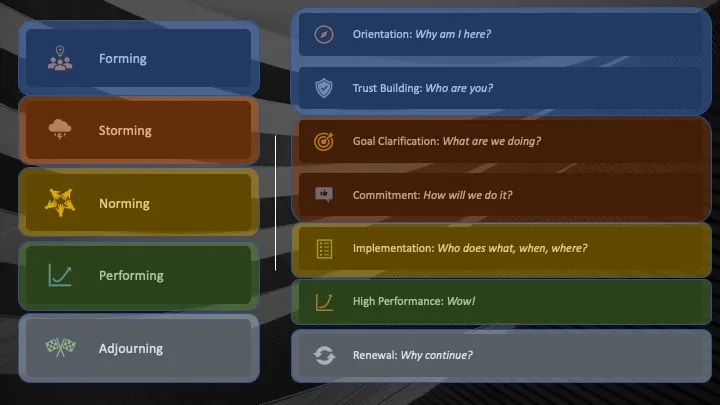
Forming
Storming
Norming
Performing
Adjourning
A manager can do things to speed the process through these steps to the performing stage, but any team member can also help. It is especially important to get through the painful storming phase, but you cannot completely short circuit the system to get straight to performance. There has to be some pain to get to the gain.
Tuckman Model
Forming
Going back to the story I started with. As the group sat in that room on the first day, we were in the forming stage. Fortunately, we had a clear mission statement, and I knew we had lots of quality people. But given the dark-cloudy looks I was getting I knew that the storming stage would soon be upon us.
Storming
Therefore, right from the start, I forced the issue of integration. I immediately re-structured the group into smaller cross-functional teams that broke down the various cliques. They would have to learn together and learn to rely on one another from the start. The storming phase could commence – as people worked out their exact roles, preferences, and approaches – and the intense work gave them focus. The enemy was now the challenge rather than other team members.
Norming
If these smaller teams still struggled it was easier to identify the problem. Team dynamics and individual characteristics were easy to identify. In a couple of cases, I moved people around until we reached the norming phase.
Performing
I would love to say we were in the performing stage before we deployed but that would not be strictly true. We finished our training and were able to operate but it was some time into the task before I would have called us a high performing team. We had been effective to a degree until that point but there was a moment where we got into a flow. We were not just getting work done, we were being creative, teams worked fluidly and independently, and results were exponential. This was high performance.
Adjourning
Sadly, all things come to an end. At the end of our tour of duty we handed over to another team and we went into the adjourning stage. We celebrated our success, shared our experience, and went off to join other teams.
The 5 Stages of Team Development
How to manage progress through the team development stages
It is useful to know these steps because it helps, particularly as the leader, to identify what stage of development your team is at. But just knowing which stage does not necessarily equip us to manage the team progression.
Being properly equipped is often down to knowing the right questions to ask. As a leader, I am constantly asking questions or myself, my situation and my team. Therefore, I have found another theoretical process, the Drexler-Sibbet model of Team Performance, a really helpful complement to the Tuckman model.
The Drexler-Sibbet model poses a set of questions that a team needs to work through to progress through each level of performance. In this model, there are seven (rather than five) stages of progression. The stages and questions are as follows:
Orientation: Why am I here?
Trust Building: Who are you?
Goal Clarification: What are we doing?
Commitment: How will we do it?
Implementation: Who does what, when, where?
High Performance: Wow!
Renewal: Why continue?
Let’s use another example to highlight the different stages and questions. Another very different and yet equally challenging management role I had was leading a large group of volunteers for a non-profit organisation. I did not have any of the levers of military rank, money, or contracts to make people work together or at all.
Drexler-Sibbet Model of Team Development
Orientation: Why am I here?
This question needed to be answered even to just recruit volunteers. The good news is that most people want to make a difference. What a good leader does is cast vision and link people’s values to that purpose.
My team was responsible for production; the setting up and running of large events. There were plenty of people supporting the organisation, my challenge was to link those individuals who enjoyed that sort of physical work and show them that they could contribute to achieving the overall mission by serving on my team.
Trust Building: Who are you?
Trust is the foundation of any relationship. The way to kick-start any relationship is by quickly building rapport. People do start to get to know each other as they work together but this is where I find creating opportunities to socialise really fast-forward this stage.
These can be as simple as water-cooler moments or coffee breaks where people can chat. For my team, we found that in what was a long hard day of work, eating together at lunch really helped team building and fostering inter-team relationships.
Goal Clarification: What are we doing?
The next step is to turn the vision into a tangible mission or goal. A leader’s responsibility is to articulate this end-state or success criteria.
With my production team, the mission was to set up, manage and then set down all the equipment in order to enable a successful event. The events supported the overall purpose of the organisation so in this way, I could link the what to the why.
Then you need to work out how to achieve the mission. In other words, you need a plan. This is breaking down the overall goal into smaller tasks and activities.
In my case, we systematically took each bit of equipment we needed to set up and worked out an overall sequence (effectively a project programme) and then worked out an efficient process for each individual task. The team played a significant role in this last part. They used their creativity and experience to find the best ways to do things; I then captured and managed the activities.
Implementation: Who does what, when, where?
This question of who links the individuals to the plan. Answering the who question is about delegating tasks and roles according to skill, preference, and experience. For working out roles within a team I have found the Belbin Team Roles model the most useful and comprehensive.
As my team grew the crew leaders took on more of this responsibility of working out the who. They knew the plan and they knew their people best. They also knew how to take on new recruits and train them up.
High Performance: Wow!
The only part of this model that I dislike is the ‘wow’ instead of a question for performing teams. It can give the impression that once you get there all you need to do is just exclaim “wow!” and watch the magic happen.
But in my experience, what great teams do that keeps them at the top and maximising their performance is continual learning and improvement.
Therefore, there are some questions that teams should remember at this stage and these are the ones related to continued learning. I use a simple model based on traffic lights for this. I ask:
Stop – What do we stop?
Start – What do we start?
Continue – What do we continue?
I would reflect on these questions at the end of every event. I would discuss these with my crew leaders and they, in turn, did so with their crews. In this way, we created an environment of continual learning and empowered everyone in the team to challenge and improve performance.
Team performance review process
Renewal: Why continue?
If the vision (why) and mission (what) remain the same, then things can generally continue. But projects end and team members come and go as a normal process of life. Therefore, we always need to answer this question, which as you will notice, takes us full circle.
With my production team, every new event was a small renewal and an opportunity to reinforce the why. So, we met at the beginning of the day to remind ourselves of how our actions would contribute to something much bigger.
The team grew and changed. When people joined our team, we made them part of the family. When people left, we grieved but also celebrated what they had done and shared their excitement for what they were moving on to. We made the process as natural and positive as possible. We ate a lot of cake along the way!
As a leader, when a team is functioning well, it is often easy to neglect the continued answering of this question. But you do so at your peril. Hard work is hard work. It makes people ask, “why bother?” Leaders need to reinforce the vision to stop people from becoming disillusioned.
YouTube Video: 7 steps to developing high performing teams
Combining team development theories for effective management
To bring all this theory together I have put the two models side by side in the picture below. The colours show how the 5 stages of the Tuckman model relate to the 7 stages of the Drexler-Sibbet model.
The Tuckman and Drexler-Sibbet Models combined
Putting team development theory into practice
Hopefully, you are now clear on the stages of team development and the questions that need to be answered to manage the building of a team from a group of individuals to a high-performance team.
Remember too that all teams experience change. That change might be faster or slower depending on the circumstances but that is why teams need continual leadership. Without this management, a team can get stuck, or even worse, can regress back through the development process.
Finally, remember that we all have a part to play, leaders or not. By understanding the stages of team development, we can all help our teams to improve, whatever our role or the purpose of that group.
So, think about the teams you are a part of. What stage are they in? Is it forming, storming, norming, performing or adjourning? Which question do you need to answer to help them evolve?
If you want the right answers you have to start with the right questions
About The Right Questions
The Right Questions is for people who want to lead better and make better decisions. We are all leaders as we all have influence, no matter how much or how little. So, how are you maximising your influence?
If you are unsure, just drop me a line. I would love to help!
Do you want to lead better? Would you like to make better decisions? Want support in achieving your goals? Get in touch and let me know how I can help!
Situational Leadership: How to Pick the Right Leadership Style
A Real-Life Example of Using Situational Leadership
The rope snaked out in front of me, linking me to my three climbing buddies. I could see each one, in turn, slowly progressing up the ridge. The problem was that they were getting harder to see. The lead climber was beginning to face into the mist as she scaled higher up the peak. It was getting darker too. Not a good sign.
We had started our Alpine climb in the sunshine but had been scrambling up the ridge for hours. While we had been edging up the rock, ominous clouds were forming on the far side of the mountain. Now, as we neared the peak, we were ambushed.
When you look at a cloud from afar it is a giant cotton ball, majestically suspended in the air, silent and ethereal. But climb into a Cumulonimbus and the experience is very different. Clouds become loud, scary and very tangible.
Within seconds of summiting, we were in a gale and had to huddle together to communicate. Rain and hail started to pummel us and, just when we thought things could not get any worse, lightning struck a nearby peak. The air crackled and spat. We were in trouble.
We had conquered the climb, but the mountain was reminding us that it did not consider itself subdued as a result. It was time to beat a hasty retreat. But the strangest thing had happened. The person who had been leading all the way up the mountain just froze. When the thunder sounded, they just stood there, wide-eyed, and did not say anything. Instead, for some reason, everyone was looking at me.
Fight, Flight or Freeze
The fight, flight or freeze response is a natural psychological reaction to a threat. It is hardwired in for good reason. As with our cousins in the animal kingdom, this response can often save our lives.
But it does not always work, and we can all react differently. The leader had frozen, but when leading, you cannot afford to just react. You must think too. You have to engage in the decision space, the opportunity that lies between stimulus and response.
“Between stimulus and response, there is a space. In that space is our power to choose our response. In our response lies our growth and our freedom.”
Victor Frankl
In our case, we actually did need to flee, but we also needed to go together and safely. This would require leadership.
Something within me grasped all of this, even if just as at a subconscious decision-making level. And so, I had started taking command. I shouted my hasty plan as we gripped the rock and tasked the team to sort their kit quickly. I looked everyone in the eye, made sure we were good, then led the way off the peak and down the mountain.
Within an hour we were out of danger. Within two we were back in beautiful sunshine. No one thought that what had happened within our team was in any way strange. We trusted each other, we shared roles and responsibility. But what had just happened?
The situational leadership model and how it can help
To be a good leader you need to know how to vary your leadership style depending upon the circumstances. Leading in a crisis requires a different approach to managing everyday circumstances.
On that day I was climbing with an experienced team. But when managing someone inexperienced they will require more support than other team members.
Therefore, as a leader, you need to adapt your style accordingly. This is called situational leadership. Paul Hersey and Ken Blanchard developed the most well-known model for situational leadership. This model helps to show the most appropriate form of leadership, depending upon the nature of the task and the competency and commitment of the team. In simple terms it breaks down into four key leadership styles; directive, delegating, supporting and coaching.
“We can’t always control what happens in our lives — things will go well, things will go poorly — but what we can control is our response to those events.”
Kenneth Blanchard
Directing
Directing is telling people what to do. This is usually used for enthusiastic novices or when in a crisis. This command style is suitable for critical problems.
When things went wrong on the mountain this was the approach I had to adopt. This is certainly not my normal and preferred way of working. In my experience, if a leader uses this style the whole time or out of context then it can be overbearing, condescending or both.
“When placed in command, take charge.”
Norman Schwarzkopf
Delegating
Delegating is giving over whole tasks to people who are experienced and able to take responsibility. This is a more hands-off leadership approach used with competent team members.
On the mountain, as soon as I had taken command, I started to delegate tasks. I did have a competent team; they were just in shock and the previous leader was exhausted. As soon as I gave out tasks the team started to break out of the stupor. Their experience broke through as they went into action and became themselves again.
“Surround yourself with the best people you can find, delegate authority, and don’t interfere as long as the policy you’ve decided upon is being carried out.”
Ronald Reagan
Supporting
This style suits when there is a high level of trust in the team and individuals can manage themselves independently. But the leader employing this style has higher participation than in pure delegation, by providing moral support, encouraging and communicating proactively.
For most of the climb, we had been in this situation. The leader knew that we could manage ourselves, but she had worked hard to support the team. This was the right approach but meant she was very tired when the storm broke.
“A leader is great not because of his or her power, but because of his or her ability to empower others.”
John Maxwell
Coaching
In this context, coaching involves selling the task to the individual and helping them grow to take on more responsibility. This works particularly well with individuals who may have lost confidence in what they need to do.
I had to use this approach with the person who had been leading. We had previously relied on her energy and enthusiasm up until we reached the summit. They were now exhausted, a little shell-shocked and probably embarrassed that they had frozen. I was able to share small tasks and responsibilities with her as we started to enact the plan. In this way, she quickly recovered her confidence and came alive again.
“A good leader inspires people to have confidence in the leader; a great leader inspires people to have confidence in themselves.”
Eleanor Roosevelt
Team member development and maturity levels
On my climb that day we were all of a similar experience and so picking the right style for the situation was the most important thing. But as well as the leadership styles we also need to consider the development levels that relate to the maturity and capability of the team members. These progress from the low end of maturity and development (for example, a new worker who has just joined the firm), to the expert level, where the person is highly capable to deal with the task.
It is important to remember that someone could be very experienced in some areas but, faced with a new task, they could find themselves out of their depth. Equally, the new joiner might have expertise that long-term team members are lacking. Therefore, as a manager, it is important to think about someone’s ability to do the specific task and how to lead them in that situation rather than just assume a default approach based on the time in a given job.
This applies no matter how senior we get. I have worked with entrepreneur CEOs who are incredibly experienced and gifted but who have required coaching support as their roles and organisations have evolved. It is an important lesson in humility for all leaders as well as team members. It does not matter how capable we are (or think we are), there will always be times where we are learners and need people to support us.
To be a leader is to be flexible in style
We all have our preferred leadership style. For me, I prefer a more non-directive approach to leading. I like to put trust in my team and support them to achieve the result rather than just telling them what to do. But I can’t always lead that way.
The best leaders are not stuck in one mode of management all the time. Fortunately, the situational leadership model can help us identify the times when we need to adapt our approach. It might be the external circumstances that prompt the change, or it could be the experience level of a team member; the important thing is to be aware of the changes in your situation so you are ready to adapt as a leader.
“Effective leaders need to be flexible, and must adapt themselves according to the situation.”
Paul Hersey and Kenneth Blanchard
Think about your team and their tasks today. As a manager, do you need to direct, delegate, support, or coach them through their next piece of work?
If you want the right answers you have to start with the right questions
About The Right Questions
The Right Questions is for people who want to lead better and make better decisions. We are all leaders as we all have influence, no matter how much or how little. So, how are you maximising your influence?
If you are unsure, just drop me a line. I would love to help!
Do you want to lead better? Would you like to make better decisions? Want support in achieving your goals? Get in touch and let me know how I can help!
What is servant leadership and who is it relevant to? Can a leader really be a servant?
I never really thought about the leadership ability of my father until I became a leader in my own right. I certainly did not fully appreciate his role as a leader until I became a parent. This was mostly because – when growing up – I never really thought of my dad, and what he did as a father, as a leadership position. To me, leaders were the loud, larger than life characters who led countries, armies, or large corporations. Back then I had a very narrow view of leadership.
My father was not the archetypal leader. He was not some charismatic figure in senior management. He was not a visionary, an intellectual or a great orator. But, to make up for this last point, he has never been shy of sharing a joke (no matter how good the joke or appropriate the context!)
So, what did he do (apart from dad-jokes) that made him a leader?
Well, he led my family – with my mother – through shared sacrifice. He served us as a family and put that team first in his priorities. He worked hard to be a provider, to be a role model for us, and he was true to his values.
As a provider, he set the standard for reliability and hard work. He was employed for the same company for most of his working life and never took a day off sick. When he came home, he read to us children (while trying not to fall asleep) and then was off working around the house or in the garden.
He led with integrity. He kept his own standards, and his actions matched his words. One example of this was that he did not swear in front of us children or bad mouth other people. This was a small but powerful lesson for us. It is only now, as a parent, that I realise how hard this is to do!
My father’s values were founded on his faith in God. He was not ostentatious in his faith, but he was always truthful about what he believed and gave straightforward answers when questioned. These values, such as his love for others, service to the community and honesty in his words and dealings, all shone through in the little things of everyday life. In so doing, my father provided a powerful example of good servant leadership.
The servant as leader
The idea of servant leadership was popularised by Robert K Greenleaf in his book, of the same name (1977). His phrase, the ‘servant as leader’ has been shortened over time to ‘servant leader’ but it is worth reflecting on the original construction. The ‘servant as leader’ reveals Greenleaf’s premise that we are all servants and, at times, we all need to take the role of leader, while maintaining this servant-heartedness.
This phrase is a seeming contradiction. Servant and leader are often (mistakenly) seen as opposites. His wording is also both divisive and inclusive. It is divisive, and potentially offensive, by using the term servant. The word servant actually comes from the Latin servus which means slave. Who wants to be a servant, let alone a slave?
But here again, lies a deeper truth. We are all servants of something. If we chase addictive substances or behaviours we become slaves. We can enslave ourselves to ideas such as wealth, fame, or appearance. And even if we avoid these extremes, we all serve something. That might be others, a higher ideal, God or ourselves, but we all choose to prioritise some thing. That is what makes us servants. The question is:
“Whom do you serve and to what purpose?”
Robert Greenleaf
If we accept the first premise, the second is that, although we are all servants, we all have the capacity and responsibility to lead. This is because the philosophy of this sort of leadership (and much of modern leadership theory) is that leadership is influence; not necessarily an official position. We can also all learn to be better leaders; there are skills we can improve. Therefore, we can lead from whichever position we find ourselves in, with whatever measure of power.
What servant leadership is
The servant as a leader is different to the leader who seeks power, fame and fortune. This serving model of leadership stands in contrast to Great Man theory and the cult of personality, or the Machiavellian, unprincipled manipulation of people to achieve one’s ends. The servant-leader is not driven to acquire power or possessions but motivated instead to serve the community, to serve others. As Greenleaf puts it:
“The servant-leader is servant first… It begins with the natural feeling that one wants to serve, to serve first. Then conscious choice brings one to aspire to lead.”
Robert Greenleaf
Within this approach, there is an emphasis on serving and developing other people. The servant-leader seeks to share power, prioritise the needs of others and raise up new servant leaders. This is why the true test of the servant leader, their legacy, is in the growth of who they lead.
“Do those served grow as persons? Do they, while being served, become healthier, wiser, freer, more autonomous, more likely themselves to become servants?”
Robert Greenleaf
The potential pitfall of servant leadership
There are pros and cons to servant leadership. There is a potential danger of this emphasis on serving others if misconstrued. Serving others is not tending to every whim of every individual. That would seem like serving them but would actually be counterproductive. To take an extreme example, you do not best help an alcoholic by giving them a drink whenever they ask for it. Equally, any parent knows, that giving a child everything they want will not serve them in the long run.
That is why there needs to be a vision, an idea of what the future can look like. Most importantly, in this vision, the servant leader must see the potential of the person they are serving. They seek to guide that person toward their future better self; not just react to the imperfect person standing in front of them. This idea of the leader serving the person, but towards a longer-term mission and goal can be seen in the inspiration that lies behind Greenleaf’s work.
Greenleaf was inspired, amongst other things, by Herman Hesse’s book Journey to the East. In this story, a group of travellers is on a pilgrimage to find enlightenment. At first, things go well, but they face a crisis and their servant, Leo, goes missing. The group falls into disarray and they abandon their journey. Many years later, the main character – still on his search – discovers that Leo is actually the leader of the spiritual order he had been seeking all along.
Greenleaf also looks to the example of Jesus of Nazareth as a historical example of the servant leader. The Jesus of the Bible did not seek fame, power and riches and yet – by serving those around him and developing his disciples – had an impact as a leader that is unparalleled.
“Servant leaders don’t think less of themselves, they just think of themselves less often”.
Ken Blanchard
Serve to lead
This paradoxical paradigm of leadership has had a great impact, even in unexpected places. I started out my career as a bomb disposal officer in the Army. Stereotypically people think of military leaders as being confident, loud, and directive. If all you watched was war movies you could assume that martial leadership is mostly about shouting!
Directive leadership does have its place when you are storming trenches or kicking down doors to enemy compounds, but it is not the cornerstone of military management. The motto of the British Army’s leadership school, The Royal Military Academy Sandhurst is, ‘Serve to Lead’. Equally, ‘Selfless Service’ is one of the seven basic values of the United States Army.
At Sandhurst I was taught to genuinely care about my soldiers, not just lead them into battle. I joined the Army for adventure, but seeing soldiers develop and grow became one of the most satisfying parts of my job. Take this short example:
When I took over my first troop of 30 soldiers, I was warned by the outgoing lieutenant about one particular soldier who was a troublemaker. After watching this young man for a while, I chose to take a risk, gave him a position of responsibility, and took him on operations. His behaviour changed and he developed into one of my best junior non-commissioned officers. It was one of the most rewarding experiences of my young career, seeing someone who was destined for the scrap-pile, turned around and set on a new course.
Why servant leadership?
Without a servant hearted approach, based on a love for others, those with power can fall into two common traps.
The leader, pursuing their dream at any cost, can use people as fuel to the fire. Just resources to be burned in order to achieve the mission. I have worked with organisations led by this type of leader. Entrepreneurs can allow their passion override their compassion. Early on this can get results but it is not sustainable. I have seen start-ups fall due to this sort of approach. This risk is shared with the Transformational Leadership style as well.
The manager, concerned with efficiency and output, can see people as just a cog in the machine. That wheel might need the occasional grease but can be run until it is worn out. A cog is easy to throw away and replace. It is very transactional. I have also seen this in the workplace. I have seen good people thrown on the pile because they are inexperienced, unconfident or just in the wrong role. It is easy – in our hire-and-fire culture – just to replace someone rather than develop or relocate them.
As a boss, this also means releasing people. It is tough losing your best team members but if a move to a new position or place is genuinely the best thing for that individual then the manager should support and encourage the move, not coerce that person to stay.
From small things to great things
The examples of servant leadership, from Abraham Lincoln to Mother Teresa, show that a servant attitude and small acts can compound into great impact, even to the national and international level.
One building trend, through organisations such as B Corps, is that business leaders are once again learning to steward their people, and the resources of the planet, by measuring success against something other than pure profit.
Is this how you are building your organisation?
Starting steps of the servant leader
Whatever your position or role, being a servant leader starts with the inspiration to act and then taking small steps. For me, it was my father who gave me my first role model of servant leadership. Then being taught to ‘serve to lead’ in the army and reading Greenleaf’s writings gave me the inspiration I needed.
Being the ‘servant as leader’ has become ingrained. Wherever I am and whoever I am with, I know that I have the responsibility to serve and to lead.
This has helped me to see people differently and to act differently. I have realised that this type of leadership can be expressed in every interaction we have. It could be in a word of praise for the person serving coffee, words of encouragement to a child who is struggling, or stopping to ask if someone needs help.
It all starts with inspiration to make a difference in the small things. So, what small act of servant leadership can you do today?
If you would like to learn more about other leadership styles and theories then check out the following articles:
If you want the right answers you have to start with the right questions
About The Right Questions
The Right Questions is for people who want to lead better and make better decisions. We are all leaders as we all have influence, no matter how much or how little. So, how are you maximising your influence?
If you are unsure, just drop me a line. I would love to help!
Do you want to lead better? Would you like to make better decisions? Want support in achieving your goals? Get in touch and let me know how I can help!
The 10 Best Leadership and Management Books: In Haiku
There are lots of list of the best leadership and management books such as those on Google, Soundview and Amazon. I have compared these against the recommendations of Time magazine, and the New York Times bestsellers lists to come up with an integrated list that I can personally vouch for, having read all of the titles.
All these books are great resources of wisdom and practical advice for leaders and managers, and I would recommend you read them all. But, with busy lives and so many books to read, where should you start?
Hopefully these pity summaries can help. I have composed these Haiku poems, each as a short synopsis of each book. Any volume would be hard to sum up in 1700 words, let alone 17 syllables, but hopefully there is enough to reveal a key lesson or inspire you to try the book.
I have included Amazon links to each publication. These are affiliate links so don’t feel you need to use them.
If you want the right answers you have to start with the right questions
About The Right Questions
The Right Questions is for people who want to lead better and make better decisions. We are all leaders as we all have influence, no matter how much or how little. So, how are you maximising your influence?
If you are unsure, just drop me a line. I would love to help!
Do you want to lead better? Would you like to make better decisions? Want support in achieving your goals? Get in touch and let me know how I can help!
What You Need to Know About Transactional Leadership
What is transactional leadership? What are its pros and cons? How does it differ from transformational leadership?
When meetings go wrong
It was turning into my worst ever Monday morning. Certainly, my worst as a project manager and probably the most miserable meeting I had endured as a leader in any context.
I was struggling to stay focused. The meeting was a disaster, playing out like a waking nightmare to my exhausted mind. I had just flown overnight, back from the US to Europe. For the first time, I really understood what flying the ‘red-eye’ really meant. My eyes felt like sandpaper. I had consumed some coffee – three rapid-fire espressos – but my tired and rebellious body just laughed this off and went on strike.
But I could not sleep. I had flown back to be at the Monday morning meeting with the property developer. This would usually be routine but as I strained under the weight of my leaden eyelids, I found myself ambushed by a project that had gone awry while I had been away. I was the project manager and – despite the fact I had been on vacation when things had gone wrong – I was held responsible in this Kafkaesque show trial.
Various costs, delays, and mistakes were hurled at me in a steady bombardment. It was the first time I had heard of these misadventures, but no one cared. The various contractors and consultants, who were generally the cause of said mishaps, were not going to lift their heads above the parapet in my defence.
The silence of the guilty. Their time would come.
I stayed on the ropes for two hours, absorbing each punch until the bell rang for the meeting to end. I tried to slope away afterwards, nurse my wounds, and start to consider what had just happened, but I was cut off by the lead developer. He took me around the back for a very personal verbal kicking. He questioned my character, competence and parentage.
I went from tired, to numb, to depressed, to angry. It took at least 24 hours, and some rest, to come up with a plan. I looked at each problem, identified the party who I believed was the root cause and then studied the legal obligations in their contracts. I did not hold much power, but I did hold the purse strings when it came to paying consultants. So armed with my contracts and cash flow projections I went into bat with the contractors. 48 hrs later and the project was back on track.
The project manager’s challenge
When I worked in the construction industry as a project manager it was a classic middle-man leadership position. As a project manager, I had very little actual power. What influence I did have, beyond my interpersonal skills, came down to contracts and cash.
It is not my preferred style of management, but this is where the real leverage lies in these sorts of situations. If something goes wrong, relationships will get you some of the way, but when it really gets painful it is the legal wording and the threat of non-payment that brings people to the negotiating table.
What is transactional leadership?
Transactional leadership is the name for this type of management. It is a leadership style following behavioural leadership theory. The approach is also related to the psychology of Transactional Analysis.
This approach relies on people’s needs and a ‘give and take’ approach to keep the team on track. In this way, it is closely linked to Maslow’s Hierarchy of Needs. The rewards and punishments reflect a trade of basic human needs. The manager barters with the team, dangling the carrot of incentives such as wages or recognition while holding the stick of contract, discipline, or expulsion to maintain cohesion.
Transactional leadership is based upon the assumption that:
“In simple terms, better pay, (are linked to) better performance, promotion, further productivity” (Bass and Avolio (1994)).
This holds true to an extent. The more enlightened factory owners in the industrial revolution realised that adequate pay, better working conditions and rest did improve productivity. By providing the basic needs of shelter, enough money for food, rest and a secure job and environment, factory owners could have happier, more productive workers. But as we shall see, this approach has its limits.
Carrot and stick
Transactional management uses both carrot and stick; rewards and punishments.
There is generally some benchmarked expectation of performance, contracted between worker and manager. Performance above this baseline of work can be rewarded, and equally, if productivity dips below the line then punishments are used to ensure compliance.
Any parent knows that there are times when this mode of leadership is needed. In the same way, there are times – when things may be less than pleasant or time-dependent – when transactional leadership may be necessary to carry through a project or phase of delivery.
The transactional approach to management is generally effective and ensuring a reasonable level of productivity but the challenge comes when you want to inspire people beyond that.
An Introduction to Transactional Leadership
The pros and cons of transactional leadership
On the plus side, transactional leadership is a simple and fair approach and can assure a level of performance. Because it relies on basic human needs and behaviours it is broadly effective in making people work. For the aspiring manager, it is also easy to understand and implement.
But, as mentioned previously, transactional leadership rarely gets the best from anyone. Going back to the discussion of Maslow’s hierarchy, once people have their basic needs covered – such as enough food to eat, basic shelter and security – just increasing a person’s potential resources does not necessarily lead to a proportional increase in productivity.
Research has shown that monetary incentives do not necessarily improve performance. Also, if penalties are too harsh, workers will be unwilling to take risks. People won’t take risks if they are worried about their pay or job security. Fear of punishment is a poor atmosphere for creativity. To allow people to experiment (and therefore likely fail) there needs to be an environment of psychological safety.
Transactional leadership, when carried to extremes, is the tool of despots and authoritarian regimes. There may be rewards but in these cases, the threat of punishment becomes the regimes preferred means of coercion.
Therefore, it is hard to develop a high-performing team with transactional leadership alone. This is why transactional leadership is usually seen as the poor cousin of transformational leadership. Transformational leadership is about inspiring the team with a vision, supporting the growth of individuals, and achieving a higher purpose rather than just getting a job done.
But there are times when you do just need to get the job done. You may not have the big vision, the team you would choose or the task you want, but you have to complete the project or task. At these times – as I experienced as a project manager – transactional leadership can be effective.
Transactional leadership is suitable for tame problems. These are problems that are well defined and understood. Tame problems may be complicated, but they have tried and tested solutions, even if a degree of creativity is involved. A process can therefore be applied to these types of problems and this process can then be managed towards a solution. This is why transactional leadership is also known as managerial leadership.
Basic project, programme and production management fall into this category. A product being pieced together in a factory may be complex in its composition, but all of the construction steps are pre-defined. Similarly, most buildings, even if they have a novel exterior design, are constructed in tried and tested ways. Some crisis and emergency situations can also fall into this category. If there is a known process for dealing with the issue, then the situation can be managed.
However, the managerial approach falls short when problems are wicked in nature or when creativity is needed. The highest performing teams and the most challenging problems require other leadership approaches.
Keep transactional leadership in your toolkit
I still feel slightly queasy when I remember back to that Monday car crash of a meeting. Fortunately, I was able to recover my situation with the help of transactional leadership.
Transactional leadership is not my preferred style of management but there are times when it is necessary. When things go wrong, and relationships break down, it is an approach to fall back on. Then it is important to be straight with people. Down the line, by the book, firm but fair.
So, as a leader make sure you have transactional leadership as a tool in your back pocket. And back up this contingency plan with the contracts or other levers you will need if things go wrong. But always remember: the carrot and stick approach is not as powerful as visionary, or servant leadership can be. People want a higher purpose to work for. Not just cash and contracts.
If you want the right answers you have to start with the right questions
About The Right Questions
The Right Questions is for people who want to lead better and make better decisions. We are all leaders as we all have influence, no matter how much or how little. So, how are you maximising your influence?
If you are unsure, just drop me a line. I would love to help!
Do you want to lead better? Would you like to make better decisions? Want support in achieving your goals? Get in touch and let me know how I can help!
How to Grow from Transactional to Transformational Leadership
What is transformational leadership? How does it differ from transactional leadership? Is it just being charismatic?
Leadership challenges
What is the hardest leadership role you have ever fulfilled? When people hear that I was a bomb disposal officer and have done multiple operational tours they naturally assume that it was in some warzone where my leadership was most tested. My leadership was certainly tested in these environments. I had to command soldiers and achieve missions but, in those early years of leadership, there was something I was lacking. That something was transformational leadership.
I only realised this when I was working for a non-profit start-up after leaving the Army. I was, among other things, employed as the Production Manager and this role meant I had to organise the set-up of all our events. Having worked on complicated construction tasks as a project manager this was – in theory at least – a relatively straightforward task. But there was one major challenge.
Event management
The preparation for our major events was driven by the set-up of the stage. This was the ‘critical path’ of activity. We had to erect the frame for the lighting and set up the speakers before the band could do their soundcheck. The band required a lot of time to do a soundcheck (picture a drummer tapping a snare long enough to induce madness) and after this was done they required a long practice too. Apparently, musicians can never have enough practice.
All this meant, that when you worked back from the start time of the event, my team had to be in way earlier than everyone else because before anyone of this strutting, tuning or even setting up could take place, we had to unpack the store and move the equipment just to get to the start point. Our venue was a big West End theatre in London and Victorian-era theatres are built like rabbit warrens. Moving large equipment around required winches, mechanical lifts, and lots of shuffling, grunting and cries of “left a bit, left a bit, no LEFT!”
So, the task was complex and had a tight deadline, but it was certainly not insurmountable. I could plan each task and the time it would require. The critical nature of the task was not the challenge.
The difficult sell
The challenge came from the fact this set-up would require a large team and we – the organisation putting on the event – were a charity. We did not have the money to pay all the people needed to do this scale of work. So basically, I had to convince a bunch of volunteers to give up their free time and work for me, for nothing, and get up early (rather than have a nice lie-in) at the weekend.
A difficult sell? Well, it gets worse, because after the event, on the same day, we had to pull everything down again. This took several more hours, so by now, you are looking at a 10-12 hour working day, on your day off, for no pay. And the real kicker? We had to do this every single week throughout the year. Volunteers? Anybody?
But the amazing thing was, we pulled it off. In the process, I learned a lot about the true meaning of transformational leadership.
From transactional to transformational leadership
I already had a good knowledge of transactional leadership. This leadership style was one that I employed a lot as a project manager. Transactional leadership plays to the needs of individuals, using rewards, and where necessary disincentives or punishments, to ensure performance and the achievement of a goal. The approach plays on our basic needs, as per Maslow’s hierarchy, to ensure compliance.
Transformational leadership, by contrast, goes beyond just self-interest. It seeks to draw people to the highest point on the Maslow triangle – that of self-actualisation. To achieve this the transformational leader needs to inspire their team with a vision. This vision is so compelling that it encourages people to stretch themselves as individuals, to come together as a team, and to work together for long-lasting change.
Who developed transformational leadership theory?
The term transformational leadership was first coined by James Downton (author of Rebel Leadership) who conducted research on charismatic leaders. However, the early theory was refined by James MacGregor Burns (1978) who differentiated leadership styles as either transactional or transformational. Burns used the lens of political leaders, such as Martin Luther King Jr, to explore the idea of those who led positive social change. This positive change was one of the key hallmarks of transformational leadership.
“In real life, the most practical advice for leaders is not to treat pawns like pawns, nor princes like princes, but all persons like persons.”
James MacGregor Burns
Bernard M Bass helped to further popularise the concept of transformational leadership in his book Leadership and Performance Beyond Expectations (1985). He has continued his research and published a large number of influential research papers on the topic since then. Bass added to previous research by working out how the influence of a leader, and their degree of transformational effect, can be measured.
Charismatic vs transformational leaders
Bernard Bass also helped to define the difference between charismatic and transformational leadership. Charisma plays an important role in transformational leadership as it is the means by which a leader communicates vision and inspires people.
“Transformational leaders motivate others to do more than they originally intended and often more than they originally thought possible.”
Bernard M Bass
But charisma without social conscience can lead to negative extremes of leadership, as displayed by the likes of Hitler or Osama Bin Laden (more akin to the Great Man theory of leadership). The authentic transformational leader is not seeking to exploit others. They transcend their own personal interest for the sake of a larger, positive vision of the future. They also have the best interests of their followers at heart. These differences can be best seen in the four core components of transformational leadership.
The four key components of transformational leadership
The four components of transformational leadership are:
Idealised Influence
Inspirational Motivation
Intellectual Stimulation
Individualised Consideration
Idealised Influence
The transformational leader creates idealised influence through being a positive role model to their followers. Their behaviour inspires others to higher standards of conduct. A transformational leader also demonstrates the willingness to take risks and displays confidence in overcoming obstacles.
Going back to my experience as a Production Manager the most important element of idealised influence for me was remaining calm. As a team we were always under time pressure and, more likely than not, we would face some issue or another on any given day. Remaining calm in the face of adversity helped everyone else to ‘keep calm and carry on,’ as the saying goes.
I also tried to set the example of work ethic. To do this, for this scenario, it was important that I was first to arrive and the last to leave. I got stuck in with the manual work and would take on the most difficult or unpleasant tasks if we were short-handed as a team. A good sense of humour also went a long way in setting the tone for the team. It was important that we had fun alongside working hard.
Inspirational Motivation
Inspirational motivation goes beyond just leading from the front. This comes from effectively communicating a vision that brings meaning to the work of the team. The vision has to be compelling enough to capture people’s hearts and challenging enough to stretch people’s minds.
“The leader articulates a compelling vision of the future.”
Bernard M Bass
For us, the work we were doing, setting up events, was part of the much bigger picture. The organisation we were part of was committed to helping transform London.
London is an amazing place. It is a cultural geezer, a well-spring of politics, art and business. But hidden beneath the glare of the lights and smothered beneath the noise there is a lot of brokenness. Therefore, the vision was to build a community, in central London, to serve the city and see it renewed at every level. It was a family of artists, accountants, musicians, bankers, teachers, emergency services workers – and everything in between – who wanted to inspire people to be better. Lawyers who wanted to see real justice, financiers who wanted to alleviate poverty and business leaders who did not measure success just by profit.
It was incredibly exciting. I bought into that vision. I moved house and changed career to be a part of it. And, even though I was not the original dreamer of the dream, once I had captured the vision, I wanted to share it.
So, my job as a leader was to connect the job we were doing to that larger vision and that is what we did at the start of every set-up. We gathered as a team to pray and remind each other of why we were giving up our weekends. There was no way I could have persuaded the teams to give up their time willingly if they did not buy into the mission.
Intellectual Stimulation
A transformational leader needs to provide intellectual stimulation to individuals in their team. This can be done by setting challenging goals, but perhaps more importantly, by encouraging creativity and allowing people to take risks.
Manual labour – which is effectively what we were doing – did not seem to lend itself to creativity but there even I was surprised. Given the opportunity, the team brought innovative solutions to every part of what we did. Whether it was new storage solutions or ethical sourcing of products, each team member was able to bring ideas to improve our work.
One simple idea that came from team members was eating together during the soundcheck. There was a slack time for us while this was going on and eating together brought social bonds beyond which we would have gained in just working alongside each other. Many deeper, long-term friendships were born out of these shared lunches. It taught me that any creative idea, no matter how small, can bring huge rewards if you are willing to experiment and try things out.
Individualised Consideration
A truly transformational leader gives special attention to every individual in their team. This is what is meant by individualised consideration. A good leader is always looking for learning and then supports the team member through their growth. As Bass puts it:
“The leader is individually considerate, providing the follower with support, mentoring and coaching“
Transformational leaders also work to turn their followers into leaders. They empower individuals, set challenges, and help people to change expectations of what they can achieve.
As Production Manager, my long-term goal was to do myself out of a role. I wanted to raise up new leaders to take over my position. The organisation was growing rapidly so there were plenty of other challenges for me to take on. Equally, if I failed to raise up new leaders, I would stymy the expansion of the organisation as a whole. Therefore, I systematically coached and mentored my team leaders. They all developed into excellent leaders and one of them did indeed go on to take over from me. It has been a great pleasure to see each of these leaders go on to success in their professional work in the subsequent years. Being part of their leadership development journey, even in a small way, was a real privilege.
Transforming your approach to leadership
Transformational leadership is a term often used but much less frequently understood. A true, authentic transformational leader is known by the following traits: they are a positive role model; they communicate a compelling vision; they embrace creativity and develop their followers into the leaders of the future.
It took a very different leadership challenge, that of leading volunteers, for me to fully grasp these lessons, but once learned I have not forgotten them since. In my subsequent jobs, I have continued to measure myself against these four key areas. That process of examining my practice against the standard for transformational leadership has changed me, as a leader and manager, for the better.
How about you? Would you describe yourself as a transformational leader? We can all find areas for improvement. Which area do you most need to work on? Why not take a couple of minutes now to think about what you can do today to develop your leadership? If you are looking for help with identifying skills, read Leadership Skills: The Five-Level Competency Framework for inspiration. You might surprise yourself – the results can be transformational!
If you want the right answers you have to start with the right questions
About The Right Questions
The Right Questions is for people who want to lead better and make better decisions. We are all leaders as we all have influence, no matter how much or how little. So, how are you maximising your influence?
If you are unsure, just drop me a line. I would love to help!
Do you want to lead better? Would you like to make better decisions? Want support in achieving your goals? Get in touch and let me know how I can help!
What is authentic leadership? How does it differ from other leadership theories and styles? What qualities do you need to be an authentic leader?
Finding authenticity (in far away places)
I stopped and stared at the footprint. It was about the size of a dinner plate and as far as I was concerned it was not supposed to be there. Unfortunately, no matter how long I stared at it, the print would not disappear from the otherwise pristine snow. It was undoubtedly a polar bear footprint, but I had assumed no bear would come this far up into the mountains. The evidence in front of me told me I was wrong. The problem was I had planned against this false assumption and decided, that to save weight, I would not carry my rifle and ammunition with me when we scaled the mountain. A rifle is not a usual bit of mountaineering equipment but when you are in a remote location in Greenland it is better to carry a rifle than to become a hungry bear’s mid-morning snack.
Gazing at the footprint reminded me of a joke. Two guys are camping, and a bear appears and starts growling. The first guy immediately opens his rucksack and starts to put on his training shoes. The second guy says “Your crazy! You can’t outrun a bear!” The first guy replies, “I don’t have to outrun the bear, I just have to outrun you.”
My climbing partner asked me why I was smiling.
Exit pursued by a bear
It would have been somewhat insensitive to share what I had been thinking. I probably could outrun my climbing partner but, considering she was also my wife, I was not going to point this out. If I did, I would have not remained alive, or married, long enough to do anything.
I pushed the distracting thoughts away and considered our options. We could head back to the tent for the rifle – which would take at least an hour – or continue up the mountain. I figured that if the polar bear was still around then the traverse back to the campsite would be the most likely way to meet it. Therefore, we choose to continue up the mountain. Hopefully, by the time we were done, the bear would have moved on, heading back to the glacier for some tasty seal, rather than following us any higher.
I have always loved adventure. As a kid, I dreamed of being Indiana Jones or MacGyver and would roam the woods with my Swiss Army knife practising my skills. Some of these dreams I turned into reality. I went on expeditions to the jungles of Central America to look for archaeological remains and went on to train as a bomb disposal officer.
I also dreamed of being an explorer and doing a real ‘first’. That led me to become a fellow of the Royal Geographical Society and researching the few bits of virgin territory left in the world. Through this study, I became attracted to Greenland as a place where there were still mountains that had no recorded first ascents or descents, particularly on skis, which is the method I was hoping to use. The mountains in Greenland are not particularly tall or necessarily technical, so they did not hold the allure for all mountaineers, but they suited me just fine. They were remote, untouched, and ripe for scaling.
That idea had led to this expedition, to this climb and this moment of decision regarding the bear. Making choices about avoiding bears is not every leader’s day-to-day but it reflected who I am. Being adventurous was part of my true self; a facet of me as an authentic leader.
What is an authentic leader?
Authentic leadership is a relatively new leadership theory in the behavioural school of leadership theories. In many ways, it is largely the coming together of other leadership models. But it does put an emphasis on being true to self that differentiates it from other approaches.
Taken at face value authentic leadership could be misleading or even damaging. After all, a toxic leader can be true to himself or herself and still be a bad leader. That is why true authentic leadership is about self-awareness, not just being true to oneself. It is also why an authentic leader also displays all four of the leadership traits listed below.
Who developed authentic leadership theory?
Bill George is the name most associated with the term after publishing his book Authentic Leadership in 2003. He approached the subject from the practitioner’s point of view, making the case for responsible leadership as compared to the fake, hubristic, greedy or power-grabbing leadership he observed in various spheres of management.
The subject has gained traction in academia and Bruce J Avolio and William L Gardner are at the forefront of scholarly writing on the theory. If you read them, and other scholars’ work, you will see there is no one agreed definition of authentic leadership. There is however growing consensus around the four key qualities of an authentic leader. These are:
Self-awareness
Balance
Transparency
Morality
The four factors of authentic leadership
Here is an explanation of the four characteristics displayed by authentic leaders:
Self-awareness
An authentic leader is self-aware. Through self-inquiry, they are aware of their strengths and weaknesses. The importance of this trait can be traced back at least as far as Socrates whose basis of wisdom was:
“Know thyself.”
Socrates
An authentic leader can also show emotion and does not need to hide weakness or failure. This gives them the humanity and vulnerability that Brené Brown advocates for in her book Dare to Lead.
An authentic leader also has an informed view of how others perceive them; not just a self-image based on hubris and self-importance. This self-awareness means that a leader comes across as genuine and humble.
Self-inquiry means that an authentic leader is on a path of continual development. They have what is commonly called a growth mindset.
Balance
Balance, for the authentic leader, means balanced processing. In other words, they reflect on their decisions to balance the needs of the task, team and individual. In this way, they encompass the Action Centred leadership of John Adair.
Balance is also reflected in other aspects of a leader, such as work-life balance. Here, the metaphor of a leader watching a control panel or dashboard is a good one to keep in mind. The authentic leader is conscious of their physical, mental, spiritual, and relational gauges. They monitor their levels to make sure they do not stray into the red, or run empty, on any given dial.
Transparency
An Authentic Leader is transparent in what they do. They have clear motives, not secret agendas. This idea is closely related to the character trait of integrity: a leader is true to their values and acts in accordance with their words. This means their behaviour is easy to understand and predict.
They also have relational transparency. That does not mean they are over-familiar with colleagues and team members. They are friendly but also clear about roles, responsibilities and boundaries, and these standards are the same for everyone. They do not have a clique or inner circle with whom they act differently.
An authentic leader seeks to resolve conflict but does not shy away from difficult conversations. They do not hide failure – be that their own or their team’s – but seek to learn from mistakes and rectify problems.
Morality
An authentic leader has a strong sense of morality. They have an internalised moral perspective – an inner compass – based on the personal and social precepts that they hold to. This concept is strongly linked to self-awareness as you must know your personal values in order to live by them. The emphasis on moral tenants is similar to that of Principle-centred Leadership espoused by Stephen R Covey.
Knowing yourself and your values is unlikely to be enough for other people to follow you. This is why the concept of morality is also related to the idea of mission and the commitment to a dream that goes beyond selfish motives. An authentic leader, as with the transformational leader, communicates a vision that inspires others and seeks to bring positive change that will outlast them.
We made it to the top of the mountain and back again without being troubled by the bear. I got to fulfil my dream of being an explorer, of going somewhere first. In this way, I was being true to myself. I love adventure; it is part of who I am. Though I am not always off on expeditions, I make adventure part of my approach to life. I continually seek to challenge myself, remain open to new experiences and find joy from being in the outdoors.
Adventure is part of who I am. How about you? What would you say defines your personality and approach to leadership?
Self-awareness is the keystone of authentic leadership. It is the main element that differentiates it from other leadership theories. But, to be truly authentic, remember the three other elements too. Authentic leadership is being balanced, transparent and having a sense of morality. An authentic leader is committed to a higher vision, a purpose that is not just personal and a set of values that promote positivity. That is what sets aside an authentic leader from a hubristic leader who is true to self, but awful!
It might be that you have never thought about it before but what makes you authentic, not just an imitation? Take a few moments to reflect on how you would describe yourself as a manager. If you get the chance today, be brave and ask your colleagues about how they would describe you.
If you want the right answers you have to start with the right questions
About The Right Questions
The Right Questions is for people who want to lead better and make better decisions. We are all leaders as we all have influence, no matter how much or how little. So, how are you maximising your influence?
If you are unsure, just drop me a line. I would love to help!
Do you want to lead better? Would you like to make better decisions? Want support in achieving your goals? Get in touch and let me know how I can help!