Why What we Value Matters

The philosophical author David Foster Wallace said,

There is no such thing as not worshipping. Everybody worships. The only choice we get is what to worship. 

David Foster Wallace

But what did he mean and was he right?

Foster Wallace was talking about how our behaviour; our habits, decisions, and actions, are dependent upon what we believe. In other words, what we do is dependent upon our values. And to work out what we value, we need to ask some why questions.

Why are you doing that?

Why do you do behave the way you do? This sounds like a stupid question, but it is actually quite profound. Why do you do that job? What is the reason that you the leader or the follower in that situation? How come you hang out with those people? Why do you read those books?

The easy answer is usually to do with liking something or other. But that still begs the question, why do we like any one thing more than another? There is always another why. But some people do not like being asked why they act or think in a certain way.

As a parent, I am very aware that why questions can be challenging, if not downright annoying. Children love to ask why, and it can get very frustrating, especially when you just want them to do something.

But it is not the repetition that pricks us most; it is how quickly the thorny question can get to the edge of our understanding. Any parent will tell you that soon enough the answer becomes something like “that’s just the way it is.” With the answer, our ignorance, as well as our lack of patience, is exposed. But the question remains: why are things that way?

Free Personal Leadership Action Plan

Just sign up here to receive your free copy

Be curious

We should all keep asking those sorts of questions. Therefore, stay curious. We do not need to be childish in our behaviour, but it is good to retain a child-like curiosity. That helps us to keep learning, keeps our sense of wonder and holds back the tide of cynicism that seeks to envelop us in our adult years.

The fact that you are reading this means that you are curious. You are intrigued to find out what I might think, what I have to say on this subject. What I find intriguing is that, even though we are likely not to have met, we are now involved in an exchange of ideas, where our beliefs, biases, and suppositions swirl together in metaphysical discourse, held in the luxurious debating chamber of your amazing mind. The very fact we can have this disembodied conversation is a wondrous thing!

There is wonder everywhere. So, remain curious. Keep asking questions. Provoke discourse.

What are values?

I like questions and, like Simon Sinek, my favourite questions are why questions. I appreciate why questions because they delve into motivation, into reason and belief. In other words, they expose the underlying values that drive purpose.

The values, exposed by why questions, are a thing of fascination to me. I have spent years examining my own values and helping others to identify theirs too.

But what are values exactly? According to the Oxford English Dictionary, values are defined as:

“Principles or standards of behaviour; one’s judgement of what is important in life.”

Lexico

This is a good starting point, but we can understand the term further through exploring this definition and the word’s synonyms:

  • Values are principles. They are ideals, truths, or propositions that we aspire to.
  • Values are standards. They are the formal and informal precepts, regulations, and rules we live by.
  • Values are judgements. They are the benchmark, the plumbline, the compass that informs our decision-making.
  • Values are beliefs. They are the tenets, convictions, and ideas we put our faith in.
  • Values are priorities. They are our motivations, the things that take precedence, that we give importance to and affect how we use our resources.

So that is what values are. Of course, the next question is why are they important?

Leadership Development: Master the Top Leadership and Life Skills

Better lead in life and work to maximise your success. Sign up and access materials for free!

Worth-ship

Values are important because they drive our behaviour. It starts with principles shaping our thinking. Standards inform our judgements and impact our decisions. We then plan according to our beliefs and act in line with our priorities.

Those are values. And values are about value; the worth that we give something. So, what do you value the most? Where do you place your worth?

If we value something very highly, we give it worth above other things or even ultimate worth. We build our lives around it. This prioritising, giving position, reverence or regard was called worschipe in Middle English.  This evolved into the present word worship.  In other words, even if you do not consider yourself spiritual, we all give something religious value.

We cannot help it. Our time and resources in life are finite and therefore we must prioritise. Something ends up on a pedestal. It may not be a spiritual entity we put on the throne of our lives but one way or another we will take a good thing and make it a god thing.

The importance of understanding our motivations

Sometimes we are not fully conscious of what this base belief is. Or we can be tentative about sharing our motivations with others.

Either way, it is vitally important we understand what drives us. That is because there are dangers hidden in what we value. As David Foster Wallace puts it:

“If you worship money and things, if they are where you tap real meaning in life, then you will never have enough, never feel you have enough…

…worship your body and beauty and sexual allure and you will always feel ugly. And when time and age start showing, you will die a million deaths before they finally grieve you…

…worship power, you will end up feeling weak and afraid, and you will need ever more power over others to numb you to your own fear…

…worship your intellect, being seen as smart, you will end up feeling stupid, a fraud, always on the verge of being found out. 

David Foster Wallace

So, it is crucial that we know what we give ultimate worth to and ask ourselves why we value it so highly.

The reason we do things

This sort of self-exploration can be a scary journey as we can be confronted by some uncomfortable truths. Often, what we think is the reason we do something is not the actual reason. As financier J P Morgan observed,

“A man always has two reasons for what he does—a good one, and the real one.”

J P Morgan

The journey of self-discovery is an essential one.  We need to know where we place our worth because what happens when these things are challenged or even taken away? What are we left with?

Crises, such as the global pandemic, shake us and often expose the foundations of what we believe. Resilience has become the new word-du-jour, but real resilience starts in the mind and is dependent upon our values.

If what we value starts to crack under the strain of circumstances, then our lives can start to crumble around us. Therefore, we need to know if our values are vulnerable.  The only way to check is to dig down and unearth our philosophical foundations. Only then can we start any remedial works.

The 5 Whys

There are lots of thinking and coaching tools you can use to conduct this psychological survey but one very good way to start is with some reflection time and the use of a technique called The 5 Whys.

The approach was developed by Sakichi Toyoda to analyse systems within the Toyota Corporation. The result was that he helped to revolutionise their production. Every system and action in the company were analysed by asking why, over and over again, until the primary reason was revealed, and the process could be refined.

We can apply the same approach to delve down to our fundamental motivations. Try in on a decision you have made today. You can take some time out to think, write in your journal or talk this through with someone. Whatever works best for you. Answer the question as to why you made that choice. Then ask why of that answer, and continue five times, or however many you need to get to the prime reason.

For example, I might ask why I am writing this. The answer might be that because I have planned that task into my diary. But why did I plan that activity into my calendar? Well, largely it is because I enjoy writing. But why do I enjoy writing? I enjoy writing because the process helps me share personal insights. Why is that important? Because I am motivated by helping people in their own personal development. Why do I care about other people’s personal development? Because I think people have amazing potential and I love to be part of helping to unlock that.

You can see from this example that asking why of even simple everyday activities can be very insightful.

One of the great things about the 5 Whys technique is that you can use it at almost any time and in pretty much every situation. It can work well as a mindfulness technique. If you feel a certain way, ask the 5 Whys. If a thought pops into your head, ask the 5 Whys. When you make a decision, ask the 5 Whys.

The next step on your journey of self-discovery

As Foster Wallace pointed out, we all worship something. If we do not know what that is, or we pick the wrong thing then we run the risk of it undermining our happiness.

So, we need to do some self-reflection to identify what we prioritise and understand our personal values. Start by asking why. Use The 5 Whys technique to explore your thoughts, choices and actions.

Good luck on your journey of self-discovery. I promise you will be better off for it!

If you want the right answers you have to start with the right questions

About The Right Questions

The Right Questions is for people who want to lead better, whether you are taking your first step or stepping up in leadership. We are all leaders (whether we know it or not) as we all have influence. So the question is, what are you doing with your influence?

Wherever you are on your leadership journey, I hope that you find resources on this site to help you on the next leg of your quest. Even if that is just the inspiration to take one small step in the right direction, then that is a success. If you can take pleasure in learning and travelling as you go, then so much the better.

Need help navigating your journey to success?

I love to serve people, helping them unlock their values, develop their leadership, and achieve their goals, through coaching, facilitation and courses. Please get in touch and let me know how I can support you.

Are You Like Captain Kirk or Mr Spock (And What Does That Mean?)

Do you relate more to Capt Kirk or Mr Spock from Star Trek? What does that say about your leadership and decision-making?

With the latest runner from the Star Trek stable dashing onto the screens (Star Trek Into Darkness) we are once again exposed to a famous universe and a much-loved movie relationship; that of Captain Kirk and Mr Spock. As well as providing a lot of fun, Star Trek ventures provide an opportunity to reflect upon current affairs from a different angle. They also make us think about what makes us human as well as how we make choices.

Science fiction frees us to think differently

The great thing about good science fiction is that it encourages divergent thinking. By creating alternative realities, that do not conform to the rules we live by, we are able to think differently. We can also address sensitive subjects by removing them from our present reality. When done well, science fiction brings a philosophical distance where we can look at modern-day issues through a different lens. In that way, we can challenge our assumptions. We can visit the future and think about the advantages and disadvantages of scientific advances. Whether that is technological development, for example in ‘I, Robot’, or mind-altering drugs such as in ‘A Scanner Darkly’. We can consider what life might be like if history had turned out differently and explore parallel universes as done in ‘Watchman’.

The original Star Trek series was always very much about social commentary. It looked at the big questions such as imperialism, globalisation, and racism and addressed them while trying to give a glimpse of a better future. The films took up this mantle and the latest outing explores issues such as terrorism. Although, this conversation takes place on a rollercoaster ride of action and can be lost amid the explosions!

Free Personal Leadership Action Plan

Just sign up here to receive your free copy

Reason versus emotion

But as well as these political and social issues there is an interesting psychological study at the heart of the Star Trek universe. This is reflected in the characters of Captain James T. Kirk and Mr Spock. Captain Kirk is a hotheaded passionate leader who follows his heart and his gut. His approach to diplomatic liaisons or tricky tactical situations is to make quick decisions and if in doubt, to punch his way out of a situation. Mr Spock is the cold face of reason and logic; the counterpoint to Kirk in almost every way. The tension of the relationship poses questions such as who is right? Who makes the best decisions? Who is the best leader?

In some ways, the assumption or conclusion (whichever way you look at it) in the Star Trek universe is that to be truly logical is somewhat alien. In comedy terms, Spock is the ultimate straight man. The humour in Star Trek is frequently displayed in Spock’s inability to think something is funny or to be engaged emotionally. Kirk on the other hand shows us that to be human is to be passionate. He can be somewhat irrational but that this human trait can be a strength as much as a weakness. If leaders have no passion – and therefore no sense of conviction behind their actions – then do we value their decisions? After all, the choices we tend to respect (if we are affected by the decision) are ones that elevate people. And we have to be emotional, we have to care, to make those sorts of choices.

Leadership Development: Master the Top Leadership and Life Skills

Better lead in life and work to maximise your success. Sign up and access materials for free!

An important lesson

So the Star Trek example of Kirk and Spock is something we should all remember. Logic is very important but it is our emotions that differentiate us as human. Our motivation, values and intuition are critical parts of our decision-making; ones that can be an advantage if they are understood and held in balance. This is true even if we are applying a logical decision-making process; we can never separate ourselves from our passions.

If you want the right answers you have to start with the right questions

About The Right Questions

The Right Questions is for people who want to lead better, whether you are taking your first step or stepping up in leadership. We are all leaders (whether we know it or not) as we all have influence. So the question is, what are you doing with your influence?

Wherever you are on your leadership journey, I hope that you find resources on this site to help you on the next leg of your quest. Even if that is just the inspiration to take one small step in the right direction, then that is a success. If you can take pleasure in learning and travelling as you go, then so much the better.

Need help navigating your journey to success?

I love to serve people, helping them unlock their values, develop their leadership, and achieve their goals, through coaching, facilitation and courses. Please get in touch and let me know how I can support you.

How to Programme Tasks and Create a Gantt Chart

Project planning is all out working out your plan in time and space. In The Right Questions Framework, the ‘When’ question relates to the ‘How’ of tasks and resources. As well as mapping these against time the ‘when’ also revisits the concept of priorities, first looked at under ‘why’. Putting this all together brings us to the concept of programming. There are various ways to graphically show a time-based plan but the Gantt Chart is probably the best known and most frequently used.

Programming

I was part of the initial project management team working on the construction of ‘The Shard’, the new tower above London Bridge station, which is the tallest building in Western Europe.  It goes without saying that it is massive and complex; too big to contemplate in all its detail.  What’s more, it is unique, there is not another building quite like it anywhere in the world.  Considering this, how could someone possibly decide how long it was going to take to build?  The key, as we looked at it under the ‘How’ question, was to break the whole plan down into manageable pieces. It is hard to estimate how long it will take to build a 330m tower, but you can start by working out how long it will take to construct one pillar or fit one window.

We can do the same for our goals.  We are already mostly there as under ‘How’ we broke down our dreams into goals and our goals into tasks.  It should be easier to assess the time for one task and if we need even greater accuracy we can break the task down into steps and work out the duration for those.

By doing this we are building up a programme (a plan with timings) to achieve our vision.  We have identified goals, worked out the necessary tasks and resources and now given time to each step.  Through this process, the dream starts to become more tangible.  Once again, don’t worry if you can’t work out everything – the important thing is to know the next few steps in enough detail to start to act.

Free Personal Leadership Action Plan

Just sign up here to receive your free copy

Critical path analysis and keeping things simple

If you work out all of the activities that you need to achieve and the duration of each task then you will have a fully functioning programme; the sort of thing a project manager will create.  When you put all your activities into sequence the quickest route through the plan becomes the ‘critical path’ and gives you the shortest duration to achieve your aim.

Remember: a programme can include as little or as much detail as you need.  The important thing is that the programme helps you to plan and helps you track your progress towards a goal.  My advice is to start simple and if you can’t fit it legibly on one A4 page, or it starts being hard to understand, simplify it.

Gantt Chart Example

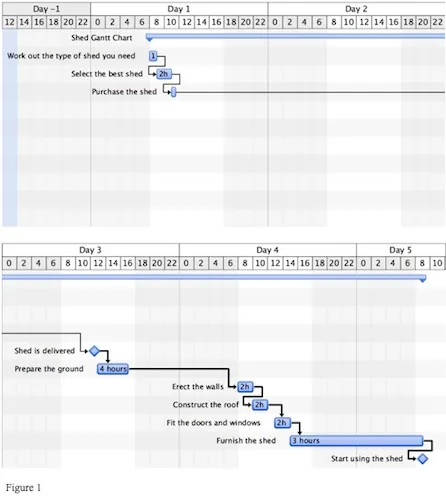
Earlier when we looked at tasks and milestones we looked at the example of building a shed. Let’s use the same example to make a simple programme. We can start by estimating the duration for each activity:

  • Work out what type and size of shed you need and where it will go. We will need to go out and do some measuring so let’s assume 1 hour.
  • Select the best shed to suit your purpose. This might require some time researching on the internet so let’s give ourselves 2 hours.
  • Purchase the shed. I am planning to do this online, so once I have decided on the right shed, it should only take me only a few minutes.  It is a good idea to always give ourselves 30 minutes, even for a simple task, so I am going to assign a half-hour here.
  • The shed is delivered. This is a milestone so I will not give it a duration. But, there is likely to be a time lag between purchasing and delivery and I will assume it will be 48 hours between payment and receiving the goods.
  • Prepare the ground. I will need to level the ground and my garden is on a slope so this is likely to take some time. I will initially give myself 4 hours. This could take longer, especially if foundations are required. So I might have to re-calculate this after inspecting the ground and the shed I have chosen.
  • Erect the walls. I am going to allow myself 2 hours for this task. This job will probably require the help of another person. I will have to ask someone to help soon to prevent my project from being delayed.
  • Construct the roof and make it waterproof. Again I will estimate around 2 hours for this.
  • Fit the door and windows. This could be a fiddly job so once again I am going to give myself 2 hours here
  • Furnish the shed ready for use. This will likely require popping to the shops again so I am going to give myself 3 hours for this.
  • Start using the shed. This is a milestone so I won’t give it a duration.

Now we can create a pictorial representation of the programme. This is known as a Gantt Chart (named after Henry Gantt, the man who developed the idea). Putting all the activities into the correct order, I have created a Gantt Chart. You can see the first version in Figure 1:

You will notice that as I start to fit the tasks into normal working hours, some activities roll forward. Now they take place over several days. I can now see that I won’t be able to start using the shed until the 5th day.

Leadership Development: Master the Top Leadership and Life Skills

Better lead in life and work to maximise your success. Sign up and access materials for free!

Prioritising

“Time is free, but it’s priceless. You can’t own it, but you can use it. You can’t keep it, but you can spend it. Once you’ve lost it you can never get it back.” Harvey MacKay

Time is limited so therefore within the plan we need to prioritise.  There is never enough time to do everything. Therefore, we need to be able to decide which things to forgo.  Our values point us towards our priorities and that helps us make the right decisions, especially when under pressure.

We have to know the tasks that are vital to success but this is not always straightforward to ascertain.  Therefore, we may need to go through a process of elimination until we can perceive the essential elements.

Which things can be done concurrently?  Which tasks could you delay or rearrange? What could you delegate or even dispense with altogether?  By asking these sorts of questions you get down to the bare bones of what are the vital actions.  You may well find that you can refine your programme after asking these questions.

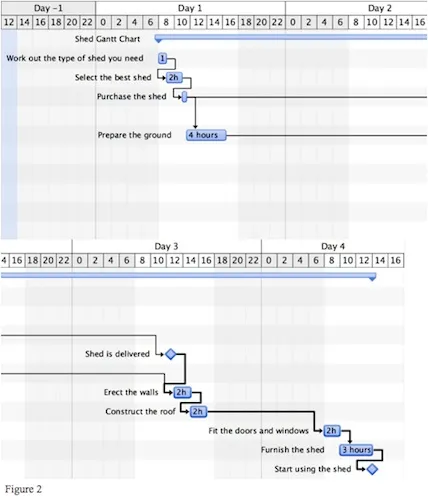
For example, looking at our shed project again I can see that I don’t need to wait for the shed to arrive in order to prepare the ground. I can save myself some time by starting this task while I am waiting for the shed to be delivered as you can see in Figure 2:

You can see that by getting on with the groundwork concurrently I have reduced the total duration of the project by a day. Therefore, I will now be able to start using the shed on day 4.

Cash Flow and Budgeting

After adding the duration to the tasks the next thing to do is to add the resources needed for each activity.  This is the next layer of the programme and can be added to your table or spreadsheet.

In this way, we can establish not just the cost of any task but also the yearly, monthly, weekly or daily cost of a goal or activity.  In other words, we create a cash flow forecast or budget.

After doing all this you should be able to link the dream you have right through to the very next step you need to take.  Hopefully, you will also know exactly how long it will take and how much it will cost.  You can now put that step in your diary and you are on your way!

Project Management Programming Software

The Gantt Charts for this post was created using Merlin Project Management Software. Merlin 2 is the best project management programming software that I have used for the Mac and if you want to find out more or try a demo then click here.

Merlin is very similar to Microsoft Project, the main software I have used on PC. This is something of the industry standard for project management software, although perhaps not the best.

If you want the right answers you have to start with the right questions

About The Right Questions

The Right Questions is for people who want to lead better, whether you are taking your first step or stepping up in leadership. We are all leaders (whether we know it or not) as we all have influence. So the question is, what are you doing with your influence?

Wherever you are on your leadership journey, I hope that you find resources on this site to help you on the next leg of your quest. Even if that is just the inspiration to take one small step in the right direction, then that is a success. If you can take pleasure in learning and travelling as you go, then so much the better.

Need help navigating your journey to success?

I love to serve people, helping them unlock their values, develop their leadership, and achieve their goals, through coaching, facilitation and courses. Please get in touch and let me know how I can support you.

Risky business: How to Assess and Manage Risk

We do not always think in terms of risk but there is risk in every decision we make. The risk is always balanced against the opportunity to some degree or another. Risk assessment, risk management and risk strategies are processes we can add to our decision-making process. We need some way to consider and manage risk. This is because our decisions and planning are continually influenced by our attitude to risk.

“Great deeds are usually wrought at great risks.”  Herodotus

High anxiety

One summer I was mountaineering in the French Alps with a group of friends.  We had just spent a few days bagging some routes when someone had the idea of tackling a nearby climb. It was not one we originally planned to do as it was a higher grade than we were generally comfortable with.

That season there had been very little snow and the ridges were more exposed and icy than usual. So, as this route was following a ridge, I argued that it would be in bad condition. It was likely to be even harder than the guidebook suggested.  The weather was also set to change for the worse, so as far as I could see, the risks outweighed the opportunity.

I thought my logic was sound but the person who had proposed the climb was very persuasive. He managed to get the other two members of the group to agree with him. They wanted to give the climb a go.  It was three against one, and I knew they needed four people to attempt the route. Therefore the pressure was on for me to accept the majority decision. But I genuinely believed it was not a safe option. It was a tough conversation. I then made myself very unpopular when I refused to do the climb. It was a stand-off. They needed a fourth climber and therefore all we could do as a group was head back down the valley.

A good call

Fortunately for them, the other three found another willing climber. I meanwhile, by now feeling somewhat sheepish, decided to go trekking for a couple of days. As I was on my own I decided to stay below the snow line and try and avoid the bad weather.

I spent most of the next few days feeling guilty about being stubborn but when I returned I found that my decision had been justified.  The weather had deteriorated and the route proved to be in poor condition, as I had predicted.  After a few hours of struggling in dangerous conditions, my old climbing partners were forced to make an emergency descent. The deteriorating weather meant they also had to make a hasty retreat back down the valley.

It turned out that they were the lucky ones; that weekend ten people lost their lives in the Mont Blanc area as high winds whipped people off icy ridges.

Leadership Development: Master the Top Leadership and Life Skills

Better lead in life and work to maximise your success. Sign up and access materials for free!

Risk affects our decision making

Life is full of decisions and intuitively we are assessing risks all the time, even if they are not as obvious as the ones in the previous example.  As we pursue our dreams we will be frequently faced with various options of ways to achieve our aims.  In order to navigate our course, we have to assess the factors, consider the risks, and make decisions as to the best way to go.  Sometimes to help answer the question ‘which way should I go?’ it is prudent to consider ‘which way shouldn’t I go?’ and this particular question is all about risk.

If a venture is suddenly deemed too risky, it is the surest thing that will stop us from acting; no matter how attractive the option first seemed. Therefore, risks need to be identified, assessed, mitigated and managed, so that we are in the best possible place to make our decisions.

Capacity for risk varies between people and situations so it is important to remember that this is an ongoing process of identification and management.  At the same time, we don’t want to become defensive, timid or risk-averse. Achieving bold visions means taking risks; we just need to make sure we have counted the cost before we commit ourselves.

When to consider risk

In The Right Questions Framework, we consider risk when we look at options. This comes under the Which question.

You don’t want to start a venture by looking at risk. If you do, the problems could easily become paralysed before you even start.  But, if you plan without considering the risk, you could quickly become disillusioned or make a serious mistake that could be hard to recover from.  Therefore it is at the point when one has a clear idea of what we need to achieve, and are considering different options to achieve that goal, that we look at risks.

“Take calculated risks.  That is quite different from being rash.”  General George S Patton

How to manage risk

Unnecessary risks can be avoided by careful planning and this process is part of your risk management process.  Your approach to risk – which risks you tolerate and those you treat – becomes your risk management strategy.

This exercise is a helpful aid to decision-making, but remember, that one should never make a decision out of fear.  Some risks will be big – you just need to know whether that danger is acceptable to achieve your aim.  Effective risk management helps us to achieve our mission, but with the risks considered and reduced as much as possible, not at the exclusion of risk entirely.  Remember, it is more important to do the right thing than the safe thing.

As you go into the process of identifying and evaluating the risks I recommend, that if you are part of a larger team, that you go through the following exercise first as an individual and then as a collective. This avoids group-think and other related biases.

Once you all have some ideas you are likely to find that as a team you will have a healthy (frequently robust) discussion about how to categorise risks. This is due to people’s different viewpoints; do not worry, this is a productive process. Diversity of thought will help you all evaluate risks more effectively and help you learn more about how the team thinks and operates. This inclusive process will also allow people to express any fears, find solutions and commit to the final plan.

Video of How to Simply Identify, Assess and Mitigate Risks Using an Easy Risk Management Process

Risk Management Process

Here is a simple risk process. If you follow this exercise you will be able to identify the key risks you face and create a basic risk management strategy:

  • Play devil’s advocate for a moment: give yourself 5 minutes to try and think of as many things as you can that could put a stop to your venture and list all these threats.
  • On a scale of 1 to 5 give each risk a score of how probable it is to occur (5 being the most likely).
  • Now do something similar, scoring 1 to 5 for the severity of the impact of each of the risks.  In this case, a ‘1’ might be a minor inconvenience whereas a ‘5’ would be a show-stopper.
  • For each risk multiply the probability score and the impact score so you get a score of 1-25 for each risk.  You can now rank all the risks in a table.
  • Start at the top with the biggest risks and think about how you can avoid, prevent, limit the damage or otherwise manage the risk.  This is called mitigation.  Write down the plan for each risk and after the mitigation measures have been applied score the risk again for likelihood and impact to see how it has improved and whether it is acceptable to you (and/or your team).
  • Now consider whether the opportunities outweigh the risks for the course of action you have chosen. If you are unsure, you can go back and look at the risks in more detail for another course of action that you generated previously.
  • Once you have identified the most important risks make someone responsible for the management of each risk. They do not carry all the risk (or blame if it goes wrong) but they do have responsibility for tracking the risk on behalf of the team.

Record and review your risks

There are lots of ways you can record the information you get from this process. Most businesses have spreadsheets to capture the key operational or project risks. Find what works for you but my advice is to keep it simple. If the document is too big and complicated people won’t read it.

The other thing is to keep it up to date. Make sure you review the risks on a regular basis. The situation changes; new risks emerge, other risks fade. Make sure you are tracking them.

But don’t get obsessed or paralysed by risk. After all, who dares wins!

If you want the right answers you have to start with the right questions

About The Right Questions

The Right Questions is for people who want to lead better, whether you are taking your first step or stepping up in leadership. We are all leaders (whether we know it or not) as we all have influence. So the question is, what are you doing with your influence?

Wherever you are on your leadership journey, I hope that you find resources on this site to help you on the next leg of your quest. Even if that is just the inspiration to take one small step in the right direction, then that is a success. If you can take pleasure in learning and travelling as you go, then so much the better.

Need help navigating your journey to success?

I love to serve people, helping them unlock their values, develop their leadership, and achieve their goals, through coaching, facilitation and courses. Please get in touch and let me know how I can support you.

How To Set Goals and Delegate the SMART Way

How should we delegate work effectively? What is a SMART or SMARTER task, and how can they help?

When we set ourselves a goal, we want to stick to it. Equally, as a leader or manager, you have to effectively delegate tasks in order for your team to perform well and to achieve your aim. Setting clear goals also helps to motivate teams and individuals because they understand what they need to do.

But this is simpler in theory than in practice. Often a leader’s’ experience is that – even when you think you have delegated something effectively – you still encounter problems. People may keep coming back and bugging you with questions, or alternatively the task is not done on time, or the job is not completed to the right standard.

To help avoid these issues we can use the acronym ‘SMART’ when delegating work. SMART stands for:

  • Specific,
  • Measurable,
  • Attainable,
  • Relevant and
  • Time-bound.

This method is accredited to George T. Doran (who first described a version of the acronym in the November 1981 edition of Management Review) and since then the method has evolved to encompass various adaptations of the acronym including having an E (for evaluate) and an extra R (for re-evaluate) to create ‘SMARTER’ goals.

Let’s look at each one in more detail.

Free Personal Leadership Action Plan

Just sign up here to receive your free copy

What a SMART or SMARTER task actually means

S – Specific

When you give someone a goal it needs to be specific. It needs to be clearly defined and unambiguous. Whether it is a large mission or a smaller task you need to express what success looks like.

Specific is the most useful word here but you could also substitute ‘significant’ or ‘stretching’ in here if you want to make a task more aspirational (such as a ‘BHAG’ – Big Hairy Audacious Goal – promoted by Jim Collins in Good to Great) or use it as a reminder to keep things ‘simple’ or ‘sustainable’.

M – Measurable

Next, the task needs to be measureable. In other words, it needs to be possible to track the progress of completion of the goal. If the task is a big one you might need to break it down into separate activities and set milestones to help monitor progress.

Having specified the goal and broken it down to measure it you have the fundamentals of a plan.

A – Attainable

It is good for goals to stretch us but the ‘A’ here makes us ensure that the task is attainable. We can be bold but the task needs to be achievable. A task can stretch a person or a team (this is healthy) but if you are asking the impossible of someone, it will quickly become de-motivational. As a leader, you set goals to help people grow, not to set them up for failure.

Therefore by asking this question we also consider whether the person in question is properly equipped and supported to achieve the task. If it is our goal then we need to reflect upon our readiness. As a manager, we should be checking that whoever we delegate to has the right training and resources to complete their work.

R – Relevant

The task needs to be relevant to the vision of the team or organisation. Ask yourself, does this piece of work take you a step closer to achieving your overall mission? It is in line with your values? If not you may need to redefine the task.

The work also needs to be relevant to the person you are delegating to. Are they the best person for the job? Is it part of their role and job description? Do they have the relevant skills and experience? Will they be developed by this task?

T – Time Dependent

Having to create a timeline makes you properly assess how long a piece of work should take. Considering time also makes you evaluate your priorities and any dependencies that one task may have upon another.

Deadlines also help to keep people accountable for finishing and stop a piece of work dragging on endlessly. The time element, as with everything else, should be set in agreement with the person you are delegating to so that you all ‘contract in’ to the parameters for the work.

E – Evaluate

Adding in the ‘E’ of ‘Evaluate’ is useful as it brings in the discipline of reviewing how well work has been done. It gives the opportunity for feedback; praise, constructive criticism and learning on behalf of the manager and worker.

For a larger goal you might want to consider these evaluation steps and plan them in along with your overall deadline. Make evaluation time dependent too.

R – Re-evaluate

Decision making and learning happen in a cycle. We recognise this by adding the re-evaluation step here. Re-evaluation is a continuation of the learning from the ‘Evaluate’ phase. Once you have identified lessons at the evaluation phase these should be incorporated in the next stage of the activity. This gives the opportunity to learn and improve as the task progresses.

For example, the first time around the deadline might not have been achieved or the person may have needed more support to achieve the goal. Once the task has been re-set and re-started then the results can be re-evaluated to identify improvement.

How to set SMART goals video – YouTube

Set SMART goals and SMARTER tasks

Setting SMART goals helps us ensure that goals are actually achieved. It helps take the goal from an idea to a plan that we have committed to.

Equally the SMARTER approach provides a useful checklist and process by which both a manager and employee can agree upon the parameters for a task and be accountable for its outcome. Setting SMARTER tasks helps to build in the reviewing and learning from goals that if often forgotten or neglected.

So what is your next goal or task? Apply the SMART or model and make sure it happens!

Leadership Development: Master the Top Leadership and Life Skills

Better lead in life and work to maximise your success. Sign up and access materials for free!

If you want the right answers you have to start with the right questions

About The Right Questions

The Right Questions is for people who want to lead better, whether you are taking your first step or stepping up in leadership. We are all leaders (whether we know it or not) as we all have influence. So the question is, what are you doing with your influence?

Wherever you are on your leadership journey, I hope that you find resources on this site to help you on the next leg of your quest. Even if that is just the inspiration to take one small step in the right direction, then that is a success. If you can take pleasure in learning and travelling as you go, then so much the better.

Need help navigating your journey to success?

I love to serve people, helping them unlock their values, develop their leadership, and achieve their goals, through coaching, facilitation and courses. Please get in touch and let me know how I can support you.