Analysing Values and How to Re-find Happiness

I am healthy, I live in a great home, in a wonderful city. I have a loving family, wife, kids, and a diverse group of friends. My work is challenging and job fulfilling. But I get unhappy. Due to how fortunate I am that makes me feel guilty and in turn, more unhappy. After all, what right do I have to be unhappy?

As I am in my forties it is easy to classify this as a mid-life crisis but that does not solve the fundamental question; why am I unhappy and what can be done about it?

Happiness is not just Maslow’s hierarchy

An observer would say that, in my case, unhappiness is not logical. In terms of Maslow’s hierarchy, the levels are ticked off, at least on first inspection. My basic physiological, security and social needs are met. I have pretty good self-esteem and the respect of others. I acquire self-actualisation through my employment, pursuits, and personal development.

So why do I get unhappy?

I am not suffering from medical depression but – as we are increasingly aware – mental health is nuanced. Malaise and malcontent may not require medication, but they are still challenges. They affect our relationships and performance as well as our joy. Therefore, these feelings need to be understood, managed and treated in their own way.

And I am not alone. It is not just my work as a coach that gives me an insight into the number of people who find themselves unhappy. And it is not just people having a mid-life crisis, it is people of all ages. COVID-19 may be the pandemic, but unhappiness is endemic.

Free Personal Leadership Action Plan

Just sign up here to receive your free copy

The equation of happiness?

The issue of happiness, or rather the lack of it, is developing a growing academic interest. Researchers seek to quantify and qualify what is it to be happy. Rakesh Sarin and Manel Baucells, relative pioneers in this field, proposed various laws of happiness in their book Engineering Happiness. The laws can effectively be summarised in the following equation:

Happiness = Reality – Shifting Expectations

This is useful, at least to a degree, as a large part of unhappiness – particularly for those in seemingly good situations – is based on unhelpful comparisons. The selectively manicured view of life on social media does nothing to help this. The fact is life can always be better, things (and people) are not perfect. But, as per the equation, we often feel the imbalance, notice the lack or get lost in the gap.

So how do we solve the problem? Does this mean that we should just have low expectations? This might be the response of cynics or ascetics. And simplifying life or managing expectations can help. But this is also not always easy nor is it necessarily the full answer to the problem. We need to understand why we have certain expectations in the first place. That is because our expectations are based on what we value.

Therefore, unhappiness can be seen as a misalignment in our values. When forced to spend our time beyond our priorities, when actions grate against our principles or when reality challenges our beliefs, we feel that imbalance. It makes us unhappy.

Creeping discontent

Sometimes this unhappiness can take us by surprise. Suddenly we are overwhelmed by the compounding of small, misaligned decisions, the incremental build-up of compromise.

When this happens to me it feels like I have been out walking in a fog. After marching on a bearing in the mist for a long time, my head pops out of the cloud, and I find that I was not where I was expecting to be. Suddenly I am faced with lots of questions. How did I get off track? What should I do now?

At times like these, the first thing I do is to re-examine my personal values. They are my moral compass. They give me direction. Therefore, I need to know whether I can trust these principles. If the precepts are still good, then I want to know, what went wrong in the process of applying them?

Leadership Development: Master the Top Leadership and Life Skills

Better lead in life and work to maximise your success. Sign up and access materials for free!

Examining my personal values

When coaching and exploring personal values, many people come up with work, family, and leisure as values. But I would call these priorities, and in that sense, they are subtly different. What we prioritise can be seen in where we use our resources, such as time and money. Our values reveal how we behave and perform in these priority areas.

So, for example, I may give a lot of time to my work – making it a priority – but the nature of the work I choose and how I perform in my employment is an expression of my values. To explain this more we will look at my personal core values.

The way I have expressed my core values has changed over time but the top three are being adventurous, serving to lead and being mission-focused. In my recent bout of unhappiness – aka mid-life crisis – examining each, in turn, helped reveal causes of discontentment. In turn, this knowledge gave me the starting point to change things for the better.

Trying to live a life of adventure 

I have always dreamed of and sought adventure. Growing up I wanted to be Indiana Jones. Explorers like Ernest Shackleton are my heroes. I am a fellow of the Royal Geographical Society. I have scaled unclimbed peaks in the arctic and searched for archaeological remains in the jungles of Central America. One of the things that led me to a career in the military for a desire for adventure, which I certainly experienced on my various operational tours.

My love of adventure influences my relationships. My best friends share a love of adventure and family holidays become mini expeditions in themselves. Even when not in the wilderness I try to bring an adventurous outlook to what I do.

Sounds good right? But the fact is that now many of my responsibilities restrict opportunities for adventure. In the interests of creating a stable home life or maintaining a good level of income, adventure can be slowly stifled. The safety and stability of a good home in a safe neighbourhood can feel like a gilded cage. A cage of my own making. So, I must ask myself, how did I box myself in?

Servant leadership and the challenges of putting others first

One of the reasons is related to another value, that of serving to lead. Servant leadership puts the greater purpose and the development of others before self. Servant leadership has always been the most influential leadership model for me. It was exemplified by my father, exhorted at church when growing up, and expected of Army Officers graduating from The Royal Military Academy Sandhurst.

As well as shaping my military career this approach also led me into coaching. Coaching is about helping others to flourish and fulfil their potential. Effective coaching is a form of servant leadership.

And servant leadership is not just about professional titles. Being a parent is about as challenging as leadership gets. There is no other leadership role where I have so constantly felt so out of depth or so frequently failing in some way! In this context, servant leadership has been putting the needs of the family and the development of children ahead of other things.

So, serving can mean less adventure, and so, as a matter of circumstance, values come under tension, pulled in different directions. This stress can cause unhappiness. When this happens resentment or resignment can set in. In these circumstances, parenthood can become just another duty, work a necessary evil, marriage a transactional partnership. The underlying passion and the purpose – the reason for serving – can get lost.

Mission focus to loss of purpose

A sense of purpose is important to most people, but I am particularly wired to go after a vision, define a mission, to set and achieve goals. I like to set targets and achieve them. I enjoy working on projects – such as expeditions and operations – that have defined start and end states.

When committed to achieving an aim it brings out other characteristics. I can be very energised, determined, and focused. On the other hand, without a clear goal, I can become restless, morose, or even lazy.

The middle stage of life is often characterised by routine and process rather than big achievements or bold challenges. Sometimes the problem is even related to having achieved so much. Writer Tal Ben-Shahar, in his book Happier, calls this the arrival fallacy. As with the happiness equation, the arrival fallacy exists because our expectations of achieving something generally outstrip the reality of completing or even just striving for a goal. Even becoming the world’s best does not help, that is why there is a recognised disorder called post-Olympic depression.

So, what happens when you have achieved your goals, or you find you have lost your drive? It is easy to lose a feeling of purpose when every day seems the same. When progress is so incremental our dreams, beliefs, even our identity can come into question. At times like these, one needs some focused self-refection.

Unhappy? Start with proper self-diagnosis

Unhappy? Mid-life crisis? Not content with life? You are not alone. There is no common circumstance that causes unhappiness but there are some key insights to help diagnose the root causes. In all cases, diagnosis proceeds proper treatment. Self-inquiry comes before self-improvement. Thinking before doing.

First, we need to examine our expectations. How do they differ from our reality? Identifying and quantifying the gap helps us understand the nature and scope of our dissatisfaction. Next, we need to identify how expectations have been shaped by our values. In this way, we can identify where the tensions and misalignments are. Only then will we have sufficient knowledge to address our challenges.

This has been my recent experience. Reflection and self-examination have given me data I need to start again. I now know where I am and how I got there. Next, I can plan where I want to go next and how I am going to get there. And even just that knowledge makes me happier. Maybe the challenge can become an adventure!

If you want the right answers you have to start with the right questions

About The Right Questions

The Right Questions is for people who want to lead better, whether you are taking your first step or stepping up in leadership. We are all leaders (whether we know it or not) as we all have influence. So the question is, what are you doing with your influence?

Wherever you are on your leadership journey, I hope that you find resources on this site to help you on the next leg of your quest. Even if that is just the inspiration to take one small step in the right direction, then that is a success. If you can take pleasure in learning and travelling as you go, then so much the better.

Need help navigating your journey to success?

I love to serve people, helping them unlock their values, develop their leadership, and achieve their goals, through coaching, facilitation and courses. Please get in touch and let me know how I can support you.

To Achieve Your Aim, You Need to Know and Apply Your Principles

I watched the target intently. I could see the picture rise and fall in my sights as I breathed, the crosshairs tracking a vertical line as my lungs expanded and contracted. Having positioned myself carefully, I aligned my body so that I naturally achieved my point of aim. My rifle was held securely, nicely balanced, but without any tension in my muscles. Feeling calm and focused, I let the crosshairs sink once again, then held my breath as they came to rest on the centre of the target. I increased the pressure on the trigger, never letting the crosshairs move from their position. There was a jolt, as the shot released, but the rifle settled back into position, aligned to the midpoint of the target. I was hundreds of metres away, but I knew that I had hit it dead centre. I knew because I had applied my marksmanship principles, and everything had been in balance. It felt right.

Understanding and applying principles

Target shooting can be very satisfying but, as I found out in my military training, that does not mean that it is easy. That is because even though the principles of shooting are simple, maintaining those standards takes focus and practice. In that way, shooting is a metaphor for other areas of life. Even when we know the theory of how to do something the practice can be hard.

It is particularly hard if we do not know the fundamentals in the first place. Without understanding the key principles of shooting I might never have become a good marksman, no matter how much I tried. As Anders Ericsson and Robert Pool point out in their book Peak, there is an important difference between practice and effective practice. If we want to get better, we need to focus on doing things correctly, according to the appropriate standards.

So, what are the right standards? How do we know the principles to live by? This is the focus of this series on understanding values. The more I teach decision-making, facilitate leadership courses, or coach people through life’s challenges, the more I see the importance of understanding and acting upon our personal values.

Free Personal Leadership Action Plan

Just sign up here to receive your free copy

The need for balance and alignment

Much of the importance of values comes down to balance. There are so many reasons that we need balance in life. Whichever aspect of our existence you look at – such as work, relationships, or health – it is a lack of balance that causes problems.

We need alignment in each area of our lives in order to flourish. To lead we need integrity; a boss needs to walk the talk if they are to be truly effective. To make effective decisions we need to make sure our choices fit our values. It is similar to our wellbeing; to be happy our expectations cannot be too far removed from reality. Our self-esteem is also dependent upon balance. We need to behave in line with our principles and live up to our standards. This is why it is so important to know our values and understand how to monitor them.

Just as your car runs more smoothly and requires less energy to go faster and farther when the wheels are in perfect alignment, you perform better when your thoughts, feelings, emotions, goals, and values are in balance.

Brian Tracy

How to work out your values and monitor your principles

I regularly take time out to re-examine my values and reflect on them to make sure they are captured accurately and to measure how I am doing against my principles. I also tend to look at my principles first before I go about setting goals. As with target shooting, you must point in the right general direction before you home in on a specific target.

It may be that you already have a clear idea of your values, or it could be that you have never really considered your personal principles. Either way, here is a good exercise to go through to identify, refine and test your ideals. Here are the steps to follow:

1. Identify a long list of values

2. Prioritise the list

3. Assess your principles against your actions

Leadership Development: Master the Top Leadership and Life Skills

Better lead in life and work to maximise your success. Sign up and access materials for free!


1. Identify a long list of values 

First, write out a long list of words that sum up your personal values. There is no limit on how many phrases to use at this stage. It is worth doing some brainstorming and thinking about the words that best sum up your principles. The choice of words is important as our interpretation of language is nuanced and personal. The terms you choose must connect with you and express both your head and your heart.

Remember, as noted in my earlier post on why what we value matters,

  • Values are principles. They are ideals, truths, or propositions that we aspire to.
  • Values are standards. They are the formal and informal precepts, regulations, and rules we live by.
  • Values are judgements. They are the benchmark, the plumbline, the compass that informs our decision-making.
  • Values are beliefs. They are the tenets, convictions, and ideas we put our faith in.
  • Values are priorities. They are our motivations, the things that take precedence, that we give importance to and affect how we use our resources.

Once you have a list, or if you are struggling to think of the right words, then you can use example inventories of popular principles as a prompt. You can find such examples in What Are Your Personal Values where I have listed over 150 common values.

2. Prioritise the list 

Once you have a comprehensive list of values the next thing to do is to prioritise the list. Initially whittle it down to ten, then aim for five or fewer. The reason to do this is to identify the most important principles, the ones that dominate your decisions and behaviours. To do this you may want to take your initial list and score each value out of ten. If you still need to reduce the list then do direct comparisons between the words you have chosen, ask yourself, if I had to choose between x and y which would be the most important?

Once you have your top five values then take some time to write out what they mean to you. As mentioned earlier, the exact meaning of a term can be very individual so write out a short sentence to define what that standard means in terms of informing your actions and decisions. This is very important. The value does not exist as just a conceptual ideal, it must be understood in relation to your thinking and behaviour.

3. Assess your principles against your actions  

The next step is then to assess each of your top principles against your actions. Here you need to be brutally honest with yourself. Reflect on your day, your week, your month and give yourself a score from 0-10 in terms of how close you lived up to your standards. Also, reflect on other big life moments and decisions, or when you were particularly happy or sad, how did you align with your values at those key times?

Examining the gap between the values we espouse, and our actual behaviour can be very revealing. Here are some common things to look for:

Continual misalignment

If there is a continual misalignment then we must ask ourselves if we really hold to that principle. It might be that we think we value something because it is a standard upheld by our culture, family, or organisation. It may well be a good precept, but it may not drive us personally. If that is the case, you might want to go back to the prioritisation exercise and see if there are other values that better describe your actual choices.

Temporary misalignment

Often, we find that we have strayed from our principles in a particular choice or fallen short of our principles in a given situation. This is not a long-term trend, more of a temporary blip. These can leave us feeling unhappy or anxious until we resolve the issue. Once you have identified the instance where there was a problem you can reflect on what you need to do to bring things back on track. Is there a decision that needs to be changed, a relationship that needs to be mended, or a goal that needs to be set? Whatever it is, work out what action will restore your balance.


Apply your principles and maintain your aim

If you want to achieve your aim it is not enough just to know what your target is. You are unlikely to hit the target if you are facing the wrong way. Therefore, you need to know your guiding principles if you truly want to succeed.

Whether you want to achieve a goal, get a better balance in life, develop as a good leader, or improve your decision-making, all these things are dependent upon understanding your personal values. The better you understand your own standards, the happier and more effective you will be.

So, take some time to:

  1. Identify a long list of values
  2. Prioritise the list
  3. Assess your principles against your actions

Seeing how close you align with your principles is foundational to creating a meaningful plan for any self-improvement. So, check your values today but then frequently take time to see how you are measuring up to your standards.

Apply your principles, maintain your aim, and you will hit the target!

If you want the right answers you have to start with the right questions

About The Right Questions

The Right Questions is for people who want to lead better, whether you are taking your first step or stepping up in leadership. We are all leaders (whether we know it or not) as we all have influence. So the question is, what are you doing with your influence?

Wherever you are on your leadership journey, I hope that you find resources on this site to help you on the next leg of your quest. Even if that is just the inspiration to take one small step in the right direction, then that is a success. If you can take pleasure in learning and travelling as you go, then so much the better.

Need help navigating your journey to success?

I love to serve people, helping them unlock their values, develop their leadership, and achieve their goals, through coaching, facilitation and courses. Please get in touch and let me know how I can support you.

What are Eulogy Virtues and Why are They Important?

A few months ago, a very good friend of mine died. It was sudden and unexpected. He was in his thirties. He was very fit (he had recently completed a marathon amongst other things) and seemed healthy. But he died in his sleep. The post-mortem was inconclusive as to his cause of death.

Unsurprisingly, his family, friends, and colleagues – like myself – were devasted. This was a combination of the shock – the fact he was young and healthy – and that he was so universally liked. This last point truly came home at his funeral. There were so many people there, from different parts of his life, all wanting to say goodbye, but also to celebrate him. And that is what we did. We remembered and appreciated the positive impact he had had on all of us. The eulogies of his brother and best friend had us laughing through our tears.

It was also very sobering. It reminded me of my mortality and posed the question, how will I be remembered?

Too busy to think about?

It seems like a morbid thing to do, to think about our own funeral, but it is an important thing to do. Thinking about the end of life changes our perspective. We can consider the demands of our busy daily lives in a different context. We can start to challenge our priorities and ask, why are we doing what we are doing?

“It is not enough to be busy. So are the ants. The question is: What are we busy about?”

Henry David Thoreau

Yes, we are all busy. But are your actions today working towards a greater purpose? People often talk about strategy, but what about our personal strategy? What is the long-term plan for our lives? What does success in life look like for us?

When our time is done, what will be our legacy? Who will miss us?

These are important questions. In fact, there might not be any questions more important than these. But how do we go about answering them?

Free Personal Leadership Action Plan

Just sign up here to receive your free copy

The problem with life plans

The challenge with life plans is that they never seem to go to plan! Circumstances have a way of knocking our best plans into the outfield. This has certainly been my experience. Just take my career as an example. At college, I had a general idea of what I did and did not like, but I could never have predicted the journey that my career has taken. Often doors have closed upon the route I have wanted to take, only to reveal an unexpected opening. Looking back, the result has often been far better than the one I could have planned or hoped for.

But my choices have not all been random. I have not been a rudderless yacht driven before the storm. Sailing is a good metaphor to consider. When sailing you have a destination in mind, but you must adjust your route according to the changing weather conditions. Fluctuations in the wind mean you have to constantly adjust your sails and you rarely get to sail directly towards where you want to go. You must tack back and forth, keeping an eye on your bearing, but also making small adjustments, so the waves don’t capsize you.

When sailing, one must watch the compass, while the hand is on the tiller. So in life, we need to consider our values as we make decisions. Our personal principles are our moral compass. They inform everything from the little adjustments to the big direction changes.

So have a plan or at least an idea of your destination. That is a good thing. But do not try to steer your life without a good idea of your values as well. Otherwise, you will find it hard to adjust to changing circumstances.

Leadership Development: Master the Top Leadership and Life Skills

Better lead in life and work to maximise your success. Sign up and access materials for free!

What is the difference between résumé virtues and eulogy virtues?

When looking at values, particularly from an end-of-life perspective, there can be a difference in our priorities. We love to portray a certain image in our daily interactions, on our résumé or CV, or social media. We feel the pressure to convey the busy, successful, manicured beauty of life the world seems to demand.

But is that the life we truly want? Are they the people we really want to be? Do we want to be remembered for being busy? For our job title? For our holiday pictures?

David Brooks, author of The Road to Character, best summed up this dichotomy in his New York Times article, The Moral Bucket List, where he defined the difference between résumé virtues and eulogy virtues.

We live in a culture that centres on self. Self-image, self-fulfilment, self-determination. But the shift with eulogy virtues is away from selfish desires, work accomplishments, external recognition, and the accumulation of stuff. Eulogy virtues tend towards selflessness, and towards life accomplishment, internal peace, and the building of a legacy.

Eulogy virtues force us to acknowledge our weaknesses and failures. They help us move from desiring independence from others to recognising our need for inter-dependence with others. We shift our motivations from success to love, from career to calling, from competence to character.

As David Brooks notes, eulogy virtues even challenge the fundamental questions of life. It goes from “what do I want from life?” To “what does life ask of me?”

“Commencement speakers are always telling young people to follow their passions. Be true to yourself. This is a vision of life that begins with self and ends with self. But people on the road to inner light do not find their vocations by asking, what do I want from life? They ask, what is life asking of me? How can I match my intrinsic talent with one of the world’s deep needs?”

David Brooks

How to work out your eulogy virtues

Having had experience taking people through this process, as a coach, I can recommend that you try and write out your own eulogy. This might feel uncomfortable at first, but, if you go with the process, it can be very insightful.

As you write, remember that this is not an obituary written by somebody that does not know you. It is not the article in the paper for the eyes of the world, it is a eulogy, shared from the perspective of someone who loves you, to the key people of your life, gathered at your funeral. The person in mind should be someone who knows you well enough to call out your weaknesses as well as your strengths. To highlight how you dealt with your failures as well as your successes. Who can talk about your character and how you did things; not just your skills and what you did.

To do this I recommend the following steps:

  • Set aside time – give yourself at least an hour of uninterrupted time
  • Find a quiet place – select an environment to help you, most importantly somewhere you will not be disturbed.
  • Engage your emotions as well as your mind – imagine what it would be like at your funeral and use your empathy to see yourself from another’s perspective
  • Write – capture your thoughts as they come. It does not necessarily need to be coherent as a first draft
  • Reflect – once you have run out of words think about what you have written. What are the underlying virtues that define your life? Which values best encompass the themes of your story?

You might want to compare this with other ways of exploring your values. If you want some examples of other exercises then you can find them in the article: What Are Your Personal Values?

Better than an action plan

By identifying your eulogy virtues, you create your own moral bucket list. This is a bucket list beyond just personal achievements. Life goals are great, but more important are the values we live by, the things that define why we do things and how we behave as we pursue our goals, whether we achieve them or not.

So, take time to reflect on your eulogy values. How do you want to be remembered? Identify and hold onto those virtues. Keep them in mind as you dive back into the busyness of your day. They will guide you through the winds and the waves, the calms, and the storms.

If you want the right answers you have to start with the right questions

About The Right Questions

The Right Questions is for people who want to lead better, whether you are taking your first step or stepping up in leadership. We are all leaders (whether we know it or not) as we all have influence. So the question is, what are you doing with your influence?

Wherever you are on your leadership journey, I hope that you find resources on this site to help you on the next leg of your quest. Even if that is just the inspiration to take one small step in the right direction, then that is a success. If you can take pleasure in learning and travelling as you go, then so much the better.

Need help navigating your journey to success?

I love to serve people, helping them unlock their values, develop their leadership, and achieve their goals, through coaching, facilitation and courses. Please get in touch and let me know how I can support you.

How to Overcome Imposter Syndrome: Remember The Why

Imposter syndrome is a psychological condition but one that can be summed up very simply: it is about feeling a fraud. It is the fear that we cannot live up to other people’s expectations or that we do not deserve our position, accolades or the praise people give us. We are scared of being found out; our weaknesses and failures are laid bare.

Ironically it is high performing people with multiple accomplishments that most suffer from this mindset. This is not necessarily surprising. As Albert Einstein observed:

“The more I learn, the more I realize how much I don’t know.”

Albert Einstein

And there is more. Unless we are delusional, we all know we are imperfect, that we could be better. That is a fact. But it becomes a problem if we then assume that this knowledge makes us unworthy or unfit. It is this negative assumption that leads to imposter syndrome.

So, what do we do to re-set our brains? The critical shift comes in remembering that what we do or what we know is less important than why we do what we do. It is our values that define us, not our job title.

Personal identity and how it is affected by your values

Our values are pivotal to who we are; they go to the very core of us, to our personal identity.  Values are a foundation to our character and the plumb line of our standards, as well as being a moral compass. Our values drive who we are and what we do.

“We are not in control, principles control. We control our actions, but the consequences that flow from these actions are controlled by Principles.”  Stephen R. Covey

Our exploration and discovery of our principles is therefore a discovery of self.  As one anonymous observer noted:

“Every one of us has in him a continent of undiscovered character.  Blessed is he who acts the Columbus to his own soul.”

Free Personal Leadership Action Plan

Just sign up here to receive your free copy

What do we value in ourselves and others?

If we want to understand who we are and what we value it is worth starting with our perceptions of other people. Think about the first two questions you are generally asked when you meet someone.  It is likely to be “what is your name?” (usually meaning your first name) quickly followed by “what do you do?”

What are people really asking when they enquire about what you do?  They are asking about your job, profession, or vocation for sure.  But the fact that this comes out so quickly when we meet people indicates how highly we rate work in our culture and how closely we identify ourselves with what we do.

What do you do?

I went along with this for many years because, for a long time, it was easy.  I started out in the Army, working as a bomb disposal officer.  This was an easy title, and one I enjoyed using, as it sounded impressive.  I enjoyed seeing the raised eyebrows and the endearing look of respect (that I so little deserved in reality).

Next, I was a Project Manager, working in the construction industry.  Again, an easy label, although I must admit it sounded less impressive at parties than something with ‘bomb’ in the title.  But hey, I was married by then so who was I trying to impress anyway?  Well, everyone actually!

The real challenge came with my next job, working for a rapidly growing church.  My job description was constantly evolving and therefore it was hard to describe exactly what I did, especially as I was not actually a church minister.  I found that introducing myself generally required a long explanation.  The process of outlining what I did was just long enough to watch people’s eyes glaze over, stare down their drinks or look furtively towards the exit.

When I moved on again and started working as a management consultant it was not really any easier, as the title ‘consultant’ invokes so many different things.   You may be motivated by helping individuals and equipping organisations, but one has a lot of justification to do when people look at you with an expression that seems to imply ‘consultant’ is synonymous with ‘parasite’!

Training dolphins to be government assassins

And then, at one networking event, I had a moment of clarity.  I started introducing myself in this way: “Hi, I’m Simon, I train dolphins to be government assassins.”  Once again, I had attained the level of eyebrow movement that I have attained as a bomb disposal officer (but I guess more out of surprise than respect).

Life was easy once again (for a moment at least) but it did make me think. Why do people, including me, care so much about titles?  Why would I be prepared to embellish or even make up something about what I do? What does it say about me? The answers to these questions are pretty challenging.

Are we just what we do?

When people ask what you do, they are actually asking who you are.  They are hoping for an answer that will help them quickly categorise you. It is a simple heuristic – to judge someone by what they do – but it also reveals our cognitive biases.

As we walk down a street, enter a room, or sit staring out of a café window we are constantly assessing those around us.  We compare looks, wealth, car, house, job, children, clothes, phone.  Much of our happiness hangs upon these comparisons.

In conversation, this process continues through things like accent, vocabulary, demeanour, politics, religion, aspirations, and education. When people share their job, we jump to all sorts of conclusions. And herein lies another irony; by making these judgements we can also make other people suffer from imposter syndrome too!

I have been guilty of this. I remember back to when one good friend of mine, a talented musician and artist, told me they were going to become a lawyer. I was shocked. I could not link what I knew of my friend – this warm, creative, caring soul – with my (quite negative) perceptions of the legal profession. But when I heard about why he wanted to become a lawyer, how he wanted to help those in need, I started to get it. Now, many years later, he is a senior partner in a law firm. I can see how his creative approach to his work and his love for people brings healing to broken situations. I can see why he pursued that career.

Leadership Development: Master the Top Leadership and Life Skills

Better lead in life and work to maximise your success. Sign up and access materials for free!

We judge others but suffer from imposter syndrome too

As proven above, many of our initial assumptions can be wrong. We try to make a value judgement in a fleeting moment, judging the book by its cover.  Not surprisingly this process reveals more about us than about the other person because how we classify others speaks volumes about how we perceive ourselves.  If we are putting someone else in a certain box or on a certain level what does that say about our own self-worth or social position?  I for one did not think I had a pride problem until I thought about this!

And pride can take us even further. We all have roles that we play, and we often wear masks that represent an aspirational self. We build up a persona to hide our imposter syndrome.

We present the idealised version of self that we want to show to the world, rather than the real us.  If you think you are exempt from this, then just reflect upon how you present yourself on social media. Is it your whole self, or a carefully curated representation?

It is not what we do, but why we do it

So, if we want to overcome imposter syndrome we have to be brutally honest with ourselves. We need to ask, how do we want to be seen and why do we care? We can challenge how we see ourselves, as well as how other people perceive us, if we examine why we do what we do. Remember, the why is more important than the what. Think about your own work situation and role:

  • What passions and dreams led you to what you are doing now?
  • What do you love (and hate) most about what you do?
  • How does your job fit into your longer-term vision of success?
  • How does your work impact what you care about?
  • If you could do anything, what would that be?
  • What do you aspire to achieve through your vocation?
  • Where do you want to get to in your career and why?

Don’t shy away from the answers. We may not be in our dream job. That does not mean failure. Sometimes we just need money to support our family, but that reveals how we value those we love. Other times we are doing a role as a stepping-stone to something else. We are conscious of the role not being the endpoint.

But we need to ask these questions and examine our motivations. If we don’t we can forget why we were doing the job in the first place. I have coached people who have become successful in their field, promoted to high positions, but unhappy. When they stopped to ask questions like the ones above, they realised that their career was based upon other people’s expectations, not their own. Don’t fall into this trap; ask the questions now.

Re-thinking how we value ourselves and others

We are all at risk from imposter syndrome and assuming that we are not good enough. And there is some truth in that; that is why it is such a powerful belief. None of us is perfect. We can all be better. So, flip the negative side of imposter syndrome to a more positive one. This other side is about having a growth mindset, continually learning, being willing to fail but improving through experience. It is also about being humble. A humble character stops us from being full of pride and gives us greater respect and empathy for others.

If we want to shift our mindset, we need to shift our focus from what we do to why we are doing it. Our identity is tied to our vocation but it is not the job title that defines us: it is the reasons that motivate our work that is important. Our passions, principles and values say more about us than any job title.

And next time you meet someone, go ahead and ask them their name and what they do, but follow up with questions to find out some more. Get curious about why they do what they are doing. Get into a conversation about what people are passionate about; not just a competition over job titles.

If you want the right answers you have to start with the right questions

About The Right Questions

The Right Questions is for people who want to lead better, whether you are taking your first step or stepping up in leadership. We are all leaders (whether we know it or not) as we all have influence. So the question is, what are you doing with your influence?

Wherever you are on your leadership journey, I hope that you find resources on this site to help you on the next leg of your quest. Even if that is just the inspiration to take one small step in the right direction, then that is a success. If you can take pleasure in learning and travelling as you go, then so much the better.

Need help navigating your journey to success?

I love to serve people, helping them unlock their values, develop their leadership, and achieve their goals, through coaching, facilitation and courses. Please get in touch and let me know how I can support you.

How Does a Real Man Act and What do They Value?

If you, like me, grew up in a culture without a specific rite of passage that marks when you change from being a boy to a man, it can be quite hard to state exactly when you became a man and, by extension, what it means to be a man.

For me, no songs were sung, or words said. I was not cut or marked. I was not cast out or assigned a specific task or role. But at some point, I just was. A man.

So, what happened and when? Was it when I went through puberty or grew to be as strong as my dad? Perhaps when I got my first job, or perhaps when I left home? Was it when I could legally marry, drive, or drink? Maybe it was all these things or none?

Being a man: is it a right or a responsibility?

Human rights – men’s and women’s rights – are very important. The UN charter was a huge stride forward in addressing injustices in society. But it seems that generally, people must state and stand up for their rights when other people are not living up to their responsibilities; the responsibility that we all must respect, love and look after others, especially those less fortunate than us.

And that is why I like to focus on personal responsibility when thinking about identity. If we take responsibility, within our sphere of influence, we can ensure the people around us are treated right. And it is hard to separate the concept of responsibility from what it is to be a man. Being a man involves taking responsibility.

Responsibility means using our influence in the right way. And influence is leadership, so being a man also relates to being a leader. For clarity, I would apply the same logic to women as well. As boys become men and girls become women there is a change of expectation when it comes to responsibility. The responsibility of parenthood and the leadership required of both the father and mother is a great example of this step change in becoming an adult.

We all have influence – to a greater or lesser degree – and therefore we all have leadership potential and responsibility as men and women leaders to use that influence for good. But that differentiates childhood from adulthood more that specifically becoming a man. So, we ask again: what makes a real man?

Free Personal Leadership Action Plan

Just sign up here to receive your free copy

What makes a real man?

It is common to hear someone referred to as a ‘real man’. Which does beg the question, what does it mean to be a real man? It is also interesting that one is less likely to hear the phrase ‘real woman’! Perhaps gents – yes, I am speaking to all of you guys – this indicates an area where men have some real insecurities. There is some deep urge to be a real man.

So, what is a real man?

The idea of a real man is very dependent upon a given culture. The idealised man is visualised variously in different places and at different times. Even as I sit here typing I know that my idea of a man is very much dependent upon unconscious biases that I have developed from living in my setting.

But even this picture can vary considerably within a given country. Just imagine a picture of a real man in your country, but either in an urban or rural setting, and you will see what I mean. The ideas are often quite different.

It is important to remember that a lot of the things often associated with the idea of a real man are often cosmetic. For example, in some cultures, a real man wears a beard, in others, not. In some cultures, a real man is obese, in others, they are supposed to be buff. In other words, when people frequently talk about being a real man, they refer to present fashion or trends within a given culture.

But these superficial ideas often indicate a deeper principle. As with the iceberg model of culture, the behaviours we observe are rooted in beliefs and values that are hidden below the surface.

Being a net provider or contributor

There are some cultural similarities, beyond fashion, that point towards a common theme of manhood, and that is the idea of being a net provider. In other words, a person who contributes more to their family group than they take from it.

Even unhelpful stereotypes of the real man, pictured as a gnarly hunter or successful businessman, point towards this deeper personal value. For example, I know for me that being financially independent of my parents was an important aspect of feeling like a man. Today, being able to provide for my family and contribute to my community is a key to my masculine identity, for good or ill.

I say for good or ill as many men suffer crises when out of work or when they retire. They are not just made redundant, they feel redundant. There have been various studies that show that men, in particular, suffer more from mental health problems at retirement. This is generally linked to more traditional gender roles and men seeing themselves as the primary breadwinner for a family, whereas women place much more worth on their maternal roles. Put simply, guys are much more likely to have an action-orientated identity; they want to be doing something. Women generally place more worth in their relational links and therefore their identity is more shaped in that context.

This may change over time as traditional roles change but, at least for now, it is worth remembering. And we males should challenge ourselves with some questions. What is it that we like to do that brings real worth? How do the things we do contribute to our community? Are we making sure we connect with people, and really foster relationships, as well as just achieving tasks? What do we really value and what do we do that brings real value?

What are male values?

There are not any exclusively male values, but there are certainly some that are historically associated with men. When working out our personal values, understanding these expectations is important. Misunderstanding these cultural principles can lead to negative expressions or behaviours.

For example, the concept of being a man is often related to strength. This primarily stems from the physiological differences between men and women and that men are generally biologically wired to have greater physical strength than women. This is largely due to body size, as comparative studies have shown. There are hormonal differences too and the increased amounts of testosterone in men, compared to women, is a key factor, particularly through puberty.

Masculine values and behaviour

The idea of physical strength can be related to positive characteristics such as being a provider and protector. In modern Western society, the need for physical strength to achieve these positive outcomes (i.e., supporting and defending our people group) has reduced, but the association remains. And with it also come negative behaviours. The idea of strength is frequently misused through posturing, aggression, and violence. These behaviours most frequently manifest in society through men. For example, the UN 2019 study on homicide shows that men are both the major perpetrator, and victims, of murder.

In terms of linking positive behaviours and values, the poem If, by Rudyard Kipling is an evocative picture of how a man could embody the strength of character, and male-associated principles such as confidence, determination and honesty.

If you can keep your head when all about you

Are losing theirs and blaming it on you,

If you can trust yourself when all men doubt you,

But make allowance for their doubting too;

If you can wait and not be tired by waiting,

Or being lied about, don’t deal in lies,

Or being hated, don’t give way to hating,

And yet don’t look too good, nor talk too wise.

If – Rudyard Kipling

What does it mean to be a man today?

Due to the challenge of working out what it is to be a man, particularly in today’s culture, there are movements to help people think about what it is to be a man. Probably the most well-known of these is International Men’s Day (IMD), which falls on the 19th of November each year.

The idea of international men’s day is to “celebrate worldwide the positive value men bring to the world, their families and communities.” It does this through six core statements of purpose, the pillars of IMD.

The 6 Pillars of International Men’s Day (IMD)

The IMD objectives or 6 Pillars of International Men’s Day are:

  1. To promote positive male role models; not just movie stars and sportsmen but everyday, working-class men who are living decent, honest lives.
  2. To celebrate men’s positive contributions to society, community, family, marriage, childcare, and the environment.
  3. To focus on men’s health and well-being; social, emotional, physical, and spiritual.
  4. To highlight discrimination against men; in areas of social services, social attitudes and expectations, and law.
  5. To improve gender relations and promote gender equality.
  6. To create a safer, better world; where people can be safe and grow to reach their full potential.

In these statements what we don’t get is a definition of what a man needs to be. Instead, the provisions create an environment where men can work this out for themselves, in a positive way, with the support of others.

Helping men and boys

The theme for International Men’s Day in November 2022 is ‘helping men and boys’. So, for you guys out there, what can you do to help other men and boys? How can you contribute to your family, community, or team? And to you gals, how can you support the men you know in doing this? We, men, may pretend otherwise, but we need support and encouragement!

One thing I have done is to create some free online resources and courses, to help everyone (but especially guys) to develop their life and leadership skills. You can find out more details by following the link below.

Leadership Development: Master the Top Leadership and Life Skills

Better lead in life and work to maximise your success. Sign up and access materials for free!

So, what does it mean to be a man?

There are no easy answers. But we have seen that men like to take action, so as you think about what you might do for IMD, let me leave the last words to Kipling, as something to ponder, as you work out what it is to be a man and help boys as they learn to do the same.

If you can talk with crowds and keep your virtue,

Or walk with Kings—nor lose the common touch,

If neither foes nor loving friends can hurt you,

If all men count with you, but none too much;

If you can fill the unforgiving minute

With sixty seconds’ worth of distance run,

Yours is the Earth and everything that’s in it,

And—which is more—you’ll be a Man, my son!

If – Rudyard Kipling

If you want the right answers you have to start with the right questions

About The Right Questions

The Right Questions is for people who want to lead better, whether you are taking your first step or stepping up in leadership. We are all leaders (whether we know it or not) as we all have influence. So the question is, what are you doing with your influence?

Wherever you are on your leadership journey, I hope that you find resources on this site to help you on the next leg of your quest. Even if that is just the inspiration to take one small step in the right direction, then that is a success. If you can take pleasure in learning and travelling as you go, then so much the better.

Need help navigating your journey to success?

I love to serve people, helping them unlock their values, develop their leadership, and achieve their goals, through coaching, facilitation and courses. Please get in touch and let me know how I can support you.

How to Make Good (Ethical) Decisions

Making Good Decisions and Choices

When I was about ten years old, I decided to run away from home and ran (unexpectedly) into an ethical issue. I can’t remember exactly why I wanted to run away (as my life wasn’t exactly bad) but I do remember that I strolled out of the house carrying nothing but a penknife. I was obviously confident in my survival skills and overly trusting that warm weather would continue!

With my elementary school logic, I decided that a hole in the ground – in the woods not far from my house – was the obvious place to start my new life. As this den was also known to my friends it was not long before one stumbled across me as I cleared the twigs from my future bed space.

“What are you doing?” My friend asked me. “Making camp.” I replied, “I have run away from home so don’t tell anyone!”

My friend wandered off and I continued working. Then, about twenty minutes later my friend arrived back. Behind him stood my dad. I remember looking into my friend’s eyes, feeling betrayed but also knowing they had done the right thing. I was outraged and relieved all at the same time.

What are ethics and why are they important?

At that stage in life, I had no idea what ethics was, but I did intuitively know that my friend made a courageous moral decision that day. Ethics is simply that; it is making good or right choices. That includes big ethical dilemmas, such should we limit artificial intelligence or genetic engineering, right through to more everyday choices, such as whether you help yourself to extra stationery at the office for personal use at home.

Making good decisions is not easy. We might have an intuitive feel of what is right or wrong but sometimes the answer is not obvious. This is particularly the case when various values come under tension.

Taking my running away as an example, my friend had to balance the value of loyalty against that of care. Loyalty might have persuaded them to keep quiet as I had shared something in confidence, but out of care for me they knew the right thing was to tell my parents.

Therefore, sometimes values on their own are not sufficient. In these moments, where good values are in tension, we can employ a decision-making tool to help make the best ethical choice.

Free Personal Leadership Action Plan

Just sign up here to receive your free copy

How to make ethical decisions

One such technique has been developed by The Ethics Centre in Australia. The Ethics Centre is a not-for-profit organisation that promotes the use of ethics in everyday life and decision-making. They suggest a decision-making model based on considering values, principles, and purpose.

In this context (and using the wording of The Ethics Centre):

  • Values tell us what’s good – they’re the things we strive for, desire, and seek to protect.
  • Principles tell us what’s right – outlining how we may or may not achieve our values.
  • Purpose is your reason for being – it gives life to your values and principles.

Of course, to employ this methodology you must first know what your values, principles and purpose are, so let’s take some time to consider each in turn.

Values

Values are things we give worth, things we prioritise. The values (or virtues) we aspire to come in different forms, such as:

  • Personal values (the ones we prioritise as an individual)
  • Corporate values (the ones we hold in a community or organization such as a company’s values)
  • Universal values (ones that are held in common more globally such as the UN Charter of Human Rights)

Therefore, the starting point, when making a decision, is working out which values are the most important ones in the circumstance. If you have never properly identified your values, then I would recommend you discover your top 3 personal values.

Leadership Development: Master the Top Leadership and Life Skills

Better lead in life and work to maximise your success. Sign up and access materials for free!

Principles

Specific principles help us think about what is right or wrong and, in this way, they complement values. These principles are essentially algorithms for behaviour. For example, when working in the British Army and considering a course of action, the principles I was taught to apply can be summed up in the following question:

“Is this action lawful, appropriate, and professional?”

Many of our principles have a basis in religion. For example, one of the principles I (like many) try to live by is the Golden Rule. The Golden Rule is the idea of treating others as we would like to be treated and this precept is reflected in various spiritual traditions. For example, the Hindu Mahabharata states:

“One should never do something to others that one would regard as an injury to one’s own self.”

Mahābhārata 13.114.8

Or in the teachings of the Buddha:

“Hurt not others in ways that you yourself would find hurtful.”

Udanavarga 5:18

And similarly, Jesus of Nazareth said:

“Do to others what you want them to do to you.”

Matthew 7:12

So, as with values, there are some common themes, but it is also worth reflecting upon the specific principles you hold to. This can be done systematically if you take time to reflect on how you make decisions. This reflective process will start to reveal the underlying principles you use.

If you would like to explore more on identifying and developing principles, then I recommend reading Ray Dalio’s book Principles where you can see how this process can be done on both a personal and organisational level.

Purpose

Similarly, to values and principles, there can be overlapping ideas of purpose. These might be:

  • Individual purpose – your own sense of personal purpose
  • Professional purpose – the specific purpose we have in a given work role
  • Organisational purpose – the mission statement of a team or business your work for

To understand purpose and make it measurable it is advisable to create a clear and concise mission statement. A good purpose statement is a definition of success, within a given context.

For example, my own mission statement is:

 “To serve people by helping them unlock their leadership, in order to support them on their adventure.”

In this case, my personal purpose statement also encompasses my top three values of serviceleadership, and adventure (but this does not have to be the case). For example, Oprah Winfrey’s purpose statement is:

“To be a teacher. And to be known for inspiring my students to be more than they thought they could be.”

What I find useful about this (and good purpose statements in general) is they can give a measure of success against different time scales. Both the mission statements above can be used to consider achievement in a day, week, year, or lifetime. These statements also help to analyse whether decisions have worked towards the good and successful outcome of the stated purpose.

Factors that impact good decision-making and ethical choices

Even after identifying our values, principles, and purpose, or those specific to a given ethical problem, there are still factors that can impact making a good choice. Most of these factors relate to cognitive bias, the subconscious rules of thumb we use to help us make quick decisions.

To minimise the negative impacts of cognitive bias it is worth considering the following:

  • Education and training. Learn about decision-making and the different types of cognitive bias
  • Diversity of thought. Bring different perspectives to a team or decision
  • Build a culture that allows challenge. Create a culture around you where people are more likely to challenge or call out bad behaviour and decisions (even if that is just a good friend who will be brutally honest with you)

The three things to help you make good ethical decisions

Therefore, if you want to make ethical decisions you need to first know your values, principles, and purpose. Then, while allowing for cognitive bias, you can then balance these three elements against each other to make your choice.

This does not mean you will immediately come up with an answer. If you are new to exploring values, principles, and purpose then that will likely throw up challenges and questions to work through before you even get back to the ethical problem you are facing!

But don’t despair. The search for good outcomes and truth is a journey, not a single destination. It should inspire personal reflection, critical thinking, and the sort of discourse that Socrates would be proud of. And that quality thinking leads to good actions, and as Martin Luther King said:

“The time is always right, to do what is right.”

If you want the right answers you have to start with the right questions

About The Right Questions

The Right Questions is for people who want to lead better, whether you are taking your first step or stepping up in leadership. We are all leaders (whether we know it or not) as we all have influence. So the question is, what are you doing with your influence?

Wherever you are on your leadership journey, I hope that you find resources on this site to help you on the next leg of your quest. Even if that is just the inspiration to take one small step in the right direction, then that is a success. If you can take pleasure in learning and travelling as you go, then so much the better.

Need help navigating your journey to success?

I love to serve people, helping them unlock their values, develop their leadership, and achieve their goals, through coaching, facilitation and courses. Please get in touch and let me know how I can support you.

What are The Right Questions for Decision Making and Strategic Planning?

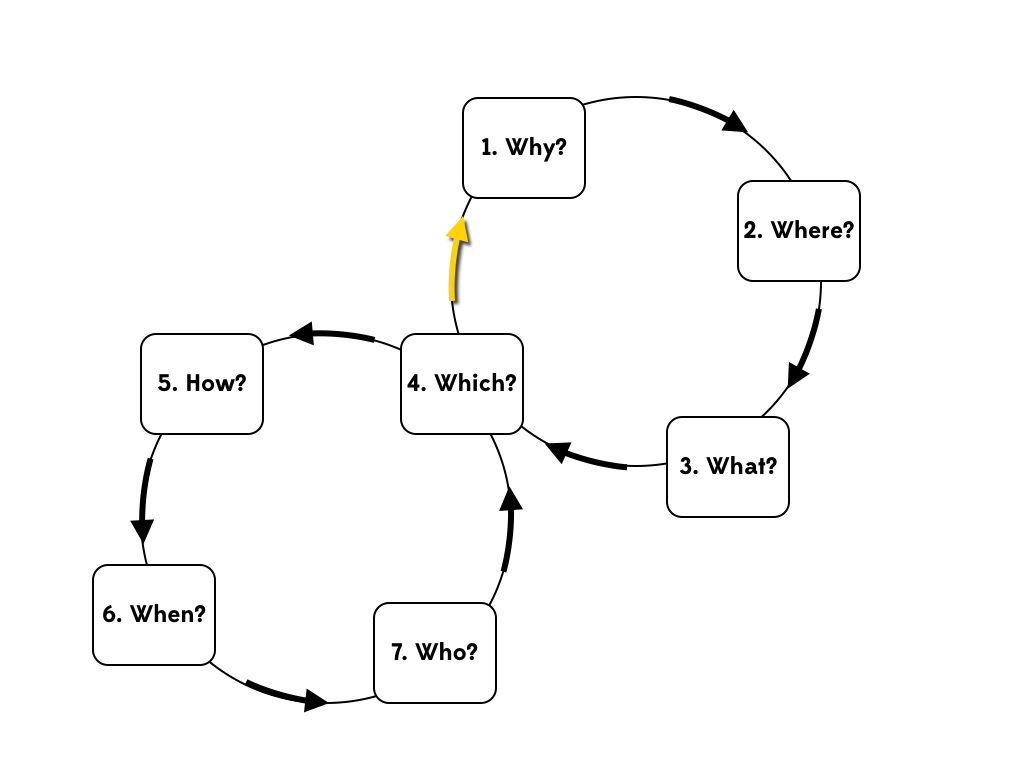
So, having established in previous posts the background to The Right Questions and an idea of their importance, we can now get an overview of The Right Questions and how they are applied to strategic planning and achieving goals, both in a personal or business context. The questions come in an order of sorts but the process of asking The Right Questions is also iterative and cyclical. In other words, the answer to one question is likely to inform an answer to another, and even after we have worked through all the questions we will generally go back and revisit the others to refine our answers.

How to Use The Right Questions Decision Making and Coaching Framework to Achieve Goals

It is beneficial to explore the questions in two broad groups. The first is comprised of the where, what and why, and these encompass the strategic framing of a situation. The second group is made up of the questions how, when, and who and these help us develop a specific plan within the aforementioned strategic frame.

The two groups are joined by ‘which’ as this question deals with the concepts of options and risk. After looking at the overall strategic picture we use ‘which’ to explore courses of action from which we can choose an option to develop into a more detailed plan. We then return to this same question to weigh the risks as the plan progresses. Looking at these options and risks are the key decision points and can lead us to return through the strategic framing or planning loops again.

Free Personal Leadership Action Plan

Just sign up here to receive your free copy

Taken all together these seven questions create a template for strategic planning and also become a decision-making process that follows a figure of eight cycle, as demonstrated in the diagram below.

“I keep six honest serving-men, (They taught me all I knew); Their names are What and Why and When, And How and Where and Who.” Rudyard Kipling

STRATEGIC FRAMING

Why? (Values and Priorities)

The ‘Why?’ represents our values. Our values are our identity; the things at our centre that define why we have the vision in the first place, why we do the things we do, why we attract certain people. They are our beliefs and worldview. These are often things we hold in common with others at one level but the particular combination and application of the values make them unique to us. Knowing our principles shows us what we value most and therefore it also helps us to prioritise and make good decisions.

Where? (Situation and Vision)

‘Where?’ is the present location and the future destination, the situation and the vision. We look at whence we have come from and whither are we going as our journey is bracketed by these ideas of ‘where’. When you get out a map the first thing you do is identify where you are and get your bearings; only once you have done this do you plan to move. And when you move, you don’t want to wander aimlessly (movement in itself is not progress), there needs to be a destination, something we are aiming for. This destination is the dream, the thing that stokes our passion and gives us our drive.

What? (Mission)

‘What?’ represents the mission, the reality of what we are going to do. The mission is the bottom line, the tangible measured difference that we are to make. To work out the mission we need to define success so that we know our finish line. We can then sum this up in a pithy and memorable way to get our mission statement.

Leadership Development: Master the Top Leadership and Life Skills

Better lead in life and work to maximise your success. Sign up and access materials for free!

REFLECTION INTERSECTION

Which? (Options, Risk and Reflection)

Options

We have to choose which way to go and therefore ‘Which?’ deals with the idea of selection. First, we have to generate a range of courses of options we can choose from. This is a creative process, requiring divergent thinking, and taking time to step out of the purely logical process in order to examine unorthodox ways of problem-solving. Generating these options is something we can do before looking at the how, when and who questions. We are generally faced with various strategy options and we have to select a route by assessing relevant factors.

Risk

One of the major factors affecting a decision is risk. If a venture is deemed too risky it is the surest thing that will stop us from acting, no matter how attractive the option first seemed. To make good decisions we need to identify, assess, mitigate risk and then manage the risk accordingly. Capacity for risk varies between people and situations so it is important to remember that this is an ongoing process of management. At the same time we don’t want to become defensive, timid or risk averse; achieving bold visions means taking risks. We just need to make sure we have counted the cost before we commit ourselves.

Reflection

The option does not have to be perfect. What we are looking for is the minimal viable product (MVP) approach to problem-solving. When an idea good enough to add some planning to it, but then we need to test it. This is where the ‘which’ question becomes the reflection point in the interlinking loops between strategic framing and planning. We test our ideas, reflect and learn from them, then adjust our plans and go again.

PLANNING

How? (Strategy, Goals, Planning and Resources)

‘How?’ is the method or plan by which we achieve the mission. Goals and activities support the overall strategy and propel us towards our dream. Breaking down the route into manageable steps gives us the basis of an action plan and makes the dream an achievable reality. Once we have worked out the detail of each task it is much easier to assess the correct resources we need for each step and therefore, by adding up these resources, we can get a better estimate of the total resources we need to achieve the whole mission.

When? (Timing and Programming)

It is no surprise that ‘When?’ refers to time. Timing is critical. Choosing the right time makes the difference between success and failure and it takes an equal measure of planning and wisdom to know when to implement strategies, to go for goals and ultimately achieve missions. Time is key to planning and is the one truly limited resource. As we overlay our plan with time we create a programme with milestones that help us to measure our progress towards our goal.

Who? (Roles, Team, Structure and Network)

The ‘Who?’ is primarily about the roles different people fulfil, the makeup of our team, the structure of our organisation and the people we connect within our personal network. Sometimes we have a mission and then we go out and put together a team and therefore we need to know what we are looking for. At other times we may need an existing team to adopt a new strategy. In this case, we need to know how best to place people as we re-structure the existing team. Even if we are operating alone, not having a specific team or organisation, we always have a unique network of contacts to draw upon. People are always involved one way or another on our journey and they are the most important resource that we can draw upon.

Now that we have looked at an overview of The Right Questions we will look at each one in greater detail in future posts.

If you want to know more about the background and evidence for the approach I recommend you read:

Beyond the 5Ws: Ask questions like a philosopher, answer as a visionary

If you want to start going through the process I recommend you ‘start with why’ (like Simon Sinek) and read the following:

What are your personal values?

If you want the right answers you have to start with the right questions

About The Right Questions

The Right Questions is for people who want to lead better, whether you are taking your first step or stepping up in leadership. We are all leaders (whether we know it or not) as we all have influence. So the question is, what are you doing with your influence?

Wherever you are on your leadership journey, I hope that you find resources on this site to help you on the next leg of your quest. Even if that is just the inspiration to take one small step in the right direction, then that is a success. If you can take pleasure in learning and travelling as you go, then so much the better.

Need help navigating your journey to success?

I love to serve people, helping them unlock their values, develop their leadership, and achieve their goals, through coaching, facilitation and courses. Please get in touch and let me know how I can support you.

The Importance of Inspiring Stories to Values and Achieving Goals

Britiish Army Values and the Stories That Show Why They Are Important

Logic and emotion are both of great importance to being effective. Sharing inspiring stories that demonstrate our values and highlight success help us to engage with both the logical and emotional sides of what we need to do.

The Psychological Requirement to Connect Logic and Emotions

“Humans are creatures with a two-sided brain: On the left side, there’s nothing right and on the right side, there’s nothing left.” Anon

Scientists have long explored the dual functions of the brain and many people have heard of the idea that the left hemisphere of the brain is for logical functions whereas the right side is more for creative thinking.

Although this lateralisation is an over simplification it does contribute to our understanding of thought processes and personality types. We all have some sort of preference to being either more rational or intuitive in our approach to challenges and psychologists have used this and other measures to help explain personality types.

For example in the Big 5’ personality traits model a preference for being more creative, intuitive and creative in approach would lead someone to have a high ‘openness’ score. Equally, within the same system, someone with a more logical, ordered and detailed approach to life is likely to have a higher ‘conscientiousness’ ranking.

Once again these measures are generalisations but they demonstrate that we all have certain preferences and that any preference to one side or another has certain strengths and weaknesses and therefore we need a balance of the logical and emotional in our approach.

Free Personal Leadership Action Plan

Just sign up here to receive your free copy

How to Get the Balance and Make the Connection

One way we can achieve that balance is through developing a good team and having people who can fulfil different roles and play to their strengths. But even with a well balanced team there are certain functions in an organisation – such as customer service and brand awareness – that everyone has an influence on and therefore, whatever their preference, they need a way to be connected to both the logical and emotional drivers in the business.

It has been demonstrated that one of the most powerful ways of connecting between the logical and emotional is the use of stories. For most people it is shared experiences, the conversations we have, and the life illustrations we hear, that are the lessons we tend to remember.  These things become the threads that tie together the logical and emotional aspects of what we do.

This knowledge is very important to organisations, as any team needs to engage their people at the logical level, through things such as goals and measurements, to more emotional issues such as values and purpose. Really successful institutions have ways of capturing and sharing stories that naturally spread through the group; encouraging people and embedding the right strategies and attitudes in people whatever level, role or function they operate in.

The Successful Military Model

Having had a military background I can share a way that the Armed Forces has created a process that enables the sharing of stories that demonstrated the values of the organisation and inspire people to achieve their tasks with the right attitudes.

Even though the values of the British Army are regularly taught to soldiers, if you asked the average private what those values were they would probably struggle to give you more than two of the six core values. The core values of the British Army are:

  • Courage
  • Discipline
  • Respect for others
  • Integrity
  • Loyalty
  • Selfless commitment

These values are the most important aspect of the emotional connection within the Army. The critical issue on the logical side is the concept of mission. The military operates within an approach called mission command and the importance of achieving the mission is drummed into every service man and woman.

Because a mission in the Army frequently requires hardship or threat to life it is vital that the values are effectively understood and adhered to. Otherwise the deeper purpose and motivation would be lost. How then is this done when the average soldier cannot recall what the values are? The answer is that they all know stories that link the achievement of a mission with the values that underpin that success.

Leadership Development: Master the Top Leadership and Life Skills

Better lead in life and work to maximise your success. Sign up and access materials for free!

Stories that Inspire: Medal Citations

Many stories are passed on informally in the bars and barrack rooms of the military but there is also a formal process for capturing and celebrating the best of these stories. This is done through citations and the awarding of medals.

In the British Commonwealth the most famous medal of all is the Victoria Cross; the highest commendation that can be awarded for valour in the face of the enemy. Introduced by Queen Victoria in 1856 the Victoria Cross (VC) has only been awarded 1356 times, and only 13 times since the Second World War.

The stories that surround VC winners are legendary; VC winners are the heroes of the Armed Forces and the stories permeate the culture of the organisation. Their history is taught during training, pictures of their heroic deeds hang on the walls of offices and messes; teams and places are even named after them.

Lieutenant John Chard – A Hero of Rorke’s Drift

For me, being a Royal Engineer Officer, one story I have been steeped in is that of Lieutenant John Chard, the Royal Engineer Officer who led the defence of Rorke’s Drift during the Zulu War in 1878.

Chard was sent to Rorke’s Drift (a small garrison at a mission station) to build a bridge but the location became the site of a decisive battle.

A Zulu impi (an Army of 3000-4000 men) descended upon Rorke’s Drift fresh from subjecting the British to a terrible defeat at Isandlwana where they had annihilated 1350 British and Native troops.

There were only 139 soldiers (including 30 sick and wounded) and a handful of local and colonial troops (making about 150 in total) at Rorke’s Drift but John Chard led the successful defence of the station. The desperate fighting, often fought hand to hand, went on through an afternoon and an entire night but the defence held. The battle cost 17 of the defenders lives. The Zulus suffered several hundred mortalities and withdrew from the attack the following morning.

The incredible valour by the defenders led to the awarding on 11 VCs and 4 DCMs (Distinguished Conduct Medals). The story is particularly well known as it was made famous by the film ‘Zulu’ where John Chard was played by Stanley Baker and Lieutenant Gonville Bromhead – his fellow officer and VC recipient – was played by Michael Caine.

John Chard’s actions demonstrated his deep commitment to his mission and an exemplary illustration of the values of the Army. The leadership that Chard demonstrated at Rorke’s Drift has inspired generations of young officers, such as myself, and this is just one of many incredible stories that could be told of brave service men and women.

Inspiring Stories for Making the Connection

A recipient of the Victoria Cross is an extreme example of a story, and certainly not an everyday occurrence, but shows the power of stories to inspire people. Stories have the power to connect people to the logical and emotional requirements that an organisation expects of them and it is important that any team or business looks at ways of capturing and spreading stories that equip, inspire and release employees to take new levels of ownership in their work.

If you want the right answers you have to start with the right questions

About The Right Questions

The Right Questions is for people who want to lead better, whether you are taking your first step or stepping up in leadership. We are all leaders (whether we know it or not) as we all have influence. So the question is, what are you doing with your influence?

Wherever you are on your leadership journey, I hope that you find resources on this site to help you on the next leg of your quest. Even if that is just the inspiration to take one small step in the right direction, then that is a success. If you can take pleasure in learning and travelling as you go, then so much the better.

Need help navigating your journey to success?

I love to serve people, helping them unlock their values, develop their leadership, and achieve their goals, through coaching, facilitation and courses. Please get in touch and let me know how I can support you.

Are You Like Captain Kirk or Mr Spock (And What Does That Mean?)

Do you relate more to Capt Kirk or Mr Spock from Star Trek? What does that say about your leadership and decision-making?

With the latest runner from the Star Trek stable dashing onto the screens (Star Trek Into Darkness) we are once again exposed to a famous universe and a much-loved movie relationship; that of Captain Kirk and Mr Spock. As well as providing a lot of fun, Star Trek ventures provide an opportunity to reflect upon current affairs from a different angle. They also make us think about what makes us human as well as how we make choices.

Science fiction frees us to think differently

The great thing about good science fiction is that it encourages divergent thinking. By creating alternative realities, that do not conform to the rules we live by, we are able to think differently. We can also address sensitive subjects by removing them from our present reality. When done well, science fiction brings a philosophical distance where we can look at modern-day issues through a different lens. In that way, we can challenge our assumptions. We can visit the future and think about the advantages and disadvantages of scientific advances. Whether that is technological development, for example in ‘I, Robot’, or mind-altering drugs such as in ‘A Scanner Darkly’. We can consider what life might be like if history had turned out differently and explore parallel universes as done in ‘Watchman’.

The original Star Trek series was always very much about social commentary. It looked at the big questions such as imperialism, globalisation, and racism and addressed them while trying to give a glimpse of a better future. The films took up this mantle and the latest outing explores issues such as terrorism. Although, this conversation takes place on a rollercoaster ride of action and can be lost amid the explosions!

Free Personal Leadership Action Plan

Just sign up here to receive your free copy

Reason versus emotion

But as well as these political and social issues there is an interesting psychological study at the heart of the Star Trek universe. This is reflected in the characters of Captain James T. Kirk and Mr Spock. Captain Kirk is a hotheaded passionate leader who follows his heart and his gut. His approach to diplomatic liaisons or tricky tactical situations is to make quick decisions and if in doubt, to punch his way out of a situation. Mr Spock is the cold face of reason and logic; the counterpoint to Kirk in almost every way. The tension of the relationship poses questions such as who is right? Who makes the best decisions? Who is the best leader?

In some ways, the assumption or conclusion (whichever way you look at it) in the Star Trek universe is that to be truly logical is somewhat alien. In comedy terms, Spock is the ultimate straight man. The humour in Star Trek is frequently displayed in Spock’s inability to think something is funny or to be engaged emotionally. Kirk on the other hand shows us that to be human is to be passionate. He can be somewhat irrational but that this human trait can be a strength as much as a weakness. If leaders have no passion – and therefore no sense of conviction behind their actions – then do we value their decisions? After all, the choices we tend to respect (if we are affected by the decision) are ones that elevate people. And we have to be emotional, we have to care, to make those sorts of choices.

Leadership Development: Master the Top Leadership and Life Skills

Better lead in life and work to maximise your success. Sign up and access materials for free!

An important lesson

So the Star Trek example of Kirk and Spock is something we should all remember. Logic is very important but it is our emotions that differentiate us as human. Our motivation, values and intuition are critical parts of our decision-making; ones that can be an advantage if they are understood and held in balance. This is true even if we are applying a logical decision-making process; we can never separate ourselves from our passions.

If you want the right answers you have to start with the right questions

About The Right Questions

The Right Questions is for people who want to lead better, whether you are taking your first step or stepping up in leadership. We are all leaders (whether we know it or not) as we all have influence. So the question is, what are you doing with your influence?

Wherever you are on your leadership journey, I hope that you find resources on this site to help you on the next leg of your quest. Even if that is just the inspiration to take one small step in the right direction, then that is a success. If you can take pleasure in learning and travelling as you go, then so much the better.

Need help navigating your journey to success?

I love to serve people, helping them unlock their values, develop their leadership, and achieve their goals, through coaching, facilitation and courses. Please get in touch and let me know how I can support you.

Is There a Crisis of Leadership?

Is there a leadership crisis? It only takes a quick scan of the media to see that some of the ‘great’ leaders of the world are deeply flawed. There are countless examples of politicians whose integrity is being questioned or business leaders who have pursued profit at the expense of everything else.

Yet these leaders have risen to prominence in our society. They could be defined as great, even effective in some ways, but are they actually good? And if they are not good, how have they risen so high?

The crisis of leadership 

There have been plenty of scandals (such as the banking scandals of the early 2000s) that have uncovered poor leadership and shown that many people in high positions are not serving others effectively.

What has gone wrong? Is it that our individualist culture has undermined positive models of leadership such as servant leadership? Are we too self-serving? If so, this is not just an institutional challenge, or a professional issue, it is a cultural problem.

But, before we go further, what do we actually mean by leadership? Is this just the preserve of the rich and powerful, or for the heads of corporations and states?

How do we define leadership? 

There are plenty of convoluted definitions of leadership, but leadership is probably most simply defined as influence. This is certainly my favourite definition, and one championed by the leadership expert John C Maxwell (author of The 21 Irrefutable Laws of Leadership).

Why is this important? Because, we are all influencers, to some degree, and in turn, we are influenced by others. That is why we should all care about leadership; it affects us all.

We often forget this – and this can be dangerous – as demonstrated by the author David Foster Wallace, in his parable the ‘Infinite Jest’. If we become passive consumers of other people’s influence (and particularly the influence of the media) we give up our gift, and responsibility, to shape culture for the better.

Leadership is influence but being a leader is taking responsibility for change. We need to be conscious of our own leadership and then have a plan for the change we want.

Great leaders or good leaders?

Jim Collins, in his excellent book ‘Good to Great’ talks about how for organisations the “good can be the enemy of the great”. In other words, by doing some things well we can often miss the opportunity to be truly great at something.

But in leadership terms, the great can often be the enemy of the good. Leaders might be great in terms of power and influence, but they may not use that influence for good. These leaders bring about change, but arguably, this change is not positive in the long term.

This type of leadership, embodied by the ‘Great Man’ theory of leadership, is narrow and frequently harmful. So, what does a good leader look like?

Not surprisingly, there are lots of different views on what makes a good leader; the values they should embody and the skills they need to have. For a very contemporary take on this take a look at Umair Haque’s excellent post:

https://eand.co/why-leadership-needs-a-revolution-3c4d7869eeb5

How can we address the crisis in leadership?

The late Rabbi Jonathan Sacks wrote and spoke a lot about the importance of meaning and purpose in society, and our responsibility to contribute positively.

In his excellent TED talk, he examines our culture and politics in the West and points out that the ‘selfie’ is an example of how we worship the individual in our culture. The anti-dote to this self-obsessed culture is living for something bigger than ourselves.

We can all bring more hope and positivity. The question is working out what that larger, positive, thing is that we are motivated by.

Even if you just want to improve your own life this is an important principle. Darren Brown (mentalist and illusionist) has demonstrated in his televised experiments the dangers of negativity. If you are in a negative mindset then you miss the good things; you are actually making yourself unhappy.

Therefore, seek the good – be positive – in your context and with your influence. Few of us have responsibilities for whole states or organisations but all have responsibility for caring for the people around us.

As young Scouts are taught, do a good turn every day. Making little positive changes to our world, within our sphere of influence, is the starting place of a leader.

“It may not change the world, but it might change my world.” 

Andy Tilsley

Our ability to contribute and influence 

We all have a part to play no matter how small. This is summed up in the wisdom of Mother Teresa:

“We ourselves feel that what we are doing is just a drop in the ocean. But the ocean would be less because of that missing drop.”

Mother Teresa

Mother Teresa talked about looking out for the next one, the next person or step; concentrating on that, not the thousands. She focussed on the small things, but in this way, she was able to have a huge positive influence.

Positive change is about getting our hands dirty, in the here and now, with the people around us who need help.

How do we find our purpose?

So where do we start in exploring our life’s purpose? In my experience I recommend people start with the question ‘why?’ (Simon Sinek’s book Start with Why is a great resource.) Asking ‘why’ helps us to understand our values, principles, priorities and passions in life. It’s a good first step.

If you want some ideas on answering this question, then take a look at my post on how to ‘What are your personal values?’

Starting on an adventure and finding your call is not easy. The challenge – the opportunity cost – when starting out, can be paralysing. We can fear that we are losing out on something else when we make a choice or pursue a dream.

But whatever we think we are missing out on now, that is nothing compared to what we could be losing longer term. This is (going back to what Jim Collins says) the good can be the enemy of the great.

So how do you start?

Take the first step. Do one small thing to make your world a better place today.


Want to find out more?

If you want to hear more on this topic then check out my podcast and conversation with Andy Tilsley. We discuss the crisis of leadership and how we can start on our journey to meaning and being good leaders.

The Right Questions Podcast Episode 2:

“Is There a Crisis in Leadership” https://www.buzzsprout.com/1748923/8302332

If you would like access to some bonus content and get updates then please do sign up to my email list.

If you want the right answers you have to start with the right questions

About The Right Questions

The Right Questions is for people who want to lead better, whether you are taking your first step or stepping up in leadership. We are all leaders (whether we know it or not) as we all have influence. So the question is, what are you doing with your influence?

Wherever you are on your leadership journey, I hope that you find resources on this site to help you on the next leg of your quest. Even if that is just the inspiration to take one small step in the right direction, then that is a success. If you can take pleasure in learning and travelling as you go, then so much the better.

Need help navigating your journey to success?

I love to serve people, helping them unlock their values, develop their leadership, and achieve their goals, through coaching, facilitation and courses. Please get in touch and let me know how I can support you.