A Real-Life Example of Learning to Identify Personal Values
How I Discovered My Personal Values Deep in the Jungle
Fear lurking in the dark
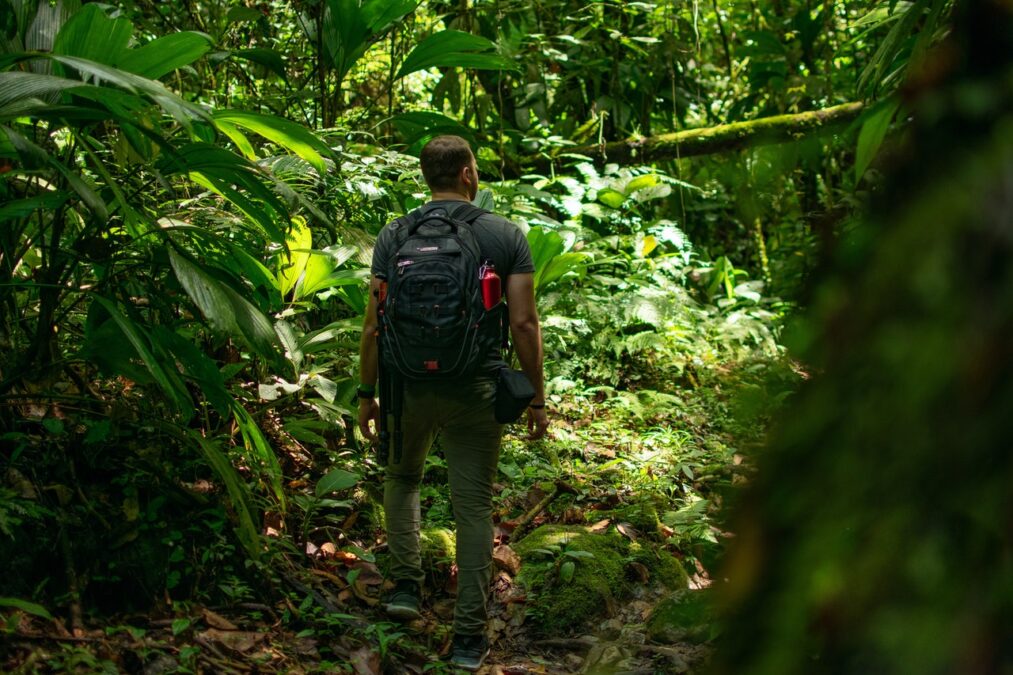
It was dark. I was lying in my hammock and couldn’t see a thing beyond my mosquito net, but I could hear something rustling in the bushes nearby, which I hoped was small and non-lethal, even if not overtly friendly. It was hard to be sure amid the more distant but louder roars of howler monkeys, carried through the dense jungle canopy.
The air was pungent with the smell of wet earth and dripping leaves, recently soaked by a rainforest downpour. All that water reminded me that I needed to go to the toilet. This was a bit of a challenge, as the hole in the ground that was our ‘restroom’ was some distance away, yet I knew that within an arm’s length of where I was, there would likely be a poisonous snake, spider or scorpion lurking in the shadows. To access the toilet, I would have to navigate a narrow forest path, where, when you shone a torch at night, you could see the reflection of a thousand tiny eyes looking back at you on either side. It was disconcerting to say the least.
What was worse was that I knew that if anything bad did happen to me, it would be a real problem, as I was about a day’s travel from the nearest civilisation.
So, guess how I felt?
Well, actually, I felt more content than I could ever remember!
Surprised by happiness
Surprising right? I too was slightly shocked by that deep feeling of happiness in that moment (despite needing to go to the loo). I had never felt anything quite like it before (the contentment, I mean, not the growing urgency to pee!)
In that moment I was thinking that if someone said I could do the same thing every day for the rest of my life, I would sign up right there and then, but I could not quite explain why.
How about you? Have you ever felt that level of amazing contentment?
Well, today I am going to explain the secret that I discovered, which explained why I felt so good in that moment. It turns out it was all about personal values. Learning this truth has helped inform my decisions from that point and steer my life into other places where I could flourish and be happy.
But let me explain what I mean by personal values.
The word ‘value’ denotes a degree of worth. For example, in monetary terms, we set a value on something by how much we are willing to pay for a product or service.
In moral terms, a value is a concept to which we give a high level of importance. Values are the moral code that guides us, and the priorities that motivate us. They are the principles we uphold, the ethics and tenets that we believe in and ascribe to. These ideals are our rules of conduct and standards of behaviour.
If you do not know what your most important values are, then it is very likely that you are living your life – whether you know it or not – according to other people’s principles or priorities. If you are not careful, this can quickly lead to dissatisfaction.
What is the difference between personal and corporate values?
There are values we hold personally, as an individual, and those we share corporately, be that with friends or family, a team or organisation, a community or society. They are often similar but expressed in subtly different ways.
For example, a common personal value might be expressed as kindness, but a team might talk about respect. A person may value honesty, whereas an organisation might express that as transparency.
Also, each word we use for a principle, such as integrity, excellence or creativity, might mean something slightly different to a given individual or context, so it is important to define exactly what we mean by a value, and most importantly, what the related behaviours are linked to that word.
How do values affect our decisions?
Positive values, or virtues, are inherently good, so we might agree that a whole list of such ideals are things we agree with, but when pushed, we will hold some principles higher than others.
This is important to understand as it is linked to how we make many decisions.
For example, when you go shopping, what you choose can reflect certain principles. You might pick an item because that is all you can afford, but usually, there is some level of choice. For instance, you might pick something because you are loyal to that brand. You might choose something expensive because you prioritise quality above price, or want something ethically sourced because you value sustainability or fairness for the producers.
Therefore, as you can see, values impact our everyday choices, no matter how big or small. The jobs we choose, the friends we make, and the ways we use our time all reflect our values.
What is the right number of values?
There is no exact number for how many personal values are too few or too many; too few, and it is unlikely to be truly reflective of your character, too many, and it becomes hard to discern the real priorities. So, a good rule of thumb is to identify three to five top virtues.
For me, my top three personal values are:
Adventure
Service and
Leadership.
So, let’s get back to the story to explain how, deep in the rainforest, I worked out what these were and what they mean to me.
Adventure: embracing challenge
I was in the jungle, and I was happy. Therefore, you might not be surprised that one of my personal values is adventure. And this principle was the easiest for me to work out, as I had long had a passion for adventure.
I grew up reading, watching and dreaming of adventure. At that time, my favourite movie character was Indiana Jones. I watched those films more times than I can count, and I loved the stories so much that I owned a Dr Jones wide-brimmed hat and satchel that I took when exploring. My friend and I even learned how to use a bullwhip, just to be more like Indy!
Indiana Jones also intersected with my love of studying the past, and while at university, I took courses in ancient history and archaeology. One day, my flatmate showed me some information about an expedition to map archaeological remains in the jungles of Central America. She had been invited but could not go, so she offered to introduce me to the expedition organisers.
I wasted no time in contacting them. For me, this was literally a dream come true. I had the opportunity to be a real-life Indiana Jones!
Suffice to say, I passed the selection criteria and was invited to join the trip. That is how, some months later, I found myself in my hammock (and yes, I did have my Indy hat with me!)
So, the principle of adventure is not surprising, but what about my other values?
Service: helping others
My next value is service. And although not as obvious as adventure, when I now look back at my old school reports, I can see comments from various teachers that highlighted that I obviously liked assisting people – be that classmates, staff or visitors.
This virtue also reflected the example set by my parents, who were both committed to serving their family and community. I had obviously caught some of their passion for supporting others.
In time, this grew into a larger desire, one to serve my country, which I realised through serving as an officer in the military (I became a bomb-disposal officer), something I had already committed to when I went to college.
When in the jungle, my commitment to service was often expressed in little ways. I would get up before anyone else to start the fire for breakfast. I had spent a lot of time outdoors, camping and hiking, so I shared that experience with people who were less comfortable living in the woods. Every day we had to walk for hours in the heat, and it was natural for me to check up on people, making sure they were ok and seeing what I could do to help anyone who might be struggling.
It wasn’t really anything I had to consciously think about; these were mostly natural behaviours and ways of being. It was only when I stopped to reflect on the patterns that I realised that these actions stemmed from the value that I call service.
Leadership: positive influence
So, I was happy being on an adventure and serving my colleagues on the expedition. Then, the overall leader surprised me. He asked me to help lead. There were two official leaders, but the overall group needed to be split into three teams, so he asked me to lead the third team.
I hadn’t thought about it until then, but my experience of adventure and love of the environment gave me confidence. My desire to help and serve people had built trust. Now, the expedition leader was pointing out something that was already happening: I was being looked at as a leader.
This was a surprise as I have never thought of myself as a natural leader. I am more introverted than extroverted, self-conscious and easily embarrassed. I was skinny, gawky and gangly in my early teenage years, with spots and braces to boot. None of this, funnily enough, helped my self-confidence!
What is leadership?
Thus, I was often quiet in a group context and did not generally push for attention or power. But, it turned out that the idea of me not being a leader was based on some false assumptions of what a leader is or isn’t. The biggest thing that helped me change how I thought about this is the definition given by leadership guru John C. Maxwell. He said that:
“Leadership is influence; nothing more and nothing less.”
In other words, leadership is not just an official role or natural charisma. There are leadership positions, but we are all leaders, as we all display leadership every time we influence a person or situation, even if we are just influencing and leading ourselves.
In the jungle, I discovered that in that adventurous context, where it was easy for me to serve people, I realised what leadership truly is, and why it is important. I embraced it, I loved the challenge and satisfaction it brought, and I have ever since.
So, there we have it. That is why my top personal values are adventure, service and leadership. Those principles continue to guide me today, informing my decisions and helping me find contentment in what I do.
I have not always made the right choices, and there have been times when I have been unhappy since, but understanding my values has helped me better recorrect my course in those situations, as you can read about in:
And, you are probably glad to hear, that you don’t need to go to the depths of the jungle to find out your principles! There are some simple things you can do to reveal them. If you would like to find these out, check out my post on:
If you want the right answers you have to start with the right questions
About The Right Questions
The Right Questions is for people who want to lead better and make better decisions. We are all leaders as we all have influence, no matter how much or how little. So, how are you maximising your influence?
If you are unsure, just drop me a line. I would love to help!
Do you want to lead better? Would you like to make better decisions? Want support in achieving your goals? Get in touch and let me know how I can help!