Understand Your Values for Better Decision-Making

How values, principles and ideals impact our choices

What is the most important decision you have ever made? It might have been choosing your romantic partner, selecting your school, or deciding upon your career. How did you make that decision? Whatever process you applied – consciously or otherwise – to your choice, that decision was informed by your personal values. This is what values-based decision-making or principle-based decision-making is all about; understanding how our precepts and beliefs inform our judgements.

Why is values-based decision-making important?

We might think that our biggest decisions would be based upon pure logic and critical reasoning, but we would be wrong. Just think for a moment; if your spouse or partner asked you why you wanted to be with them, how would you reply? Would you immediately say,

“Well, I considered the factors, and – following an analytical process – decided that you were the most rational choice of partner, presenting the best statistical chance of a successful union (given the limited alternatives)”?

I doubt that would get a kindly reception.

You are more likely to answer that it is because you love them. But then you must think about the follow-up question of why do you love them? When you explore that question you can see that, knowingly, or otherwise, you have made a values-based decision. The reasons for loving someone are bound up with your principles, beliefs, and passions.

When I first started to think about decision-making, during my time as a bomb disposal officer, I did use to think that decision-making was largely a rational process. It took some near-death experiences for me to realise that the neuroscience of decision-making is much more complicated. Slowly, I came to appreciate the important psychology of heuristics and bias, as well as understanding the importance of assumptions and how values underpin our decision-making.

Free Personal Leadership Action Plan

Just sign up here to receive your free copy

Values, principles, and ethics in decision-making

The book that introduced me to the concept of principle-based decision making was The Seven Habits of Highly Effective People. Stephen Covey points out:

“We are not in control, principles control. We control our actions, but the consequences that flow from these actions are controlled by Principles.”

Stephen R Covey 

So, the fact is that – whether we know it or not – our personal values drive our decision-making and influence the choices we make. But this is not a new discovery and Covey was not alone in this idea. For example, Gandhi said,

“Your values become your destiny.”

Gandhi

And this school of thought goes back much further. The idea of making right judgements is the field of ethics in philosophy. In Western philosophy, it was Socrates, Plato and Aristotle – the so-called founding fathers of ethics – who started this tradition.

Ethical decision-making is not just about choices in medicine (such as when to end care) or complex moral conundrums faced by society (such as assisted suicide). You cannot separate ethics from personal values and our everyday behaviour. As well as the moral code of the society we live in, we all have our own inner sense of morality that informs our actions. The ability to make these choices, according to our values, is inextricably tied to our understanding of freedom. Aristotle summed it up this way:

“Freedom is obedience to self-formulated rules.”

Aristotle

Leadership Development: Master the Top Leadership and Life Skills

Better lead in life and work to maximise your success. Sign up and access materials for free!

How do values influence our choices?

My favourite analogy for personal values is that they are like a compass. The whole point of a magnetic compass is that it points to the North, no matter which way we are facing. Even when we cannot see properly – for example, when stuck in fog or deep in a jungle – the compass gives us reliable data about our direction.

Personal values do the same for us. Whatever our circumstances, our values are an inner compass, informing us of whether the direction we are choosing is in line with principles or not.

“I have learned that as long as I hold fast to my beliefs and values – and follow my own moral compass – then the only expectations I need to live up to are my own.”

Michelle Obama

To complete the analogy, it is worth remembering that a compass can be affected by magnetic interference and occasionally not be trusted. In the same way, even our moral compass can be thrown off by cognitive bias. That is why no one aspect of decision-making can be considered without respect to other facets. We must be aware of all the various neural processes if we really want to make good decisions.

Values in decision-making for organisations 

Ray Dalio is an expert in how values affect decision-making in an organisation. In his book, Principles, he shares the values that he has identified and implemented – both in personal and business life. What makes Ray Dalio’s company Bridgewater, so impressive is the way they have built their values into the very fabric of the business.

For many organisations, their company values are just nice-sounding universal values (such as trust or creativity) that have been decided upon by an executive, but with little thought to how these values should truly affect the culture of an organisation. Many employees can barely remember their company values, let alone explain how they should inform their judgements and behaviours. Not so at Bridgewater.

Building a company from the values up

At Bridgewater, not only did they identify the company values, but they also then built organisational processes to reflect those principles, even writing code to embed these principles into automated decision-making. With each decision made these values are tested, the results examined, and the algorithms refined in a constant process of improvement.

This approach, backed up by the transparent way Bridgewater makes choices, empowers people at every level in the business to make decisions. Decision-making is not the preserve of management or the executive suite. At Bridgewater, this empowerment has fuelled effectiveness, growth and profitability.

As Roy Disney, the co-founder of another values-driven company observes,

“It’s not hard to make decisions when you know what your values are.”

Roy Disney

It is worth reflecting upon. You can ask these questions:

  • What are the principles of your organisation and how do they inform processes?
  • Do the actions and behaviours of employees reflect the core values?
  • Are people empowered to make decisions measured against stated principles?

Principle-based leadership

This sort of organisation is led by a leader who understands the importance of values; someone who knows their own principles and lives according to them. We call that integrity; someone who walks the talk, and integrity is one of the most frequently listed essential traits of a leader.

Stephen Covey wrote about this sort of leadership in his other popular book, The Principle-Centred Leader, but this approach to leadership also has a lot in common with servant leadership, transformational leadership and authentic leadership, all of which emphasise leaders of moral principle and purpose.

So how do you start?

So, having seen that understanding personal values is important as they affect our choices, what do we do about it? The first step in making better decisions is to identify the principles that guide you in your judgements. This will help both you and the people you work with. As Ray Dalio points out,

“The most important thing is that you develop your own principles and ideally write them down, especially if you are working with others.”

Ray Dalio

Take a moment to think. Can you write down your top values? Try to think of the top principles that you adhere to. I recommend 5 to 10 as a maximum. If you are a bit stuck then there are various tools, exercises that can help you do this and if you would like some help then read my post on What Are Your Personal Values?

How to practically apply personal values in decision-making

Once you have your list of personal values, there are some simple, practical ways you can employ them to inform your decision-making. For example:

Values Venn Diagram

Create a venn diagram that shows how your core values overlap. You can then think of past experiences, upcoming events, roles you play and choices your make, and plot them on the Venn diagram to indicate how these different situations utilise or impact your principles.

In theory, the intersection of your values, where they are all being employed to the max, is a sweet spot. This should be a space of fulfilment, flow and effectiveness. If you are trying to work out the ideal career or vocation, then this is a good place to start.

For example, my core values are leadership, service and adventure. Therefore, it is no surprise that I served as an officer in the military, as this profession sits at the nadir of my values.

You can also consider the factors relayed in my post on:

How do you find a job that you love?

Principle Driven Courses of Action

Another way to use values is to use them as factors when weighing up different courses of action. When facing a choice or considering a goal, there are often multiple options we can pursue. To decide between these potential paths, we can score each option against our key principles. A course of action that scores the highest, according to the values you choose, is likely to be the preferred choice.

You can read more about developing and choosing between courses of actions in my post:

Choose the Best Course of Action to Achieve Your Goal

Values Dashboard

Another way you can use your personal principles is to think of them as a dashboard, with each value as a gauge that monitors levels in real time. This is a useful way of thinking about how our values are impacted on a more continual basis, day-to-day.

In this way, the console helps us maintain a life balance. I like to imagine them like a dashboard in a plane, where my values gauges sit alongside other dials that measure other important factors such as rest, nutrition and emotions. You can read more about how to use this approach in:

How to Maintain Balance in Life to Ensure Success

If you want the right answers you have to start with the right questions

About The Right Questions

The Right Questions is for people who want to lead better, whether you are taking your first step or stepping up in leadership. We are all leaders (whether we know it or not) as we all have influence. So the question is, what are you doing with your influence?

Wherever you are on your leadership journey, I hope that you find resources on this site to help you on the next leg of your quest. Even if that is just the inspiration to take one small step in the right direction, then that is a success. If you can take pleasure in learning and travelling as you go, then so much the better.

Need help navigating your journey to success?

I love to serve people, helping them unlock their values, develop their leadership, and achieve their goals, through coaching, facilitation and courses. Please get in touch and let me know how I can support you.

How to Make a New Year’s Resolution and Make it Stick

A resolution is just another word for a decision. But a resolution has a particular weight to it. It is a firm decision, a choice to resolve a problem, something we are resolute about doing.

But many people fail in their New Year Resolutions. So how do you set yourself up for success? From my experience of achieving my personal goals, plus coaching many clients through achieving their aims, I would offer 5 Ps to help make a successful resolution: psychology, prioritising, principles, process, and people.

Psychology

There is a reason that New Year’s resolutions are popular. Psychologically the New Year represents new opportunities. Even though in reality it is just a date, mentally it is like being presented with a fresh blank canvas. A fresh new year, a new calendar with 12 full months to look forward to; giving us the feeling that we can achieve something new.

What’s more, having (hopefully) had a break over the holidays we bring a fresh perspective to what we want to do. It is hard to make decisions and life changes in the busyness of work and normal life. A vacation gives us distance from our responsibilities, and a chance to reflect on where we are and where we are going. Therefore, this break in regular activity presents an opportunity for changing direction.

But if you want to make the most of this psychological advantage and set yourself up for success, you need to make the resolution before the New Year. The decision and plan need to be ready so you can start immediately. Trying to make important life decisions, when you have a sore head on New Year’s Day, is perhaps not the best way to go about things! Equally, if you leave your planning until you are going back to work it is likely the resolution will get lost in your old patterns and routine. So, start thinking and planning now.

Free Personal Leadership Action Plan

Just sign up here to receive your free copy

Prioritise 

Most people have lots of goals and things they want to achieve. It would be very easy to make multiple resolutions and try to succeed in as many of these aims as possible, but that would be a mistake.

If you want the best chance of succeeding, you need focus. Therefore, you must choose the most important, most impactful resolution, out of all the things you might want to do. Don’t let the good be the enemy of the great. Prioritise your goals and put all your energy and effort towards the top one.

Principles 

One of the best ways to prioritise your goals is by examining your personal principles. This is because we are much more likely to see through a decision if it is in line with our values. Understanding principles helps to answer why you want to see a resolution through.

And you need to be honest with yourself and find the underlying reason as to why you want to do something. We often mask our real reasons from ourselves or others, but if you want to succeed you need to be brutally honest with yourself.

For example, your resolution might be to get fit. But why do you want to get into shape? Is it health, a desire to compete, a loss of body confidence or something else? Keep asking why until you really know the root motivation for what you are doing.

It is important to understand the why that underpins our motivation, as success in any goal or mission in life, is largely down to willpower. Our will is reinforced by beliefs, and our beliefs are reflected in our values and principles. If you have not thought about what your personal values are then that is a good thing to do before you choose any goal or resolution.

Leadership Development: Master the Top Leadership and Life Skills

Better lead in life and work to maximise your success. Sign up and access materials for free!

Process

When you have identified your most important life goal and why you want to achieve it the next step is to create a process.

A process is just a series of steps. The best plans identify the next small step to take, making it easy to progress. The will to take the incremental steps that lead to success is down to discipline. But a process, and particularly a process that becomes a habit, helps to reinforce our willpower.

If you want to get fit have a plan. It is highly likely that whatever aim you set yourself, someone will have succeeded in it before. By definition that makes it a simple type of problem. A simple problem does not mean guaranteed success, but it does mean that other people have overcome the same issue. So, learn from them. Find the best practice for achieving that specific goal. Take that blueprint and make it your own.

And don’t get disheartened if things don’t go exactly to plan or you struggle with your new habit. This is why most people fail in their resolutions. At the first setback, they decide to give up. Change your mindset. Take on a growth mindset: each failure is just a learning opportunity. Reflect on what happened and ask yourself, what went wrong? Creating new habits is a process of experimentation so analyse what happened and then try something new and go again. And again. And keep going.

This is effectively the Kolb learning cycle. You do something (a concrete experience), you review what happened (reflective observation), you make your conclusions (abstract conceptualisation) and then you try out a new idea (active experimentation). If the only thing you succeed in this year is embedding this process into your mental toolbox, then you will have achieved something great no matter what!

People 

The final P is for people. We have already seen that other people can help by providing plans if they have already achieved the same thing that you want to. So, once you have decided upon your resolution, start by finding out who else has successfully achieved the same goal.  If you can, then compare different people’s approaches and work out which one would best work for you. Better still, speak to them in person, get their experience and advice first-hand.

Then find someone to be accountable to. You are much more likely to fulfil your resolution if you share your goal with someone else and ask them to keep you on track. That person could be a friend, a colleague or a coach; it just needs to be someone who will challenge you and not let you off the hook.

For example, when I was training for an ultra-marathon, I got a training partner. There were plenty of days when I did not feel like putting in the hard miles, but it was much harder to cancel a training session than do it when there was another person involved. The result was I trained effectively, and I successfully completed the race. Find someone who can do the same for you.

The 5 Ps of a successful New Year’s Resolution

There is no shortage of advice about New Year’s Resolutions, whether it is making them or avoiding them completely! But remember, a resolution is just a decision. You can make a decision to pursue a life goal at any time but there are some benefits to starting at the turn of the seasons.

These 5 Ps will give you the best chance of achieving your aim:

  • Use the psychology of the New Year and new beginnings to your advantage
  • Prioritise what you want to achieve. Focus on the most important thing.
  • Make sure the goal is in line with your principles.
  • Create a process to reinforce your resolution. You need a solid habit to succeed.
  • Find people who can support you and keep you accountable.

And remember, don’t wait. Start thinking and planning now so you are ready for the New Year. Don’t leave it until you are drinking bubbly and singing auld lang syne!

May you have a productive and successful year, fulfilling your resolutions and achieving your dreams!

Season’s greetings and happy holidays!

If you want the right answers you have to start with the right questions

About The Right Questions

The Right Questions is for people who want to lead better, whether you are taking your first step or stepping up in leadership. We are all leaders (whether we know it or not) as we all have influence. So the question is, what are you doing with your influence?

Wherever you are on your leadership journey, I hope that you find resources on this site to help you on the next leg of your quest. Even if that is just the inspiration to take one small step in the right direction, then that is a success. If you can take pleasure in learning and travelling as you go, then so much the better.

Need help navigating your journey to success?

I love to serve people, helping them unlock their values, develop their leadership, and achieve their goals, through coaching, facilitation and courses. Please get in touch and let me know how I can support you.

The 36 Proven Decision-Making Tools That I Most Recommend

Which mental models (if any) do you use to make decisions? There is a lot to choose from. Do you know the best decision-making tools for each situation?

Over the years I have been taught, and then tried and tested many decision-making approaches. I have also researched, adapted, and even invented a few others along the way.

In writing this recent series of articles on decision-making, I thought I would collate and share the decision-making heuristics, processes, and approaches that I use the most. These are all tools that I find the most helpful, whether making decisions in a personal context or in my work as a leader, strategy consultant and executive coach.

Having experimented with these approaches in different situations over the years I have found certain models that are my ‘go to’ tools for certain circumstances. Therefore, I have grouped the tools by context. I hope you find some familiar faces and new friends among the models below.


Methods for easing or improving simple choices

Take a chance

It really is not worth sweating the small stuff. If choice really does not matter, then just flip a coin (if it is a binary decision) or roll some dice (if there are multiple options). This approach can seem flippant (pun intended) but can also provide deeper insight. Once you have flipped or rolled then reflect on how you feel about the result. If you are overly disappointed at the result, then maybe you cared more about the decision than you admitted to yourself. If this is the case, you might want to reconsider.

Replace the decision

If it is a simple decision, then replace it with an automatic process or quick heuristic (rule of thumb). We can spend a lot of time each day thinking about what to wear, what to eat, or what to do. Creating routines reduces these decisions to allow time and energy for more important decisions.

Make a habit

To reinforce good decisions, we need good habits. In order to develop good habits, we need to assess the process of stimulus and response. I favour Charles Duhigg’s model, the habit loop when analysing and experimenting with developing new habits. Work out:

  • The cue – the stimuli
  • The routine – the response or required action
  • The reward – the payoff gained or gratification from the activity

Free Personal Leadership Action Plan

Just sign up here to receive your free copy


Heuristics for when you need more information to decide

Ask a trusted person

If in doubt, phone a friend! And don’t just ask friends. What you want when making a choice is informed – and sometimes critical – thought. Friends and family can often tell you want to hear, rather than what you need to hear. So, ask a person who will give you a straight answer. That might even be a competitor or someone you don’t get on with. If it is a complex issue, then ask several different people. The more diverse the group of people the more useful the data will be for informing your decision.

Rub your nose against it

In the military, there is a saying that “time spent in reconnaissance is seldom wasted.” In other words, if you are deciding what to do, there is nothing quite as good as seeing the ground for yourself. In mountaineering, there is a similar phrase, that you should “rub your nose against the mountain” before deciding. Things can look very different when you are up close to them. So, if you have an important decision to make, try to get an immersive experience to inform you. See it, try it. Engage the senses, then decide.


Hacks for when you need to commit

Get accountable

If you need to choose and stick to your decision then make yourself accountable to someone. Many people use a professional coach for this, but you can use someone else, as long as you trust them not to let you off the hook!

Put your money where your mouth is

Put money against your decision to make it stick. There are even apps now that allow you to put up a sum of money that goes to charity if you fail in your decision or goal. The money is controlled by a trusted third party who can release the cash back if you see your decision through. George Halachev has an article on Better Humans with 6 you could try.

Announce first, decide later

If you are still unsure of your exact choice but still want to commit, then you can set a self-imposed deadline. Announce publicly that you are to going to share your decision on a particular date. This does not need to be a press release, it could be just to friends, colleagues, or family, but it is much harder to go back on a choice when it is shared (just ask any government!) A deadline also helps to focus the mind.


Tools for big choices or important decisions

Consider consequences

If you are trying to work out if a decision is significant then it is worth thinking through the consequences. The importance of a choice is relative to its impact. Ask yourself, what is the worst that can happen? Then ask, is this decision reversible? If the impact is small or the decision is reversible then you should not delay. As Darren Matthews recommends, ask where will this decision take us?

Personal values

Knowingly or unknowingly, we make many decisions based on our individual beliefs. Our most important decisions – such as whom we want to marry or spend our life with – are informed by our principles. We may differ from someone in skills and interests but be bonded by precepts. Therefore, it is important to work out your own personal values. The hardest decisions in life are often the ones where our values are in tension with one another. If you understand that tension you can find ways to choose.

Leadership Development: Master the Top Leadership and Life Skills

Better lead in life and work to maximise your success. Sign up and access materials for free!


Models for judgements based on your personality 

The Big 5 personality traits

As well as knowing personal values it is important to understand our personality type. This helps us play to our strengths and compensate for our weaknesses when we make decisions. There are plenty of psychometric tools available to help but my preferred model is the Big 5 or OCEAN model. This assesses your personality across five factors:

  • Openness to experience (curious vs cautious)
  • Conscientiousness (efficient vs extravagant)
  • Extraversion (outgoing vs reserved)
  • Agreeableness (compassionate vs critical)
  • Neuroticism (sensitive vs resilient)

There are plenty of free tests you can do online, just do a quick search and try one.


Approaches to rational decision-making

Consider factors

When assessing a choice rationally, work out what the key factors are that affect the decision. For example, when buying a home these might be things like location, type of property, number of rooms, access to transport etc.

Weighted factors

Once you have a long list of factors you will likely find that some factors are more important than others. For example, as per the example above, the location might be more important than the exact type of property. Therefore, give greater weight to more important factors. If you were scoring your options, you can multiply a factor’s scores relative to their importance.

Pros and cons

Once you have worked out the factors influencing a decision and weighted them, you are still likely to have different options to choose from. To approach the decision logically, consider the pros (advantages) and cons (disadvantages) of each course of action you can take.


Simple tools for a faster decision-making process

The OODA loop

If you want to speed up decision-making for you, your team or your organisation then you can use the OODA loop to analyse your processes. OODA represents a decision-making cycle in its basic form. It stands for observeorientatedecide and act; the key steps of decision-making. By studying the cycle, working through each stage of the process, you can identify where you are faster or slower in making choices. Then you can identify ways to speed up that element of the cycle.


Mental tools for generative and creative thinking

Mindmapping

When making notes I tend to use mindmaps. These are particularly good in assisting decision-making as they keep to one page, forcing you to crystallise and prioritise information. Having the data branch out from the central concept also allows links to be made between ideas that might not have been seen in linear notes.

The Thinking Environment

The best way to help someone make a decision is to help them to think clearly. Nancy Kline developed the principles of the Thinking Environment based on research and practice over the course of 30 years. The components of the Thinking Environment include attention, equality, ease, appreciation, encouragement, information, feelings, diversity, incisive questions, andplace. And the most important thing we can do: give people our full attention and really listen (without interrupting) when they are trying to think.

The 6 Thinking Hats

Edward de Bono, the advocate of lateral thought, developed the 6 hats approach to considering problems. The idea is to look at the problem from 6 different perspectives that are represented by 6 coloured hats. The hats are:

  • White hat – analytical and fact-based
  • Red hat – emotional and subjective
  • Black hat – critical and sceptical, identifying risks
  • Yellow hat – optimistic, looking at best case
  • Green hat – creative, brainstorming
  • Blue hat – the big picture, structured and strategic

Coaching tools for choosing life goals and improving work-life balance

The Wheel of Life

The wheel of life is a great way to look at life balance. You simply draw a circle and divide it into segments (usually 8). Name each segment after a role or aspect of life. These could include family, health, work, learning, leisure, finance, relationships, spirituality for example. Then score and mark up each element; a zero being the centre of the circle, 10 being the outside. You now have a visual representation of which aspects of life you want to improve.

The GROW model

The GROW model is one of the most common coaching tools for choosing and refining life goals. GROW stands for goal, reality, options and will and is applied in this way:

  • Goal – define and state the aim
  • Reality – analyse the present situation and how that affects the goal
  • Options – consider different courses of action and any obstacles that stand in the way
  • Will – make the decision and commit to it

Exercises for choosing a vocation or career

The perfect day

When coaching people through a career change, the first exercise I recommend is writing out their idea of a perfect day. This dream – developed in detail from the moment of waking, to going to sleep – is a powerful way to inform what future work-life balance should look like.

Writing your eulogy 

The second exercise is to write your own eulogy. This might sound morbid but, writing a fictional version of what you would want to be said at your funeral, or written as your obituary, changes your perspective from the here and now, to the end of life. This challenges short-term ideas of success and reveals longer lasting values. These exercises are surprisingly powerful.


Simple methods for situational awareness and deciding upon a strategy

The 5Ws

The 5Ws approach uses interrogative words starting with a w (why, where, what, who, when). The H of how is usually added to this list and I have found that adding which is very helpful too in decision-making. It is a technique I was taught as a bomb disposal officer. The idea with the 5Ws is that you list the question words and use them as triggers or prompts for questions related to the problem. For example, the where interrogative can prompt inquiries such as where have we come from, where are we now and where are we going?

The SWOT analysis

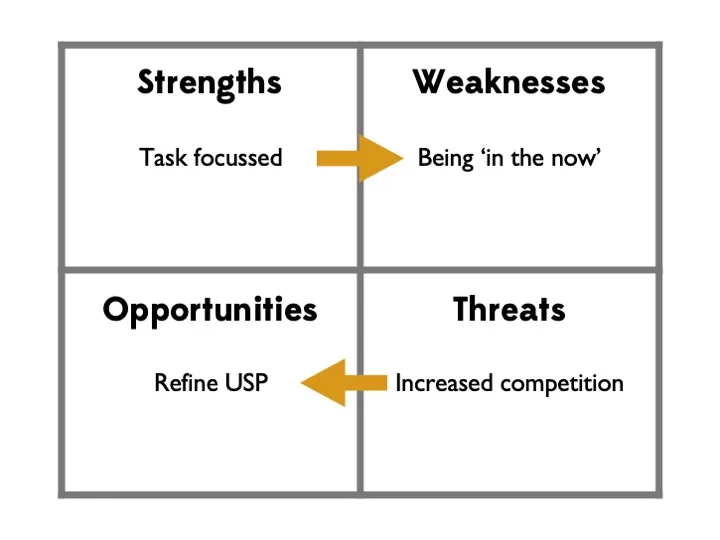
Ok, so you are very likely to know the SWOT analysis but don’t discount it just because it is common. There is a good reason why it is so popular. SWOT – as you may know – stands for strengthsweaknesses,opportunities, and threats and is generally drawn as a 2-by-2 matrix. The SWOT is a quick and effective way to get a snapshot of a situation, by brainstorming the critical points in each quadrant. It was developed with organisational strategy in mind, but I have also found it useful for individuals too. Some of the best insights come from identifying relationships between the quadrants.

The Hedgehog Concept

As well as being an entrepreneur in my own right I have worked in and with many start-ups. When working with growing businesses, developing strategy, one of the most insightful tools I have used is the one set out by Jim Collins in his bestselling book Good to Great. It is what he calls the Hedgehog Concept, based on the Greek parable that says “the fox knows many things but the hedgehog knows one big thing.” The model is drawn as a Venn diagram; three circles that encompass three questions:

  • What are you deeply passionate about?
  • What can you be the best in the world at?
  • What drives your economic engine?

There will be various answers to these questions but when the answers align, in the centre, is the answer to what you should be focussing on.


Mental hacks for productivity and prioritisation

The Eisenhower matrix

Another well-known tool, the Eisenhower matrix uses a 2-by-2 grid as per the SWOT analysis but this time the matrix relates to two axes: what is important and what is urgent. This creates four fields that you can sort your tasks into, and what you should do about them:

  1. Urgent and important – do them now
  2. Not urgent but important – plan them into your diary
  3. Urgent but not-important – try to delegate these to someone else
  4. Not urgent or important – try to avoid or reduce these activities

The Pareto principle

The Pareto principle – or 80:20 rule – is a simple rule of thumb for inputs and outputs. The idea is that 80 per cent of our productivity and profit is likely to come from 20 per cent of our work or client base. It is an easy but effective way of assessing where you should focus your time and energy.

Be more Steve

Productivity largely comes down to good prioritisation and Steve Jobs used to ask himself one critical question every time he had to choose what to do next. He asked, “if you could do just one thing, what would it be?” In other words, what is the single most important, impactful way you can use your next block of time? Do that. Be more Steve.


Tools for when you want to delegate tasks and evaluate decisions

SMARTER tasks

A ‘SMART’ task is one that is specific, measurable, attainable, relevant and time-bound. This is good to remember for your own goals. But people often forget to use the SMARTER framework that adds evaluateand re-evaluate to the SMART acronym. This allows for the assessment and, if necessary the adjustment, of decisions and plans as the situation progresses. Don’t just be SMART, be SMARTER when you set goals.

Traffic lights

There are lots of ways to review decisions, assess projects and identify lessons but my favourite method is the traffic light approach. It is based on three simple questions to consider after an event:

  • Red – what should we stop doing?
  • Amber – what should we continue doing?
  • Green – what should we start doing?

Mental models for defining the challenge and problem-solving

The Cynefin framework

Problems are not made equal and if we wrongly identify the type of issue we are facing then we can make the situation worse, not better. The Cynefin framework helps us define problems and therefore assess the correct approach.

  • Clear problems are simple and have tried and tested best practice solutions
  • Complicated problems can be assessed using first principles and good practice
  • Complex problems are new, emergent issues that require an experimental approach
  • Chaotic problems require swift action to create enough order to move the problem into another quadrant

Theories for choosing the right leadership or management style

The Grint Model

Keith Grint’s model relates different leadership approaches to varying problem types, but in a more simplified way than the Cynefin framework. The Grint method says that for:

  • Tame problems, that have known solutions, use a tested plan and manage the process
  • Critical problems, where there is crisis or time is limited, then command and provide quick, clear direction
  • Wicked problems, where there are no simple or good responses, then lead, providing a clear vision and empowering people to deal with complexity

Situational leadership

Another related model is the situational leadership model developed by Kenneth Blanchard. The model assesses the circumstances and the capability of the team to guide the leader into either:

  • Directing – when time is critical, or team confidence is low
  • Delegating – when teams are capable to do the task with little management
  • Supporting – where trust is high, and teams can mutually support one another
  • Coaching – when individuals might need focussed support to develop confidence

Tools for choosing and developing a team

The 3Cs

When choosing a team member, I refer back to the 3Cs or character, competence and chemistry, recommended by Bill Hybels in his book Courageous Leadership. These 3Cs should be considered in that order when hiring because:

  • Character is hardest to develop, and bad characters can do you the most harm
  • Competence is important but people (especially of the right character) can develop this
  • Chemistry is less important. It is great to like people but hiring people just because they are similar to us is not the recipe for a successful team, as we shall see in the next model.

The Belbin Team Roles

Meredith Belbin conducted research over a couple of decades that identified the 9 critical roles that are needed within any team. Some people have preferences for certain roles, but each function is critical to success. Whatever size of the team this model will help you work out what needs to be done and who is best to fulfil each role (if you know your people). The titles and descriptions are as follows:

  • Plants are highly creative and good at solving problems
  • Resource Investigators connect with the world outside the team, bringing in external views on opportunities and competition
  • Monitor Evaluators provide a logical, impartial view and help to weigh up options
  • Co-ordinators focus on the objective and delegate tasks to team members
  • Implementers plan and manage a workable strategy
  • Completer Finishers bring high standards, see errors, and add polish to the final solution
  • Team workers help the team gel and identify things that need doing to help the team
  • Shapers challenge and provide momentum by driving the team forward
  • Specialists provide in-depth knowledge within a key area

The Tuckman Cycle

If you want to know where your team is on the journey to high performance, then the Tuckman cycle can help analyse which stage you are at. Bruce Tuckman identified that every team goes through these phases:

  • Forming – coming together, tentatively
  • Storming – working out roles, often with friction
  • Norming – settling into a functioning team
  • Performing – team synergy is producing exponential gains
  • Adjourning – a project ends or team member leaves, starting the cycle to start again

For help in moving a team from one stage to another, I also recommend the Drexler-Sibbet model.

The Best Decision-Making Tools: Start now and try one!

Making effective decisions is a skill. Honing that skill requires practise but the good news is that there is a host of models, tools and processes that can help to refine that competency.

So next time you need to make a decision, work out which tool would best situation. Choose one of the models listed above and give it a try. I recommend you make a note of the approach you use, your decision and then review your choice later. This reflection process is probably the most important aspect of improving your decision-making skills. We need practice and feedback in order to improve.

Think about what you must do today. Which mental model could help you make the right choice? Give it a go!


If you want the right answers you have to start with the right questions

About The Right Questions

The Right Questions is for people who want to lead better, whether you are taking your first step or stepping up in leadership. We are all leaders (whether we know it or not) as we all have influence. So the question is, what are you doing with your influence?

Wherever you are on your leadership journey, I hope that you find resources on this site to help you on the next leg of your quest. Even if that is just the inspiration to take one small step in the right direction, then that is a success. If you can take pleasure in learning and travelling as you go, then so much the better.

Need help navigating your journey to success?

I love to serve people, helping them unlock their values, develop their leadership, and achieve their goals, through coaching, facilitation and courses. Please get in touch and let me know how I can support you.

What are Eulogy Virtues and Why are They Important?

A few months ago, a very good friend of mine died. It was sudden and unexpected. He was in his thirties. He was very fit (he had recently completed a marathon amongst other things) and seemed healthy. But he died in his sleep. The post-mortem was inconclusive as to his cause of death.

Unsurprisingly, his family, friends, and colleagues – like myself – were devasted. This was a combination of the shock – the fact he was young and healthy – and that he was so universally liked. This last point truly came home at his funeral. There were so many people there, from different parts of his life, all wanting to say goodbye, but also to celebrate him. And that is what we did. We remembered and appreciated the positive impact he had had on all of us. The eulogies of his brother and best friend had us laughing through our tears.

It was also very sobering. It reminded me of my mortality and posed the question, how will I be remembered?

Too busy to think about?

It seems like a morbid thing to do, to think about our own funeral, but it is an important thing to do. Thinking about the end of life changes our perspective. We can consider the demands of our busy daily lives in a different context. We can start to challenge our priorities and ask, why are we doing what we are doing?

“It is not enough to be busy. So are the ants. The question is: What are we busy about?”

Henry David Thoreau

Yes, we are all busy. But are your actions today working towards a greater purpose? People often talk about strategy, but what about our personal strategy? What is the long-term plan for our lives? What does success in life look like for us?

When our time is done, what will be our legacy? Who will miss us?

These are important questions. In fact, there might not be any questions more important than these. But how do we go about answering them?

Free Personal Leadership Action Plan

Just sign up here to receive your free copy

The problem with life plans

The challenge with life plans is that they never seem to go to plan! Circumstances have a way of knocking our best plans into the outfield. This has certainly been my experience. Just take my career as an example. At college, I had a general idea of what I did and did not like, but I could never have predicted the journey that my career has taken. Often doors have closed upon the route I have wanted to take, only to reveal an unexpected opening. Looking back, the result has often been far better than the one I could have planned or hoped for.

But my choices have not all been random. I have not been a rudderless yacht driven before the storm. Sailing is a good metaphor to consider. When sailing you have a destination in mind, but you must adjust your route according to the changing weather conditions. Fluctuations in the wind mean you have to constantly adjust your sails and you rarely get to sail directly towards where you want to go. You must tack back and forth, keeping an eye on your bearing, but also making small adjustments, so the waves don’t capsize you.

When sailing, one must watch the compass, while the hand is on the tiller. So in life, we need to consider our values as we make decisions. Our personal principles are our moral compass. They inform everything from the little adjustments to the big direction changes.

So have a plan or at least an idea of your destination. That is a good thing. But do not try to steer your life without a good idea of your values as well. Otherwise, you will find it hard to adjust to changing circumstances.

Leadership Development: Master the Top Leadership and Life Skills

Better lead in life and work to maximise your success. Sign up and access materials for free!

What is the difference between résumé virtues and eulogy virtues?

When looking at values, particularly from an end-of-life perspective, there can be a difference in our priorities. We love to portray a certain image in our daily interactions, on our résumé or CV, or social media. We feel the pressure to convey the busy, successful, manicured beauty of life the world seems to demand.

But is that the life we truly want? Are they the people we really want to be? Do we want to be remembered for being busy? For our job title? For our holiday pictures?

David Brooks, author of The Road to Character, best summed up this dichotomy in his New York Times article, The Moral Bucket List, where he defined the difference between résumé virtues and eulogy virtues.

We live in a culture that centres on self. Self-image, self-fulfilment, self-determination. But the shift with eulogy virtues is away from selfish desires, work accomplishments, external recognition, and the accumulation of stuff. Eulogy virtues tend towards selflessness, and towards life accomplishment, internal peace, and the building of a legacy.

Eulogy virtues force us to acknowledge our weaknesses and failures. They help us move from desiring independence from others to recognising our need for inter-dependence with others. We shift our motivations from success to love, from career to calling, from competence to character.

As David Brooks notes, eulogy virtues even challenge the fundamental questions of life. It goes from “what do I want from life?” To “what does life ask of me?”

“Commencement speakers are always telling young people to follow their passions. Be true to yourself. This is a vision of life that begins with self and ends with self. But people on the road to inner light do not find their vocations by asking, what do I want from life? They ask, what is life asking of me? How can I match my intrinsic talent with one of the world’s deep needs?”

David Brooks

How to work out your eulogy virtues

Having had experience taking people through this process, as a coach, I can recommend that you try and write out your own eulogy. This might feel uncomfortable at first, but, if you go with the process, it can be very insightful.

As you write, remember that this is not an obituary written by somebody that does not know you. It is not the article in the paper for the eyes of the world, it is a eulogy, shared from the perspective of someone who loves you, to the key people of your life, gathered at your funeral. The person in mind should be someone who knows you well enough to call out your weaknesses as well as your strengths. To highlight how you dealt with your failures as well as your successes. Who can talk about your character and how you did things; not just your skills and what you did.

To do this I recommend the following steps:

  • Set aside time – give yourself at least an hour of uninterrupted time
  • Find a quiet place – select an environment to help you, most importantly somewhere you will not be disturbed.
  • Engage your emotions as well as your mind – imagine what it would be like at your funeral and use your empathy to see yourself from another’s perspective
  • Write – capture your thoughts as they come. It does not necessarily need to be coherent as a first draft
  • Reflect – once you have run out of words think about what you have written. What are the underlying virtues that define your life? Which values best encompass the themes of your story?

You might want to compare this with other ways of exploring your values. If you want some examples of other exercises then you can find them in the article: What Are Your Personal Values?

Better than an action plan

By identifying your eulogy virtues, you create your own moral bucket list. This is a bucket list beyond just personal achievements. Life goals are great, but more important are the values we live by, the things that define why we do things and how we behave as we pursue our goals, whether we achieve them or not.

So, take time to reflect on your eulogy values. How do you want to be remembered? Identify and hold onto those virtues. Keep them in mind as you dive back into the busyness of your day. They will guide you through the winds and the waves, the calms, and the storms.

If you want the right answers you have to start with the right questions

About The Right Questions

The Right Questions is for people who want to lead better, whether you are taking your first step or stepping up in leadership. We are all leaders (whether we know it or not) as we all have influence. So the question is, what are you doing with your influence?

Wherever you are on your leadership journey, I hope that you find resources on this site to help you on the next leg of your quest. Even if that is just the inspiration to take one small step in the right direction, then that is a success. If you can take pleasure in learning and travelling as you go, then so much the better.

Need help navigating your journey to success?

I love to serve people, helping them unlock their values, develop their leadership, and achieve their goals, through coaching, facilitation and courses. Please get in touch and let me know how I can support you.

How to Make Good (Ethical) Decisions

Making Good Decisions and Choices

When I was about ten years old, I decided to run away from home and ran (unexpectedly) into an ethical issue. I can’t remember exactly why I wanted to run away (as my life wasn’t exactly bad) but I do remember that I strolled out of the house carrying nothing but a penknife. I was obviously confident in my survival skills and overly trusting that warm weather would continue!

With my elementary school logic, I decided that a hole in the ground – in the woods not far from my house – was the obvious place to start my new life. As this den was also known to my friends it was not long before one stumbled across me as I cleared the twigs from my future bed space.

“What are you doing?” My friend asked me. “Making camp.” I replied, “I have run away from home so don’t tell anyone!”

My friend wandered off and I continued working. Then, about twenty minutes later my friend arrived back. Behind him stood my dad. I remember looking into my friend’s eyes, feeling betrayed but also knowing they had done the right thing. I was outraged and relieved all at the same time.

What are ethics and why are they important?

At that stage in life, I had no idea what ethics was, but I did intuitively know that my friend made a courageous moral decision that day. Ethics is simply that; it is making good or right choices. That includes big ethical dilemmas, such should we limit artificial intelligence or genetic engineering, right through to more everyday choices, such as whether you help yourself to extra stationery at the office for personal use at home.

Making good decisions is not easy. We might have an intuitive feel of what is right or wrong but sometimes the answer is not obvious. This is particularly the case when various values come under tension.

Taking my running away as an example, my friend had to balance the value of loyalty against that of care. Loyalty might have persuaded them to keep quiet as I had shared something in confidence, but out of care for me they knew the right thing was to tell my parents.

Therefore, sometimes values on their own are not sufficient. In these moments, where good values are in tension, we can employ a decision-making tool to help make the best ethical choice.

Free Personal Leadership Action Plan

Just sign up here to receive your free copy

How to make ethical decisions

One such technique has been developed by The Ethics Centre in Australia. The Ethics Centre is a not-for-profit organisation that promotes the use of ethics in everyday life and decision-making. They suggest a decision-making model based on considering values, principles, and purpose.

In this context (and using the wording of The Ethics Centre):

  • Values tell us what’s good – they’re the things we strive for, desire, and seek to protect.
  • Principles tell us what’s right – outlining how we may or may not achieve our values.
  • Purpose is your reason for being – it gives life to your values and principles.

Of course, to employ this methodology you must first know what your values, principles and purpose are, so let’s take some time to consider each in turn.

Values

Values are things we give worth, things we prioritise. The values (or virtues) we aspire to come in different forms, such as:

  • Personal values (the ones we prioritise as an individual)
  • Corporate values (the ones we hold in a community or organization such as a company’s values)
  • Universal values (ones that are held in common more globally such as the UN Charter of Human Rights)

Therefore, the starting point, when making a decision, is working out which values are the most important ones in the circumstance. If you have never properly identified your values, then I would recommend you discover your top 3 personal values.

Leadership Development: Master the Top Leadership and Life Skills

Better lead in life and work to maximise your success. Sign up and access materials for free!

Principles

Specific principles help us think about what is right or wrong and, in this way, they complement values. These principles are essentially algorithms for behaviour. For example, when working in the British Army and considering a course of action, the principles I was taught to apply can be summed up in the following question:

“Is this action lawful, appropriate, and professional?”

Many of our principles have a basis in religion. For example, one of the principles I (like many) try to live by is the Golden Rule. The Golden Rule is the idea of treating others as we would like to be treated and this precept is reflected in various spiritual traditions. For example, the Hindu Mahabharata states:

“One should never do something to others that one would regard as an injury to one’s own self.”

Mahābhārata 13.114.8

Or in the teachings of the Buddha:

“Hurt not others in ways that you yourself would find hurtful.”

Udanavarga 5:18

And similarly, Jesus of Nazareth said:

“Do to others what you want them to do to you.”

Matthew 7:12

So, as with values, there are some common themes, but it is also worth reflecting upon the specific principles you hold to. This can be done systematically if you take time to reflect on how you make decisions. This reflective process will start to reveal the underlying principles you use.

If you would like to explore more on identifying and developing principles, then I recommend reading Ray Dalio’s book Principles where you can see how this process can be done on both a personal and organisational level.

Purpose

Similarly, to values and principles, there can be overlapping ideas of purpose. These might be:

  • Individual purpose – your own sense of personal purpose
  • Professional purpose – the specific purpose we have in a given work role
  • Organisational purpose – the mission statement of a team or business your work for

To understand purpose and make it measurable it is advisable to create a clear and concise mission statement. A good purpose statement is a definition of success, within a given context.

For example, my own mission statement is:

 “To serve people by helping them unlock their leadership, in order to support them on their adventure.”

In this case, my personal purpose statement also encompasses my top three values of serviceleadership, and adventure (but this does not have to be the case). For example, Oprah Winfrey’s purpose statement is:

“To be a teacher. And to be known for inspiring my students to be more than they thought they could be.”

What I find useful about this (and good purpose statements in general) is they can give a measure of success against different time scales. Both the mission statements above can be used to consider achievement in a day, week, year, or lifetime. These statements also help to analyse whether decisions have worked towards the good and successful outcome of the stated purpose.

Factors that impact good decision-making and ethical choices

Even after identifying our values, principles, and purpose, or those specific to a given ethical problem, there are still factors that can impact making a good choice. Most of these factors relate to cognitive bias, the subconscious rules of thumb we use to help us make quick decisions.

To minimise the negative impacts of cognitive bias it is worth considering the following:

  • Education and training. Learn about decision-making and the different types of cognitive bias
  • Diversity of thought. Bring different perspectives to a team or decision
  • Build a culture that allows challenge. Create a culture around you where people are more likely to challenge or call out bad behaviour and decisions (even if that is just a good friend who will be brutally honest with you)

The three things to help you make good ethical decisions

Therefore, if you want to make ethical decisions you need to first know your values, principles, and purpose. Then, while allowing for cognitive bias, you can then balance these three elements against each other to make your choice.

This does not mean you will immediately come up with an answer. If you are new to exploring values, principles, and purpose then that will likely throw up challenges and questions to work through before you even get back to the ethical problem you are facing!

But don’t despair. The search for good outcomes and truth is a journey, not a single destination. It should inspire personal reflection, critical thinking, and the sort of discourse that Socrates would be proud of. And that quality thinking leads to good actions, and as Martin Luther King said:

“The time is always right, to do what is right.”

If you want the right answers you have to start with the right questions

About The Right Questions

The Right Questions is for people who want to lead better, whether you are taking your first step or stepping up in leadership. We are all leaders (whether we know it or not) as we all have influence. So the question is, what are you doing with your influence?

Wherever you are on your leadership journey, I hope that you find resources on this site to help you on the next leg of your quest. Even if that is just the inspiration to take one small step in the right direction, then that is a success. If you can take pleasure in learning and travelling as you go, then so much the better.

Need help navigating your journey to success?

I love to serve people, helping them unlock their values, develop their leadership, and achieve their goals, through coaching, facilitation and courses. Please get in touch and let me know how I can support you.

What are The Right Questions for Decision Making and Strategic Planning?

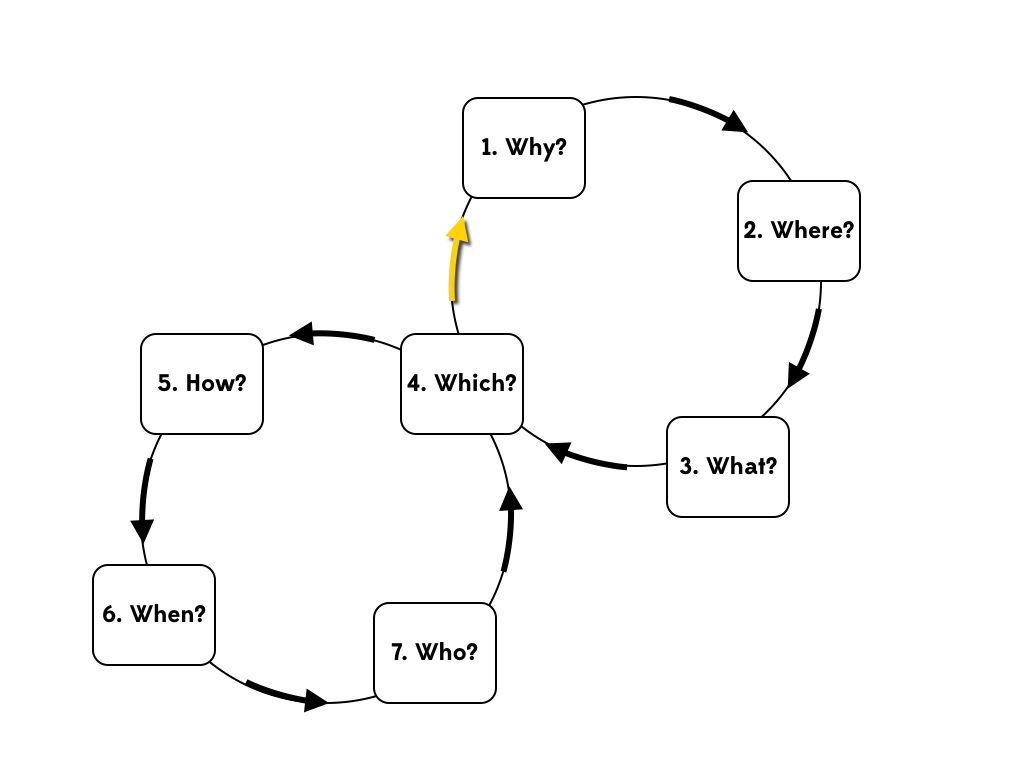
So, having established in previous posts the background to The Right Questions and an idea of their importance, we can now get an overview of The Right Questions and how they are applied to strategic planning and achieving goals, both in a personal or business context. The questions come in an order of sorts but the process of asking The Right Questions is also iterative and cyclical. In other words, the answer to one question is likely to inform an answer to another, and even after we have worked through all the questions we will generally go back and revisit the others to refine our answers.

How to Use The Right Questions Decision Making and Coaching Framework to Achieve Goals

It is beneficial to explore the questions in two broad groups. The first is comprised of the where, what and why, and these encompass the strategic framing of a situation. The second group is made up of the questions how, when, and who and these help us develop a specific plan within the aforementioned strategic frame.

The two groups are joined by ‘which’ as this question deals with the concepts of options and risk. After looking at the overall strategic picture we use ‘which’ to explore courses of action from which we can choose an option to develop into a more detailed plan. We then return to this same question to weigh the risks as the plan progresses. Looking at these options and risks are the key decision points and can lead us to return through the strategic framing or planning loops again.

Free Personal Leadership Action Plan

Just sign up here to receive your free copy

Taken all together these seven questions create a template for strategic planning and also become a decision-making process that follows a figure of eight cycle, as demonstrated in the diagram below.

“I keep six honest serving-men, (They taught me all I knew); Their names are What and Why and When, And How and Where and Who.” Rudyard Kipling

STRATEGIC FRAMING

Why? (Values and Priorities)

The ‘Why?’ represents our values. Our values are our identity; the things at our centre that define why we have the vision in the first place, why we do the things we do, why we attract certain people. They are our beliefs and worldview. These are often things we hold in common with others at one level but the particular combination and application of the values make them unique to us. Knowing our principles shows us what we value most and therefore it also helps us to prioritise and make good decisions.

Where? (Situation and Vision)

‘Where?’ is the present location and the future destination, the situation and the vision. We look at whence we have come from and whither are we going as our journey is bracketed by these ideas of ‘where’. When you get out a map the first thing you do is identify where you are and get your bearings; only once you have done this do you plan to move. And when you move, you don’t want to wander aimlessly (movement in itself is not progress), there needs to be a destination, something we are aiming for. This destination is the dream, the thing that stokes our passion and gives us our drive.

What? (Mission)

‘What?’ represents the mission, the reality of what we are going to do. The mission is the bottom line, the tangible measured difference that we are to make. To work out the mission we need to define success so that we know our finish line. We can then sum this up in a pithy and memorable way to get our mission statement.

Leadership Development: Master the Top Leadership and Life Skills

Better lead in life and work to maximise your success. Sign up and access materials for free!

REFLECTION INTERSECTION

Which? (Options, Risk and Reflection)

Options

We have to choose which way to go and therefore ‘Which?’ deals with the idea of selection. First, we have to generate a range of courses of options we can choose from. This is a creative process, requiring divergent thinking, and taking time to step out of the purely logical process in order to examine unorthodox ways of problem-solving. Generating these options is something we can do before looking at the how, when and who questions. We are generally faced with various strategy options and we have to select a route by assessing relevant factors.

Risk

One of the major factors affecting a decision is risk. If a venture is deemed too risky it is the surest thing that will stop us from acting, no matter how attractive the option first seemed. To make good decisions we need to identify, assess, mitigate risk and then manage the risk accordingly. Capacity for risk varies between people and situations so it is important to remember that this is an ongoing process of management. At the same time we don’t want to become defensive, timid or risk averse; achieving bold visions means taking risks. We just need to make sure we have counted the cost before we commit ourselves.

Reflection

The option does not have to be perfect. What we are looking for is the minimal viable product (MVP) approach to problem-solving. When an idea good enough to add some planning to it, but then we need to test it. This is where the ‘which’ question becomes the reflection point in the interlinking loops between strategic framing and planning. We test our ideas, reflect and learn from them, then adjust our plans and go again.

PLANNING

How? (Strategy, Goals, Planning and Resources)

‘How?’ is the method or plan by which we achieve the mission. Goals and activities support the overall strategy and propel us towards our dream. Breaking down the route into manageable steps gives us the basis of an action plan and makes the dream an achievable reality. Once we have worked out the detail of each task it is much easier to assess the correct resources we need for each step and therefore, by adding up these resources, we can get a better estimate of the total resources we need to achieve the whole mission.

When? (Timing and Programming)

It is no surprise that ‘When?’ refers to time. Timing is critical. Choosing the right time makes the difference between success and failure and it takes an equal measure of planning and wisdom to know when to implement strategies, to go for goals and ultimately achieve missions. Time is key to planning and is the one truly limited resource. As we overlay our plan with time we create a programme with milestones that help us to measure our progress towards our goal.

Who? (Roles, Team, Structure and Network)

The ‘Who?’ is primarily about the roles different people fulfil, the makeup of our team, the structure of our organisation and the people we connect within our personal network. Sometimes we have a mission and then we go out and put together a team and therefore we need to know what we are looking for. At other times we may need an existing team to adopt a new strategy. In this case, we need to know how best to place people as we re-structure the existing team. Even if we are operating alone, not having a specific team or organisation, we always have a unique network of contacts to draw upon. People are always involved one way or another on our journey and they are the most important resource that we can draw upon.

Now that we have looked at an overview of The Right Questions we will look at each one in greater detail in future posts.

If you want to know more about the background and evidence for the approach I recommend you read:

Beyond the 5Ws: Ask questions like a philosopher, answer as a visionary

If you want to start going through the process I recommend you ‘start with why’ (like Simon Sinek) and read the following:

What are your personal values?

If you want the right answers you have to start with the right questions

About The Right Questions

The Right Questions is for people who want to lead better, whether you are taking your first step or stepping up in leadership. We are all leaders (whether we know it or not) as we all have influence. So the question is, what are you doing with your influence?

Wherever you are on your leadership journey, I hope that you find resources on this site to help you on the next leg of your quest. Even if that is just the inspiration to take one small step in the right direction, then that is a success. If you can take pleasure in learning and travelling as you go, then so much the better.

Need help navigating your journey to success?

I love to serve people, helping them unlock their values, develop their leadership, and achieve their goals, through coaching, facilitation and courses. Please get in touch and let me know how I can support you.

How Do You Overcome Fear?

In a previous post I talked about the Stockdale paradox and coming to terms with the brutal facts of our situation. That is the first step in addressing our fears.

When one looks at the reality of where we are it can be scary at first but as you take think everything through logically it can start to dispel those fears.  We need to ask ourselves, Ok, so what is the worst that can happen? If we analyse the problem in this way we can put things into perspective as often the worst thing is not that bad after all.  We can also start to plan and work out how would we would act if the worst case scenario was to happen.  In this way we can confront our fears.

Confronting fear

Confronting our fears helps us to avoid either living in a dream world or being crippled by limiting assumptions.

As the Japanese proverb says:

Vision without action is just a dream; action without vision is a nightmare.

We need a clear vision and we need to understand the assumptions we have that either enable or limit our actions.  Sometime negative assumptions are referred to as defeater beliefs but I think it is more helpful to think of them as assumptions as belief can have more fixed connotations and if negative, these thought patterns need to be challenged.

Free Personal Leadership Action Plan

Just sign up here to receive your free copy

Challenging negative assumptions and defeater beliefs

For example, when trying to introduce a change in your professional life you may face fears about your job, your promotion prospects or your financial security.  This can trigger thoughts such as “I can’t do that – I would lose my job!”  This is reasonable enough, as losing one’s job can have major consequences, but make sure you think it through.  You may well find that:

  1. If you are smart about how you do things then you probably don’t need to lose your job, or
  2. That it would be worth the risk as you do not like your job anyway, or
  3. You are pretty confident you could find a new and better job

There are plenty of other defeater beliefs that we could add in here such as:

  1. “I won’t be able to pay my mortgage/student loan/credit card bill/monthly subscription to Sky Sport*”, or
  2. “My boss/parents/family/imaginary friend won’t let me*”, or
  3. “I will lose my friends/the good favour of my colleagues/the respect of my dog*”

(*delete as appropriate)

Leadership Development: Master the Top Leadership and Life Skills

Better lead in life and work to maximise your success. Sign up and access materials for free!

Overcoming fear

Whatever fears pop into your mind when you look at your present and future situation make sure you capture them and interrogate them fully.  Assess each of them to see how real the perceived threat actually is. This way we can overcome fear.

We also need things in balance. Therefore when considering the ‘where’ question we keep one eye on the present and one on the future; one on the location, one on the vision.  The dream of the future needs to be compelling enough to draw us forward, no matter what the challenges are that we face, and we will be looking at this aspect of ‘where’ in a future post.

Which fears have you faced and overcome? Which would you like to overcome?

If you want the right answers you have to start with the right questions

About The Right Questions

The Right Questions is for people who want to lead better, whether you are taking your first step or stepping up in leadership. We are all leaders (whether we know it or not) as we all have influence. So the question is, what are you doing with your influence?

Wherever you are on your leadership journey, I hope that you find resources on this site to help you on the next leg of your quest. Even if that is just the inspiration to take one small step in the right direction, then that is a success. If you can take pleasure in learning and travelling as you go, then so much the better.

Need help navigating your journey to success?

I love to serve people, helping them unlock their values, develop their leadership, and achieve their goals, through coaching, facilitation and courses. Please get in touch and let me know how I can support you.

How to do a SWOT Analysis (With Simple Explanation and Examples)

The SWOT analysis is one of the easiest and best-known decision-making tools. Leaders and managers employ this method frequently, but it can be used by anyone. Here is an explanation of what a SWOT analysis is, when to use one and how to write a good SWOT analysis. I have also included a worked example.

What is a SWOT Analysis?

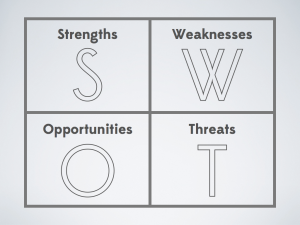
SWOT is an acronym that stands for: Strengths, Weaknesses, Opportunities and Threats.

The SWOT analysis was developed by researchers at Stanford University, following a study in the 1960s. The study looked at various Fortune 500 companies and found that there was a difference between an organisation’s set strategic priorities and what was actually done. The study also revealed that the problem was not poor employees, but rather a lack of clear objectives. Therefore, SWOT was developed to give staff a clear understanding of a business or project.

Why is SWOT analysis effective?

The SWOT analysis is one of the most important and popular tools for decision making and strategy development. This is because of its:

  • Simplicity – it is simple to learn and quick to use
  • Clarity – it focusses on the key issues and aids clear communication
  • Flexibility – it is applicable to individuals and organisations.

Having a coherent strategy is vital to any organisation, and equally, self-awareness is critical to personal effectiveness. But you need to be able to understand and communicate these things clearly. This is why SWOT analysis is such an important tool.

When should you use SWOT analysis?

The SWOT analysis is best used to:

  • Improve situational awareness
  • Develop strategy
  • Identify and refine actions and goals
  • Improve self-awareness (for an individual or team)
  • Reflect upon a completed project or activity

The SWOT analysis was designed for organisations but it can equally be used by individuals. The SWOT process identifies crucial internal and external influences within a given situation. Therefore it gives us a snapshot of where we are and is excellent for situational analysis.

Free Personal Leadership Action Plan

Just sign up here to receive your free copy

SWOT Template

The most common way to present and consider the SWOT approach is as a matrix. Here is an example template:

How do you do a SWOT analysis?

Do you want to know how to do a SWOT analysis? Don’t worry; it’s easy! Just follow these steps.

Step 1: Create a SWOT table:

The SWOT matrix is set out thus:

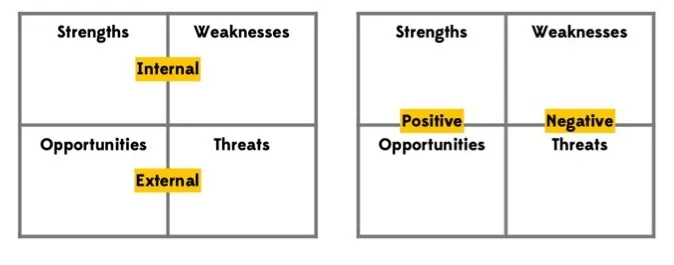
  • Strengths and weaknesses are usually listed in the first row of the matrix; S and then W. These relate to internal factors.
  • Opportunities and threats are external issues or circumstances. These create the second row; O and then T.
  • In this layout, the first column, strengths and opportunities, signify the positive or helpful factors
  • The second column, weaknesses and threats, are the potentially negative or harmful issues


SWOT Analysis Template Layout

Step 2: Brainstorm

Next, brainstorm as many different considerations as you can under each heading.

Here are some questions to help you:

Strengths (internal/personal):

  • What are your/your team/organisation’s key skills, areas of experience or expertise?
  • Can you define your USP (unique selling point/proposition)?
  • What are your core values? What do you love, enjoy or prioritise?

Weaknesses (internal/personal):

  • What do you not enjoy doing?
  • Where have you failed or fallen behind the competition?
  • What skill gaps do you have?

 Threats (external/circumstantial):

  • What circumstances are most troubling you?
  • Who is your major competition?
  • Which challenge is the most important right now?
  • What is the worst thing that could happen to you/your organisation?

Opportunities (external/circumstantial):

  • How can you leverage your present situation?
  • Who/what could most help you right now?
  • How is change providing new openings?

Step 3: Prioritise

Now prioritise the lists; work out which are the top three to five things in each quadrant.

Whether you are using it as an individual or as part of a team, keep it simple and high-level; that is the systems greatest strength.

Step 4: Analyse

Look at each item in turn and consider the actions you could take. Here are some questions to help:

  • How can you play to or maximise your strengths?
  • What personal development goals, people and processes can help address your weaknesses?
  • How can you exploit, expand or multiply the opportunities?
  • What control measures do you need to put in place to limit the threats?

Now look for further relationships that you can identify across the columns, rows and diagonals.

Remember that weaknesses are often a reflection of strengths. For example, if you have a strength in that you are very good at coming up with lots of ideas, or you are a business with lots of products, a weakness might be that you find it hard to focus on just one of them.

Similarly, look at the flip side of external factors; you may find that threats can also provide opportunities. For example, a competitor could actually be a potential partner.

A failed project is always an opportunity for learning. From your analysis, how could you use that learning and pivot the idea, or re-purpose the team?

How to do a SWOT analysis

SWOT Analysis Example

Here is a short example using personal strengths and weaknesses:

SWOT Analysis Example

First looking at the strengths I recognise that I am quite task-focused. This means I am a good planner and show determination when seeing a project through. Moving across to the right quadrant I have noted a related weakness. Because I am task-focused that means I am quite future-orientated. The downside of this is that sometimes I can forget to be content in the moment or to celebrate the success of achieving something before moving on to the next goal.

Then looking at threats I have noted down that there is increased competition in my industry, with more people entering the market all the time. This threat does lead to an opportunity in the bottom left quadrant. I have the chance to refine my USP (unique selling proposition) in order to stand out from the crowd.

Leadership Development: Master the Top Leadership and Life Skills

Better lead in life and work to maximise your success. Sign up and access materials for free!

Example analysis

It is more likely that I would list more items under each heading before continuing, but for the sake of simplicity let’s do a little analysis on what we already have.

How do I maximise my strengths and minimise the impact of my weaknesses? There are a few options I could consider under the ‘3 Ps’:

  • Personal development: I could attend some training to improve my mindfulness and being ‘present’
  • Person: find or employ someone else with a complementary skill set whose strengths/weaknesses are the opposite of my own
  • Process: put some time in the diary to be more reflective on a daily basis and plan ahead to celebrate after achieving a goal

When considering the threats, I cannot control new people entering the market but I can work out how to best serve, and therefore retain, my existing clients. The opportunity of refining my USP becomes a strategic task, something that is going to require more work delving into why I do what I do, how that makes me different, who I can best serve and what extra benefit I can bring. The other items that I list in the strengths quadrant will help to develop that USP.

Making a plan from your SWOT Analysis

The ‘Right Questions’ format is an excellent way to examine this issue and so if this is something you want to pursue further then I recommend that you read my post on What are the Right Questions for Decision Making and Strategic Planning?

If you want the right answers you have to start with the right questions

About The Right Questions

The Right Questions is for people who want to lead better, whether you are taking your first step or stepping up in leadership. We are all leaders (whether we know it or not) as we all have influence. So the question is, what are you doing with your influence?

Wherever you are on your leadership journey, I hope that you find resources on this site to help you on the next leg of your quest. Even if that is just the inspiration to take one small step in the right direction, then that is a success. If you can take pleasure in learning and travelling as you go, then so much the better.

Need help navigating your journey to success?

I love to serve people, helping them unlock their values, develop their leadership, and achieve their goals, through coaching, facilitation and courses. Please get in touch and let me know how I can support you.

How to Develop a Business Decision Process

Whether you work on your own or in a large team, you will inevitably develop some processes to help you quickly make decisions about your work. The problem is that few people know how to develop a new business decision process or how to create a flow chart to illustrate what they want to happen.

Systems, procedures and processes (when working properly) help us to be efficient in achieving our goals. They can help us save time and money as well as assuring quality or reducing risks.

Many systems in businesses are things that will evolve organically – without much real planning – but there will also be times when something is not working well and you will need a more formal approach to improve an existing process, or to create a new one.

Casestudy: A Business Decision Process for a Hotel

Here I will demonstrate how you can use The Right Questions to analyse a procedure and develop a new system. We will also look at how to create a process flow chart.

To help explain the application of The Right Questions format I will use the example of a hotel case study. This is simplified but based on some actual work I did with a hotel business.

Free Personal Leadership Action Plan

Just sign up here to receive your free copy

Where are we now and where do we need to be?

First, we look at our present situation. What is the present workflow, and what is the problem that has been identified that means a business decision process is needed?

Let use the hotel example to explore the question. The hotel receives new bookings on a daily basis and needs rooms prepared and cleaned every day too. Here the challenge is that the manager who takes the bookings is not the same one that manages the cleaners. But the cleaners need to know to prepare the rooms. Therefore there needs to be a communication process in place so that everyone knows what to do and when.

So that is the situation, how about the other side of the question: where does the hotel want to be in terms of service?

Ideally, all of the rooms should be cleaned and prepared so that guests feel welcome when they arrive. The team should be happy too because everyone knows what they are doing without having to ask.

What does success look like?

Next we need to define what we need to achieve. In the case of the hotel we have identified that:

  • Customers need to feel that they are getting a good service
  • Therefore they need clean rooms when they arrive

So, our mission statement or definition of success for this process could be:

‘Rooms need to be cleaned (on time and to the correct standard) in order that guests feel welcome.’

Why do we need the business decision process?

From the situation, we should be able to draw out some reasons behind the process. In the case of the hotel we can identify the following values that relate to what we are doing:

  • Customer service – making sure the guests are being looked after
  • Effective teamwork – people know what to do and when
  • Efficient management – the managers do not need to be interrupted or intervene over little details

How does the process work?

Now we can look at the steps or activities that have to take place for the process to work. One effective way to look at these tasks is using a flow diagram or flowchart. In a flowchart, you can break down the process into key component parts. This can include any decisions that might affect the outcome.

Using the hotel example this might look like the flowchart on the right.

Now we have identified the current steps in the process we can analyse it better. Now we can see the workflow we can start to ask questions like: are there any steps missing? Are there any shortcuts that could be created? Where are the problems?

In terms of problems, processes usually fall down at the interfaces; the places where a job passes from one party to another. This is something we will come back to.

When do the steps of the process need to take place?

As well as establishing all the tasks that need to take place we also need to work out when they need to take place. Which tasks are time-critical? What are the deadlines?

Now we have the flowchart it is easier to work out the time needed for one single task. We can now create a timeline alongside it with any deadlines or decision points that are critical to achieving the aim.

In the hotel example, bookings and the preparation of rooms is a daily task. It is simple to work out how long each task takes but complications arise around other time issues.

Firstly bookings can come at any time. Secondly, the deadlines here are created by the arrival of guests. But some guests may arrive in the morning, others in the afternoon or evening. Thirdly, staff are not all on duty at the same time. So, there is no single moment in the day for communicating what needs doing.

Who is involved in the business decision process?

Each step should be assigned to a party. That person or team needs to own that task and make sure it is completed so that the next step can be completed by whoever takes over. Once again, breaking down the process into a flowchart makes the identification of these parties much easier. Responsibilities and expectations for each stakeholder can now be specified.

For the hotel example different colours have been used in the flowchart to highlight the different people involved in the process (Manager 1, Manger 2, the Cleaners and the Guests).

Which different ways can we achieve the aim?

There will be different ways to solve a problem so it is worthwhile taking some time to look at the options. Going through this process with the team, or whoever will be affected by the process, is an excellent way to engage people with the change. It will help them to understand the need for the change, take ownership of it and also help to generate new and creative ways to solve the problem.

By identifying the exact steps and interfaces where a process is not running smoothly it is possible to hone in and propose alternative solutions for each activity where things aren’t running smoothly.

In the case of the hotel’s workflow, it has been seen that sometimes Manager 2 is busy with another urgent matter and cannot create the list of rooms that need to be prepared. Equally, there can be a problem if Manager 2 is not around when cleaners have a question about preparing the rooms. The third challenge is that Manager 1 is not always informed when a room has been prepared ready for a guest.

Now the exact problems have been identified new solutions can be proposed. Is there a software solution that can inform everybody as soon as a booking has been made? Could there be a noticeboard or whiteboard in a common area where all parties can update the details about the rooms? Could roles be rearranged to make things run more smoothly?

Leadership Development: Master the Top Leadership and Life Skills

Better lead in life and work to maximise your success. Sign up and access materials for free!

Experiment with business decision process options

Generally, there is no one right answer to making a business process work. It will often take the trialling of different options to find the one that works best. Also, processes need to change. The growth of a business or changes within a team could mean that a system needs to be reviewed.

One very important lesson is that processes, systems and structures within an organisation are just a means to an end; not the end in themselves. Large institutions often forget this and their processes can grow to become the driving force within the organisation. This should never be the case. Systems should always be checked, challenged and improved. They are only ever truly efficient if they are effective; they are only effective if they are helping to achieve the overall mission.

If you want the right answers you have to start with the right questions

About The Right Questions

The Right Questions is for people who want to lead better, whether you are taking your first step or stepping up in leadership. We are all leaders (whether we know it or not) as we all have influence. So the question is, what are you doing with your influence?

Wherever you are on your leadership journey, I hope that you find resources on this site to help you on the next leg of your quest. Even if that is just the inspiration to take one small step in the right direction, then that is a success. If you can take pleasure in learning and travelling as you go, then so much the better.

Need help navigating your journey to success?

I love to serve people, helping them unlock their values, develop their leadership, and achieve their goals, through coaching, facilitation and courses. Please get in touch and let me know how I can support you.

How to Estimate The Resources You Need to Achieve Your Plan

What resources do you need to achieve your goal? How do you estimate those resources for your plan? Which ways can you get the resources you need?

Quite often we limit ourselves and our plan to our present resources.  After all, it is reasonable to ask ‘Which holiday can I afford?’ before going and booking one.  Budgeting is good stewardship and I would certainly not recommend getting into debt on a whim.

But we will never be able to dream big or make macro leaps forward if we limit our goals to what we can achieve with the resources we have now.  It is better to first ask what we are passionate about doing, working out the resources required, and then thinking creatively of ways to get what we need.  That is why this question comes some way down the planning process.

The importance of logistics

An army needs logistics. A large portion of every military is concerned with delivering the right resources to the right people in the right places.  In fact, there are many more logisticians than infantry soldiers in the average army.  But the army does not exist for logistics. It has a mission to achieve. That aim is very rarely just to do with just moving men and equipment from one place to another.  Logistics is a large and essential part of achieving your aim. But it is there to support the mission, not to drive it.  History testifies to the fact that an army will beg, borrow and steal if necessary to get the job done if (or rather when) logistics fail.  You can still achieve your aim when resources are difficult to come by if you remain focussed; as the United States Marine Corps would say: you just need to ‘improvise, adapt and overcome!’

Free Personal Leadership Action Plan

Just sign up here to receive your free copy

The right motivation is key

This is because there are very few times when finances and resources are fixed.  A compelling vision inspires us to innovate and save. It motivates us to earn and raise the funding that we need and find the tools to get the job done.

Why is it that many people who win the lottery often struggle. Why do they end up having spent their money within a few years?  The gambling industry sells winning as the dream; it does not provide a vision for what comes beyond that.  Many people who win do not have a clear idea of what they want to do with the money. They might take a nice holiday and pay off the mortgage but that is not a grand vision. Anyway, these things can be done without playing the lottery or the roulette wheel.

People who make (and keep) large amounts of money use it productively. Resources that continue to grow are usually driven by a vision beyond that of just making cash.  Bill Gates, the richest man in the world for most of the last decade, was not motivated primarily by money.  When he started Microsoft with Paul Allen they had a vision of a computer in every home. This dream, of how computing could transform the world, drove Microsoft. It became the most successful software business in the world and made Bill Gates a multi-billionaire.

Money, Manpower and Materiel

So we start with the dream and then work out what we need to make it a reality.  When we need to make something happen it generally comes down to the three ‘M’s:

  • Money
  • Manning
  • Materiel

Cash, workers and equipment are all important but it is usually the first element, the money, which drives others; so this is the primary consideration here (we will look at the people issue more under the Who question).

Estimating the cost

When we have our dream or our goal, we can start to put a cost against it.  If it is hard to assess the cost for a whole goal we can break it down, as we have done previously, and cost each constituent task or step.

Remember to put a cost against the time you invest in achieving the goal.  When doing something yourself you can feel you are getting it done for free but that is not actually true.  Our time is worth something, even if it is just the opportunity-cost of not being able to do something else while we are engaged with a task we have decided upon.

Often it will turn out cheaper to pay someone else to do a task that can be delegated as this leaves you just the things that no-one else can do and you will achieve your goal all the sooner.  We will look at delegation some more under the ‘Who’, but having broken down tasks and now putting costs to them will help you make decisions on the team you might need.

Leadership Development: Master the Top Leadership and Life Skills

Better lead in life and work to maximise your success. Sign up and access materials for free!

Alternative funding

Once you have estimated a cost for each individual task you will get an idea of the budget for the whole project.  Once this has been done you can start to think creatively about how to reduce the costs. Or you can seek further resources in more inventive ways (and no I am not talking about stealing here!).

For example, instead of paying for a qualified professional, could you get someone to do the work voluntarily? Perhaps you could offer them experience as an intern? If someone is still in training or education they may value the experience more than pay.  Alternatively, think about what service or product you might be able to offer someone in return. Bartering is as old as trade itself but sometimes people forget it. I have used this sort of transaction in building my business. For example I have coached people in return for help with my website.

I used this method when I employed someone to develop my website. They worked on the website in return provided some coaching to help them further their career. It was an easy win for both of us, and no cash changed hands.

Fuel the dream

Considering the resources we need and how we are going to get them is an important aspect of how we make our dreams real.  An idea becomes a lot more tangible as we think about and assess the tools and materials we need for the job. It can take some time, and may not be as liberating as some of the big picture thinking, but it is important so stick with it!

“First, have a definite, clear practical ideal; a goal, an objective. Second, have the necessary means to achieve your ends; wisdom, money, materials, and methods. Third, adjust all your means to that end.” Aristotle

If you want the right answers you have to start with the right questions

About The Right Questions

The Right Questions is for people who want to lead better, whether you are taking your first step or stepping up in leadership. We are all leaders (whether we know it or not) as we all have influence. So the question is, what are you doing with your influence?

Wherever you are on your leadership journey, I hope that you find resources on this site to help you on the next leg of your quest. Even if that is just the inspiration to take one small step in the right direction, then that is a success. If you can take pleasure in learning and travelling as you go, then so much the better.

Need help navigating your journey to success?

I love to serve people, helping them unlock their values, develop their leadership, and achieve their goals, through coaching, facilitation and courses. Please get in touch and let me know how I can support you.