The Evolution of a Leader – How to Make Sense of Leadership Theory
I know what you are thinking: leadership theory, surely that is dull and largely irrelevant? Believe me, I understand! I have always thought of myself as a practitioner rather than a theorist but, reflecting upon my journey as a leader, and having been taught various theories over the years, I can highly recommend that you read on. These leadership models can be very instructive in understanding your own leadership style, the areas where you can develop and approaches to help you improve as a manager.
To illustrate this, and hopefully give some relevance to the theories, I will share how — somewhat unexpectedly — I became a leader and then went on to develop my management skills. Leadership theory can be a very dry subject so hopefully, these stories and examples will give you an accessible introduction to each one.
You do not have to know every leadership theory in detail in order to be a good leader but, through my experience and coaching other leaders, I have found that understanding a few key models really helps in developing management skills and self-awareness. The most useful theories help us to understand leadership – both our own and others – and how people influence each other. Listed below are some of the major theories that I have found most useful at a personal level.
If you would like more detail on any one of the leadership theories listed below just click on the hyperlinks and they will take you to posts with a fuller description, an expanded story and more examples.
My Leadership Journey – Simon Ash
1. Great Man theory
Great Man theory (Carlyle, 1840) is one of the oldest leadership theories and is the idea that leaders are born with the innate ability to shape history. This is a problem for most aspiring leaders if, like me, you were not born a Great Man by any means. I certainly wanted to be powerful. I wished that I could be great (or at least popular). Back then I did not aspire to be Alexander the Great or Napoleon, I did not even know who they were when I was that young; at that time my role models for leadership were superheroes.
More specifically, I wanted to be Superman. But, unfortunately, I was not gifted with superpowers from birth. Therefore I had an idea that with some rigorous training and putting myself in peril, that my burgeoning powers would be revealed. So, I undertook flying training. This involved me jumping from the stairs in my house to a chair in the hall. For every successful jump, I moved the chair further away. This progressed until a crash, a scream and a broken collarbone later, I found myself the only person in Guildford hospital in a superman costume. I recovered but did not learn immediately. I broke my collarbone a second time before giving up on the superhero training.
So much for the Great Man approach! This theory has mainly been debunked now but the important thing to remember is not to discount yourself from leadership. We may not be born to greatness but we can all achieve great things in whichever situation we find ourselves. And don’t make the wrong comparisons. Don’t assume you are powerless just because you don’t seem to have the same influence as a CEO or world leader.
2. Control and domination
Great Man theory was linked to the idea of power and that leaders could naturally dominate others by the strength of their personality and presence (Moore, 1927). This control of others was considered the natural state of affairs for a leader.
This brings us to my next disastrous attempt at leadership when I was a Cub Scout, aged about 10. By virtue of my age, as much as anything else, I was made a ‘Sixer’; a leader of six other poor Cub Scouts. Every week, on the evening the pack met, we had to line up on parade for an inspection. To achieve this, I used the threat of violence to control and dominate my six. It was a misuse of the little power I was given. Not only is this horrific it is also ridiculous. I was a very skinny boy who could hardly stand up in a stiff breeze. Any show of power was at best highly tenuous and when I look back it is all very embarrassing.
The important lesson here is that power is frequently abused, no matter what the level of responsibility. The events of the early twentieth century and the abuses of power by the likes of Hitler, Stalin and Mao were enough to make people rethink these early ideas of what makes a leader great. We need to remember these lessons if we are going to avoid misusing our influence and becoming toxic leaders.
3. Leadership traits and skills
The next step in leadership theory was studying the traits of leaders, to see what common characteristics made a good leader. In the early iterations of the theory, these traits were very much of an unachievable ideal (Galton, 1869). The idea of a leader being male, tall, good looking, charismatic, confident and outgoing held sway for some time.
Therefore, by this measure, things did not get better for me as I went from a scrawny child to a gawky teenager. If I compared myself to the leadership traitsfrom early theories I had little to offer. I was not charismatic, confident, or attractive. I was not the sports star or the leader of any gang at school. It is almost a surprise that my leadership journey did not stop there.
The idea of innate leadership traits evolved into finding more positive characteristics such as integrity, moral courage or wisdom. It was recognised that these traits could be developed and therefore the next logical step was identifying key leadership skills, ones that could be taught. The tipping of the balance in the theory, from nature to nurture, was an important one, not least for me! Now the focus was on skills and tools that could be learned by new leaders and managers.
4. Action-centred leadership
When I went to college, for the first time in my life, I was actually taught specifically about how to be a leader. Leadership development was part of our syllabus and I can still remember the lecture where we were taught John Adair’s Action-Centred Leadership model (1979). This approach was based upon a straightforward theory you could learn and skills that you could employ.
The simple idea behind Action-Centred Leadership is that of balancing the three core management priorities of the task, team and individual. Most commonly illustrated as a Venn diagram, these three interlocking circles represent the juggling act of a leader. They must continuously seek to achieve the task, build the team and support the development of each individual.
At the time I found, that with this simple tool, I could at least start to identify what I needed to do as a leader and where perhaps I might be failing. I went from the quietest person in my year to the dizzy heights of college prefect with my newfound knowledge. I finally felt that I was developing as a leader. This is the product of having an effective tool that you can apply when learning to manage others.
5. Situational leadership theory
The next key step for me was a lesson in situational leadership. Situational leadership (Blanchard, 1985) is a model that demonstrates how you can adapt your management style depending upon the team you are working with and the environment you find yourself in. The leader chooses their approach – to delegate, support, coach or direct – as appropriate.
I have always loved the mountains and during university, I was climbing in the Alps with a few friends. There was no official leader of the group but the loudest person in the group (not me) inevitably assumed that role. But they did not need to do much as we were all competent. Once roles were delegated out we did not need coaching or even that much support. That went well until we hit a real challenge.
One day we were climbing a long route and the weather deteriorated quickly. The clouds thickened and, as we reached the summit, we found ourselves in the middle of an electric storm. The person who had been leading seemed paralysed by this turn of events. I suddenly knew what to do. It was a crisis and the team needed clear direction. Without even really thinking I took command. I outlined a quick simple plan and led the team, at pace, down the mountain to safety.
Being directive is not my usual or favourite leadership style so this experience gave me new confidence in my ability to flex my approach as a leader. I still find the situational leadership model useful when considering how best to manage a team given their experience and the circumstances.
6. Servant leadership theory
After university, I went to the Royal Military Academy Sandhurst. The motto of Sandhurst is, famously, ‘Serve to Lead’ and here the emphasis was on putting the mission and the team before self. This idea of ‘the servant as leader’ (or servant leadership) was developed by Robert Greenleaf (1977).
This model of servant leadership – creating an environment where people can flourish and succeed – has influenced all my leadership since. Helping others to succeed is something that motivates me, particularly in my work as a coach.
But what I like most about this model is that it turns traditional leadership (particularly the Great Man theory) on its head. Servant leadership empowers us to lead, humbly, from whatever our position or situation. For me, Mother Teresa would be an example of this sort of leadership. She had a global impact through living by this philosophy.
7. Non-directive leadership
The exposure to situational leadership and servant leadership helped me to learn that my favourite leadership style was non-directive. I liked to ask questions rather than telling people what to do. I prefer to encourage people to be creative, to work together and to share success rather than being loud and the centre of attention.
This style was well suited to bomb disposal which was my first job as an officer in the Royal Engineers. I learned to love working in small, specialist, highly motivated teams. It also set me up for the coaching and consulting work I would do more of later.
If you feel uncomfortable bossing people around then it is important to understand non-directive leadership and how you can influence people without having to shout at them. If you like bossing people around then maybe consider adding some non-directive techniques into your management style. You might be surprised by how effective they are!
8. Transactional leadership theory
I left the Regular Army and started working as a project manager on large construction projects, such as The Shard, the tallest building in London. Here I was mainly managing consultants and building contractors on the behalf of property developers. As compared to the Army, people in this job would not do what I said just because of my position. When the chips were down it was all about transactions.
As a project manager, I had to fall back on the leverage of contractual agreements and money to ensure that things got done. This, for me, was a lesson in transactional leadership (Burns, 1978). This was management using a carrot and stick approach; a functional style that relies on basic human needs such as income and job security. As such it has its uses – as I found – but the approach remains quite limited in its overall effectiveness. That is why it is often considered the poor twin of transformational leadership.
This managerial style of leadership was not one I was inspired by nor one I wanted to rely on. Having to use it was a valuable lesson but I soon realised that the construction industry was not where my heart was.
9. Transformational leadership theory
So, when I was offered the chance to be a part of a non-profit start-up I jumped at the chance. In my new role, I was responsible for the charity’s operations and this included needing to recruit, train and manage large groups of volunteers.
The largest group of volunteers that I led needed to give up one Sunday in three and work a ten-hour day. To achieve this, I had to learn about transformational leadership(Burns 1978). In other words, my leadership had to be linked to a higher cause or vision that would inspire people. My position held no real power. There was no military law, contract, or money to use as an influence. Scarily, I had to motivate the team, without these levers, for them to turn up and do the job. This was the first time I really had to think about vision and how to inspire people to be part of something.
I also learnt a lot about coaching. As the team and work grew, I had to mentor and develop new leaders to take on the extra responsibility. That is another key facet of being a transformational leader – raising up new leaders – and one that I continue through my various responsibilities, not just my work as a leadership coach.
10. Authentic leadership theory
All these experiences led me into the coaching and consulting work I do today. Here I am able to help businesses and leaders as they face their own challenges. As I reflect on the leader that I am today, I feel I am getting closer to what might be called authentic leadership(George, 2003). Being an authentic leader is primarily about self-awareness, balance, transparency and a strong sense of morality.
In my case, I am increasingly comfortable leading in a way that reflects my values, my character and the things I am passionate about. I know that I am a leader who loves adventure and challenge and I find empowering and equipping others deeply satisfying. I am also more confident to share my thoughts and experiences; including admitting when I don’t know or when I have messed up.
And that is good as we can all get complacent as leaders. The saying goes that ‘pride comes before a fall’ and that was certainly the case for me. Just when I thought I was getting this leadership thing sorted, I became a parent and realised I still had plenty of failings! So the journey continues.
Understanding and promoting your own leadership development
So that is the journey so far. Basically, I have come a long way down the leadership path, but I have a long way to go. But that is not a problem. One theme that runs through newer leadership theories is that becoming a leader is a journey of continual learning and development. Each new day, each new challenge is an opportunity to grow.
Leadership theory is only useful if it helps us in that growth. My advice, especially if you are new to management, is to take one or two models that you can most relate to and then use them to help reflect on your leadership and the leaders that you follow or admire. Once you feel comfortable with one style, try another.
I am biased (being a leadership coach!) but having a coach or mentor can massively accelerate your development as a manager. Think about leadership as you would any other skill; if you want to get better, find someone who can help you as you set goals and practice.
You can start now. Take a few moments to reflect. Which of the leadership theories above most intrigues you? Once you have identified one then ask, what aspect of this model could you apply in the interactions you have today?
If you want the right answers you have to start with the right questions
About The Right Questions
The Right Questions is for people who want to lead better and make better decisions. We are all leaders as we all have influence, no matter how much or how little. So, how are you maximising your influence?
If you are unsure, just drop me a line. I would love to help!
Do you want to lead better? Would you like to make better decisions? Want support in achieving your goals? Get in touch and let me know how I can help!
Today you will make hundreds, maybe thousands of choices. Some of those judgements will be more important than others, but if there is one thing that I have learned, it is that we can all be better at decision-making.
I have spent years studying and teaching decision-making. This has not been a purely academic exercise either; as a leader and entrepreneur, I have had the opportunity to practice and learn from the practical application of the theory. I have not always got it right or made the best choices, but I have improved through the process.
I started this series on decision-making with a post on the things to do to make effective decisions. You can use these as a blueprint for learning how to make better choices, following each stage in turn. Here are the 10 steps:
How to Make Effective Decisions
Take time out
Identify the type of problem
Apply a decision-making process or model
Ask questions
Understand what matters
Assess factors and constraints
Identify assumptions
Consider your options
Think through the consequences
Make your choice and act upon the decision
Here is each step in more detail with the relevant links to previous posts:
Take time out
If you have a big decision to make it is worth taking some time to think about it. If you are facing an important choice, you should invest time and effort proportionate to the scale of the problem. For example, purchasing a house will require more thought than buying a coffee. So be proactive, plan in some thinking time.
My favourite way of getting quality thinking time is taking a walk, preferably in the great outdoors. Walking is not only good for making decisions as you can read about in The Surprising Power of Going for a Walk.
Identify the type of problem
When you start to think about your choice it is worth starting by classifying the sort of challenge you are facing. That is because the solution to the issue is dependent upon the sort of problem that confronts you.
There are two very helpful models to assess the sort of problem and how to deal with them. The first one was developed by Keith Grint and I explain in the post: What Sort of Problem Do I Need to Solve?
Decision-making is a process. Whether or not we are conscious of how we make our choice and whatever the balance of intuition and logic in our decisions, there is always an underlying structure.
If the choice is not an obvious one, then we need to start asking some questions. Good questions lead us to the data needed to inform our decision. When asking questions, it is good to use a framework to ensure as many bases are covered as possible. One simple approach, using interrogative words, is explained in How to Ask The Right Questions from a Bomb Disposal Officer.
Understand what matters
The more I have worked as a leader and coach, the more I appreciate the importance of values in how we make decisions. Values are the moral compass that guides our choices, as I explain in Unlock Your Values to Make Better Choices.
Having asked questions about your situation you will be presented with data to process. These are the factors and constraints that influence your choice. But the way we process data is not necessarily as rational as we might like. Our brains use hacks, and our neurological programming has bugs. These cognitive biases can undermine quality decision-making so you need to be aware of them, as I explain in You are More Biased Than You Think.
Identify assumptions
Another beartrap to be aware of when making decisions is poor assumptions. We frequently don’t have all the information we want when making a judgement and therefore we rely on assumptions. Sometimes these assumptions are reasonable and other times they are harmful fallacies. Learn to work out which is which in How to Identify and Disarm Wrong Assumptions.
Consider your options
Having considered all the factors and avoided the pitfalls of harmful biases and wrong assumptions, the next step is thinking about the different courses of action that you can take. Most choices have multiple options and one of the challenges of decision-making is negotiating these options. There are decision-making models to help do this, but I have found that the most important thing is to first create an environment where people can think to the best of their ability. The critical elements of this thinking environment are laid down in How to Give The Gift of Generative Thinking.
Think through the consequences
Once a preferred option is identified then it is worth considering the consequences of embarking on the course of action. Before fully committing you can try and assess what the obstacles and outcomes are likely to be. Most importantly you can work out whether a decision is reversible and what is the impact of going back once a decision is made. If we fail to do this final check on our decision then we can end up in trouble, as seen in How a Heuristic Nearly Killed Me.
Make your choice and act upon the decision
Finally, we need to act. A decision is only really a decision when we take the first step. That is the first challenge as the first steps are often the hardest. The next issue is keeping going as many choices – such as big life goals or changes – requires determination to see them through. The trick here is to make a discipline of incremental progress. To do this we have to change our behaviours and we do this by building effective habits. One tried and tested way of building habits is explained in How to Build Supreme Habits and Compound Good Decisions.
Putting it all together
So, there you go. You are now equipped with the psychology, steps, and models that you need to make better choices. And as with any other skill, we improve through deliberate practice so apply the knowledge, review what you have learned, and apply those lessons to your next decision.
What choices do you need to make today? Pick one and start to work through the steps. Let me know how you do!
This article was first published on Medium.
If you want the right answers you have to start with the right questions
About The Right Questions
The Right Questions is for people who want to lead better and make better decisions. We are all leaders as we all have influence, no matter how much or how little. So, how are you maximising your influence?
If you are unsure, just drop me a line. I would love to help!
Do you want to lead better? Would you like to make better decisions? Want support in achieving your goals? Get in touch and let me know how I can help!
Why Culture Will Eat Your New Strategy For Breakfast
Management guru Peter Druker reportedly said “culture eats strategy for breakfast”, but other leaders and strategists express similar sentiments. The underlying message is, it does not matter how good a plan you have, if you don’t consider the human element then your strategy is unlikely to succeed.
Having worked with numerous companies on developing a strategy it can be all too obvious when grand plans are doomed to failure. One key metric is the delta between a company’s stated values and the behaviour of the people within the organisation. But to address this gap you first need to understand the organisational culture.
Why strategy fails
A strategy is a plan of action to achieve a long-term goal. As Richard Rumelt notes in his book Good Strategy Bad Strategy, a good strategy must diagnose the challenge to overcome, create a guiding policy to address that challenge, and then produce coherent actions that ensure that the policy is carried out.
Most people get the essentials of what strategy is. Where it generally fails is in the third element, the implementation; ensuring people carry out the actions is where things go wrong. This is often because the board level strategists fail to take culture and values into consideration. Actions are just behaviours, but real change is not brought about by one single action. It is the compounding effect of multiple actions over time. If you want to shift the way you want people to act you need to change their normal routines.
Routines are just one element of organisational culture. Changing our personal habits can be difficult, so why – do leaders – expect to change a whole organisation and the habits of hundreds, if not thousands of people, just because they say so? Making this sort of transformation requires careful consideration and to make a change in behaviour you first need to understand all the facets of the culture of a given group.
The importance of understanding organisational culture
Every group of humans has a culture of some sort. Every family, company, and sports team – let alone a country or nation-state – has its own culture. The problem is when we live within these tribes the culture is so ingrained, we often don’t think about it or can struggle to express it.
Therefore, it is useful to have a model to examine and explain a culture. The Cultural Web, the tool developed by Johnson and Scholes, is a simple and effective lens to use in this context. Johnson and Scholes break down culture into six component parts: stories, symbolsritualsandroutines, power structures, organisational structure, and controls.
The Cultural Web
The Cultural Web comprises of the following components:
Stories
These are the past events people talk about. The shouted successes and the whispered failures. The discussions around the water cooler. These narratives carry important messages about the underlying values of a people group. The language used to express these stories – the jargon, acronyms, and lingo of a group – are just as important. Every tribe has its own dialect.
Symbols
These are not just flags, badges, and company logos. Symbols are also expressed in how people dress, office décor, even in a preferred brand of software and technology! Every item you see around you is the result of a choice influenced by a principle. For example, why have that type of coffee? Because it’s the highest quality, a trusted brand, or the best value? Understanding the decision can reveal a value judgement.
Rituals and routines
Every tribe has its own rituals and routines. The time when people start and finish work, what people do for lunch, even how (if at all) people celebrate birthdays and successes are all cultural rituals. Meetings are one fascinating way of examining culture. The routines of how a meeting is conducted, who sits where, who speaks when, and the language people use, all speak volumes about the culture and values of a group.
Organisational structure
There are always formal and informal structures in any group. Both need to be understood. An organisational chart may capture the official structure but what are the networks that exist, the webs hidden below those regimented lines? Look to see the tribes that gather; the smokers and the lunch-time runners as well as the project or function-based teams.
Power structures
Power derives from people and particularly the individuals who are decision-makers. These power structures do not always follow the official hierarchy either. For example, the personal assistant who manages access to an executive can wield power that outweighs their perceived grade in any management structure. Think: who are the internal influencers?
Controls
Controls are the systems, processes, and regulations that an organisation develops. These controls assist the conduct of work but also regulate behaviours. These can include things like financial controls, contracts, and company articles but there are also a host of unwritten rules and ways of working in any group. If you don’t think that is true, then just ask the newest member of the team about what they had to learn to be accepted into the clan.
Culture is manifest in behaviour
Once a culture is understood you can start to identify potential levers of change. But that still does not mean it is easy, if you don’t believe me just try changing the dress regulations for any given team!
We are all creatures of habit and therefore change at any level requires overcoming inertia. We all know this. Habits can be changed but think back to the last bad habit you tried to modify. It is not easy, even when you do identify the cues, routines and rewards in a habit loop.
Therefore, even if the intellectual argument for change is compelling, there is a huge work to be undertaken once a strategy is agreed upon. As John P. Kotter shows in Leading Change, you must have leadership and a plan to take people through the change, not just set the target. To develop a plan, you need to understand the psychology of influencing groups of people and gently motivate them to act in the right way. This is the essence of nudge theory; people need subtle cues, personal incentives, and positive reinforcement to change.
How values should be expressed to inspire action
One way to engage a whole team or organisation in the change process is through a discussion of values. Values are symbiotic with culture, as it is our shared principles and corporate beliefs that are expressed in the symbols, structures, and stories that we share in an organisation.
The problem is the behaviour of many individuals and teams are not aligned to the stated values of their organisation. This is often due to one of these three problems:
The wrong values
Sometimes a company just picks the wrong values. The values are generally not bad in themselves – virtues such as creativity, inclusivity or productivity are all good – but that does not mean they are the right values for that given group or capture the drivers for change in a strategy.
Corporate values need to express the key beliefs of that given group. They express how that team makes decisions, how they are different and most importantly why they behave that way. If you want to change the priorities of an organisation, as happens in strategy implementation, then the values need to align with that strategy.
If this is the problem – and values do not express either the current situation or strategy – then it is worth starting again, examining culture, and engaging as many team members as possible to identify the true values of the organisation and the core principles of the new strategy.
Poorly expressed values
Expressing values poorly is the next common problem. This is often the case when companies choose single virtue words to communicate their principles. Take the word creativity. I have seen creativity stated as a value for schools, legal teams, and accountancy firms, not just the obvious ones such as advertising teams, tech firms and artists.
So, if you pick a term like creativity, the question is, what does that mean within your given context? One simple way to improve the expression of a specific virtue is by coupling it with another word. Creativity could become continual creativity, collaborative creativity, playful creativity, or something else. But suddenly, with just adding one (or two) extra words that value statement becomes more personal to the group and can better express the way that value informs choices and behaviours.
Misunderstood values
And that thought on behaviours brings us nicely to the third point – misunderstood values. Even if a value is expressed succinctly it may still need further explanation to describe how that value informs the actions of that group.
Therefore, when considering corporate principles (or personal values for that matter), once the value has been identified and expressed, the next step is to define its meaning in terms of how it informs action. Every value needs a paragraph of explanation that unpacks how a value should inform the thought processes and behaviours of the team.
Expressing organisational culture through shared values
So, don’t let your organisational culture eat your shiny new strategy for breakfast. If you want a strategy to succeed, having a good strategic plan is not enough. You need to bring strategy, culture, and values together. To do this you must:
Understand the organisational culture
Identify values that align that culture with the strategy
Explain and demonstrate how those values should be expressed in behaviour and decision-making
This may not be a quick or easy process, but it is better to go slow than to race towards the strategy car-crash that is likely to happen if you try to enforce a change without following these steps. It is a thankless task – for managers and workers alike – to have to continually prod people to change direction.
But if a company’s strategy and values are aligned, and the team behaves according to those principles, then it is like a flywheel starting to turn. It builds up momentum to a point where the positive inertia pulls the organisation towards its goal. Then, as the boss, you can stop thinking about prodding and start thinking about what new ritual you might introduce to celebrate the success of the team!
If you want the right answers you have to start with the right questions
About The Right Questions
The Right Questions is for people who want to lead better and make better decisions. We are all leaders as we all have influence, no matter how much or how little. So, how are you maximising your influence?
If you are unsure, just drop me a line. I would love to help!
Do you want to lead better? Would you like to make better decisions? Want support in achieving your goals? Get in touch and let me know how I can help!
Why Personal, Corporate and Universal Values Are Important
Individual, Group and Global Values Explained
I am fascinated by the concept of values and their different types; particularly how they affect our character, decision-making and leadership. The more I explore this topic and implement the lessons, the more I am convinced of the importance of understanding principles at every level, from the individual to the global.
In my own learning journey, I have discovered the impact of knowing my core values and applying that to my life choices. As a coach, I have witnessed the transformation that exploring personal values can have; seeing people gain a deeper understanding of themselves and others. As a leader, I have seen the impact of leading authentically, by my principles, and the transformation of groups into high-performing teams, when they properly understand and behave according to their shared values.
I have also witnessed first-hand the friction when people breach universal values on the international stage and the terrible conflict that results. Now, as we live through yet another terrible war in Ukraine, it is important to reflect on what these values are and how we should respond. Not only that, there are other crises, such as environmental change – wicked problems – that require a principled approach if we are ever going to tackle them.
This specific post looks at the different levels of values and brings together the differing perspectives, paradigms, and insights that I have shared in the most recent ten articles in my Leadership Unlocked column. This post provides an overview of the topic as well as embedded hyperlinks to help you explore in more depth any area that particularly piques your interest.
The different types of values
Firstly, we should ask the question, what are values? Among other things, values are principles, standards, judgements, beliefs, and priorities. They are things we give worth, a concept that is explored in How We All Worship Something (and Why That’s Important).
Broadly, values can be categorised into three types:
Personal values
Corporate values
Universal values
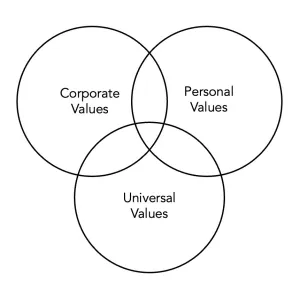
These different types of values tend to overlap and have some commonalities but the way these values are expressed and prioritised is often subtly different at each level. These can be visualised as overlapping spheres or ellipses, as in the diagram below.
Different typoes of values and how they overlap
Let’s look at each type of value in turn:
Personal values
Personal values are the specific combination of values that best reflect our character and preferences. For example, these could be compassion, courage, honesty, or any number of other virtues. For me, adventure and inquisitiveness are core personal values.
Finding your personal values is an important part of self-awareness. As the Greek philosophers said, the starting point of wisdom is to know thyself. Self-inquiry is the start of self-improvement, as explained in Why Socrates is the Father of Self Improvement.
Understanding our personal values is also important in terms of mental health and physical wellbeing. Our values help us to gauge our performance and energy levels, as seen in Burnout Prevention: How to Monitor the Essentials.
But it does not stop there. We need to constantly re-examine our values. We change and our situation changes. These changes can cause misalignments between ourselves and these actions. This can lead to feelings of frustration and unhappiness, as I have experienced and shared in My Mid-life Crisis and How to Re-find Happiness.
Corporate values
Corporate values are the precepts we hold in common within a family, team, organisation, or people group. These are the principles that bind a group of people together for a particular purpose.
Many organisations have statements that include values such as integrity, creativity, and collaboration. These values should be visible in the behaviour of an organisation, as explained by the Iceberg Model of culture.
If organisations don’t take their values and culture into account then things can go very wrong, especially when they are implementing change programmes, as explained in How to Stop Culture Eating Your Strategy for Breakfast.
Universal values
Universal values are core virtues that transcend individuals, organisations, and national borders. Examples of these would include those enshrined in the United Nations Charter, such as peace, freedom, equal rights, and human dignity.
We often examine values through a very personal lens, and this is important, but this can often limit our ideas of success, both in time and level of impact. Values or virtues should help us define what achievement really means. This success goes beyond just us as individuals as none of us can live a life without interacting with and influencing others. Therefore, we cannot examine values in isolation. Personal values are nothing without the context of corporate and universal values.
There can often be a difference between how we try to sell ourselves – through our CV or on social media – and what really matters when we consider the perspective of universal values. What does success actually mean in this life? The author David Brooks challenges the question “what do I want from life?” and asks another question, “what does life ask of me?” This challenging idea is explored further in What is the Difference Between Eulogy Virtues and Resume Values.
Here is another way to look at the three types of values (personal, corporate, and universal) intersect. This time we have three overlapping circles.
Where values overlap can give us insight to our purpose
Each of us has a unique expression of how and where these circles meet. When you have explored and understood each different sphere you should have a better idea of where and how the values overlap.
Why is that important? Well, this intersection can give us a great insight into the specific role we can play, and the special impact that we can bring to the world. We may not feel we can change the whole world, but we can certainly change our world; the environment and the community we live in. This opportunity, where our values align and can bring the greatest impact, can reveal our personal or life purpose.
So, what is that place for you?
If you want the right answers you have to start with the right questions
About The Right Questions
The Right Questions is for people who want to lead better and make better decisions. We are all leaders as we all have influence, no matter how much or how little. So, how are you maximising your influence?
If you are unsure, just drop me a line. I would love to help!
Do you want to lead better? Would you like to make better decisions? Want support in achieving your goals? Get in touch and let me know how I can help!
The Best Books on Leadership, Management, Strategy, Decision-making (and More!)
Here are the books that I recommend the most to other people. The list reflects my favourite writings on leadership, management, work, strategy, decision-making and success in life.
I read (and listen to audible books) vociferously but these books have impacted me most and are ones that I keep re-reading, referring to and recommending to others.
You may well recognise a few, and hopefully, you will find some to add to your reading list. I hope they help you as much as they have helped me (just click on the bold-italic links if you want to find them on Amazon).
The 21 Irrefutable Laws of Leadership by John C. Maxwell is one of the best-selling leadership books of all time. One of the reasons is that it is easy to read and apply. If you are wanting to examine your strengths and weaknesses as a leader then this book is a great aid. I find that Maxwell’s definition of leadership as ‘influence’ as being one of the most useful paradigms for thinking about leadership, in all its forms.
For people who want to lead but don’t feel confident
There is little evidence to support the idea of people born to lead, but when you step into leadership (or it is thrust upon you) it can be daunting looking at all the confident looking executives that seem to be everywhere you look. The truth is, even experienced leaders can feel a lack of courage when faced with the challenges of leading authentically in an ever more challenging environment. That is why I recommend reading Dare to Lead by Brene Brownno matter where you are on your leadership journey.
For people exploring their own or their company’s purpose
The obvious choice here is Start with Why by Simon Sinek.It is an easy and pleasurable book with a simple premise: why people do things is more important to understand than just what they do.
The other book I recommend isGood to Great by Jim Collins. It is a bit dated now, especially as some of the example companies have failed to remain great since publication, but there are still some great insights in this book such as the ‘hedgehog principle’ that helps to work out an organisation’s sweet-spot for success.
For understanding business strategy
Strategy is a common word in the business (as well as military and political) lexicon, but it is very hard to get any two people to agree on a definition of strategy, let alone how to make one. Good Strategy Bad Strategy by Richard Rumelt does a great job in sifting through what is and isn’t a strategy and then outlines the building blocks of developing a good one.
For leading people through change
Leadership is all about steering people through change. Change is a constant (and therefore so is the need for leadership) but this is often forgotten, particularly in large institutions. Another common mistake is trying to implement change management without the right leadership direction. Leading Change by John P. Kotter outlines the steps of successful change leadership, based on over 25 years of experience in the field.
For those starting a new business
The Lean Startup by Eric Ries is required reading for any entrepreneur and start-up, but should also be read for those working in larger corporations. Every size of business have to deal with complexity and fast-moving change, the principles of ‘lean’ organisations and agile management are relevant to all.
For people who want to understand and build teams
In terms of identifying team roles and helping team members understand each other, I still refer to R. Meredith Belbin’s work, captured in his book Team Roles at Work. The 9 roles, identified by Belbin in his research, are a useful framework for analysing or building any team.
For people who want to develop their communication, listening and soft skills
Good communication is dependent upon people’s ability to listen effectively. It turns out that is also the case for quality thinking as well. If you want to improve your active listening skills (and other so-called soft skills such as question technique and rapport building) then I cannot recommend the works of Nancy Kline highly enough. Her insights have transformed how I coach, facilitate meetings, even the way I talk to my family. Her first book, Time To Think is a great place to start.
For people who want to understand and influence groups
For people who want to understand and influence individuals
If you want to understand and influence people at a one-to-one level, then I recommend the book Rapport by Emily and Laurence Alison. The Alisons are world leaders in forensic psychology and have honed a framework for building rapport through 30 years of experience in trying to effectively communicate with the most challenging of people. It has been proven with terrorists, hardened criminals…even teenagers!
For people who want to improve their presentations and public speaking
Who doesn’t enjoy and admire a good TED talk? Well, the same principles that make a viral TED talk can be used in other presentations and public speaking engagements. The TED Talks official guide to public speaking by Chris Anderson is one of the most practical books on presentation skills you will find, and the evidence for it…well just go and see another TED talk!
For people who want to communicate an idea effectively
TED talks are all about communicating one big transformative idea. If you want to know how to make that idea go viral then read Made to Stick by Chip and Dan Heath. The Heath’s give you all the ingredients for turning an idea into a great story that people will remember and want to share.
For people who want to market and sell their idea
Once you have your idea, you have crafted it, packaged it and know how to communicate it, then you are ready to sell it. Daniel H. Pink’s book, To Sell is Human, is a great compliment to the other books listed above. It is particularly helpful if (like me) you are not a natural salesperson or can’t shake the negative connotations of marketing.
For people who only want to ever read one self-help book
The Seven Habits of Highly Effective People by Stephen R. Coveywas the first self-help book I ever read, and I still refer back to it. There is a good reason why it is still a best-seller today, there is a lot of wisdom to be found in the book, particularly around being ‘principled centred’, a theme which echoes in Simon Sinek’s book Start with Why.
For challenging the 9-5 culture and getting work-life balance
The 4-Hour Workweek by Tim Ferrissis a provocative read. Tim Ferris uses hyperbole, over-simplification and clever marketing to get his point across, but his book is still a useful challenge to the ways we choose to work. It is always good to examine why we work the hours we do and how we can be more effective, even if we don’t want to fully buy into Ferris’ idea of the ‘new rich.’
If you are thinking of creating new ways of working within your organisation then I would also recommend Brave New Work by Aaron Dignan. Dignan gives practical advice that can help businesses function more effectively and is particularly poignant as teams seek new ways of operating in the post-pandemic world.
For understanding how decisions work
Simply put, Thinking Fast and Slow by Daniel Kahneman is the most influential book on decision-making in at least the last 20 years. Kahneman’s research has transformed the way we understand psychology, demonstrating the limits of human rationality, and thereby challenged a lot of traditional economics. A must-read.
For integrating values into decision-making
If, after reading Kahneman, you want to think about how you make choices in line with your values or want to incorporate new decision-making processes into your organisation, then I recommend reading Principles by Ray Dalio. Dalio became a successful individual and built a highly successful company, by embedding his values into his decisions in life and work. He shares the principles and the approach in his book.
For people who want to be world-class in what they do
If you want to be excellent at what you do, in whatever field and with whatever skill, then it takes hard work and time. Most people are aware of the science of expertise due to Malcolm Gladwell’s bestselling book Outliers, but it isPeak by Robert Pool and Anders Ericsson that best explains the secret to success and how deliberate practise makes the difference between good and exceptional people. Both are great books but if you read one, read Peak.
For people who want to develop better habits
Achieving our goals is generally down to our behaviours. Our success in being productive, in keeping fit and healthy, in learning new skills, is all dependent upon the habits we have, be they good or bad. If you want to properly analyse the habits you have and build new (and better) ones then read The Power of Habit by Charles Duhigg.
For people who want a healthier and more balanced life
There is a ton of advice out there about daily routines and examples of people who seem to get by with little sleep. But before you try to emulate any of them read Why We Sleep by Matthew Walker. The clinical research on sleep is eye-opening (excuse the pun) and the science will inform how you construct your days and nights. I radically changed my routines as a result of this book and feel healthier and more energetic as a result.
I am always reading and updating my book lists so do let me know your favourites or what you think of my recommendations above. Happy reading!
If you want the right answers you have to start with the right questions
About The Right Questions
The Right Questions is for people who want to lead better and make better decisions. We are all leaders as we all have influence, no matter how much or how little. So, how are you maximising your influence?
If you are unsure, just drop me a line. I would love to help!
Do you want to lead better? Would you like to make better decisions? Want support in achieving your goals? Get in touch and let me know how I can help!
How do leaders build trust? It was on one of my operational tours in the Balkans that the importance of trust in the workplace really came home to me. At short notice, I was deployed to an existing multi-national mission. I was given a team, drawn from various parts of the military, which had come together at equally short notice. As a leader, I was facing trust issues both externally and internally.
Externally, the other international partners were dubious about our commitment. The UK had been involved before but had then withdrawn. The new team was therefore met with scepticism by the very people I needed to establish good working relationships with.
Internally I had a group of people who had never worked together before and, coming from different branches of the army, were naturally prejudiced against each other. The tribal nature of the regimental system creates in-group/out-group biases that can be challenging to overcome. I knew I had work to do to change this mindset and culture.
To address these issues, I made sure I was honest about previous failings and transparent about what we wanted to contribute. Then, I picked challenging tasks, but ones we could deliver on, to help build my team together while delivering tangible results to the international headquarters. I also gave my team leaders latitude as to how they would achieve their tasks; I just mandated what they needed to do. It was not all smooth going but we did manage to develop a culture of trust both within the team and with our international partners, and because of this, we achieved our mission.
This is just one example where I have faced important issues of trust in the workplace. I can think of many more – both good and bad – where the whole culture of an organisation is affected by the trust people feel for one another.
So hopefully, with the example I have shared, we start to get an idea of why trust is important. But before we get ahead of ourselves let’s just check what we mean by trust. Which words come to mind when you think about trust? How would you define it?
Trust can be thought of as faith, belief, hope, conviction, or confidence. From these synonyms, we can start to see that trust has both a logical and emotional quality. We choose to trust a thing because of how we think and how we feel.
In relationships, trust is foundational, whether that is with friends and family, or with colleagues at work. In this context trust can be defined thus:
“Trust is the willingness of a party to be vulnerable to the action of another party based on the expectation that the other will perform a particular action.”
So, whether we are starting to get to know someone and building rapport, or maintaining a long-lasting relationship, trust is critical. But, knowing this, how do you develop a culture of trust and psychological safety in the workplace?
The neuroscience of trust
The first thing we need to understand is how our brains work when it comes to trust. Paul J. Zak has spent many years studying the neuroscience of trust (HBR, 2017). His research has centred around how the hormone oxytocin is related to trust. His work demonstrated that higher levels of trust are linked to the brain producing higher levels of oxytocin.
It is great knowing that oxytocin helps to develop trust, but it is unlikely that we will be wanting to dose ourselves with synthetic hormones just to be more trusting! Fortunately, during his research, patterns emerged of actions that promoted oxytocin levels (positive behaviours) and things that inhibited its production (such as high stress). These were narrowed down to eight key behaviours that foster trust.
The 8 behaviours that foster trust in the workplace
So here are the eight behaviours, identified by Paul Zak, that can help to release oxytocin naturally and build a more trusting culture in the workplace:
Recognise excellence
Induce “challenge stress” (difficult but achievable tasks)
Give people discretion in how they do their work
Enable job crafting (let employees choose projects to work on)
Share information broadly
Intentionally build relationships
Facilitate whole-person growth
Show vulnerability
It is worth taking some time out to reflect on these. As a leader or manager, what are you doing to foster these behaviours? As an employee, how would you rate your team on each of these behaviours?
With these eight behaviours, we have started to link the neuroscience of trust to the psychology and practice of trusting cultures. As with the cultural iceberg, we are linking what is seen in an organisation with what is unseen. But there is another model that is worth being aware of, and that is the trust equation.
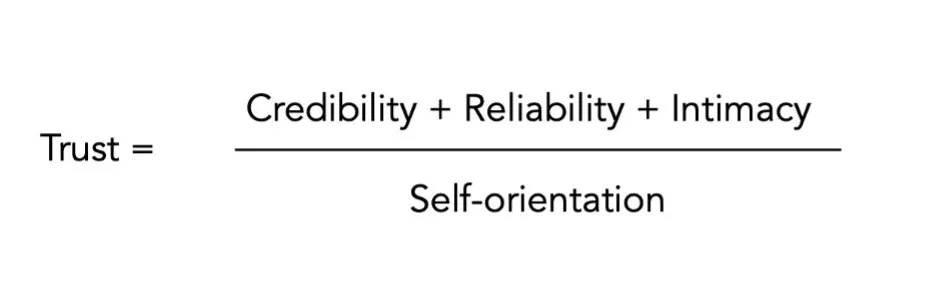
The Trust Equation – understanding the psychology of trust
Charles H. Green developed the Trust Equation, along with David Maister and Robert M. Galford, co-authors of The Trusted Advisor. They explored the psychology of trust by looking at professional services and how people relate to one another. The result of this study was the Trust Equation.
The equation is actually a measure of trustworthiness, in other words, how much trust we are willing to invest in a person. In this context, to have trust between two parties, you need someone who is trusting and another person who is trustworthy. The equation gets to the heart of that relationship.
For clarity, it is worth exploring the terms that Green uses in the equation. Here are some questions you can ask to think about how someone might score against each of these terms.
Credibility (words)
Is the person professionally credible; do they live up to their CV?
Do the person’s words fit their actions?
Reliability (actions)
Are they dependable?
Will they do what they promise?
Intimacy (feelings)
Do you feel safe or secure around the person?
Do you trust that person with confidential or personal information?
Self-orientation
Is a person self-centred, putting themselves before the needs of the vision and team?
Are they self-obsessed (always framing an issue from their own perspective) or do they look at a situation more broadly?
If you want to quantify each factor you can give a numerical value (1-10) for the answer to each question. You can score someone you are thinking about (to better analyse that relationship) or you can score your team culture to examine the levels of trust within your workplace. Finally, you can also use this as a self-reflection exercise and examine how you perform in each area. Remember to think of evidence – of actual experiences – to back up your scores.
So, those are the steps to building trust. Understand the trust equation and you can quantify the levels of trust that you have with an individual or team. Then you can implement the eight behaviours to develop a more trusting culture in your workplace.
Therefore, which behaviour do you most need to work on today?
If you want the right answers you have to start with the right questions
About The Right Questions
The Right Questions is for people who want to lead better and make better decisions. We are all leaders as we all have influence, no matter how much or how little. So, how are you maximising your influence?
If you are unsure, just drop me a line. I would love to help!
Do you want to lead better? Would you like to make better decisions? Want support in achieving your goals? Get in touch and let me know how I can help!
How to Use the Rule of 3 to Structure Your Communication
As a leader, I often have to speak, at short notice, to various groups of people. This might be in the context of a meeting, while facilitating training, or even at a social function where I might be asked to “say a few words”. When this happens, I have a simple hack that helps me prepare, even if I have just a few seconds. That hack is the rule of 3.
Using the rule of three I quickly come up with three main points that become the structure of any impromptu public speaking. Equally, when I write an essay or article, I start by identifying three core arguments or facts. And again, when decision-making, I generate three courses of action before making my choice.
So, the rule of 3 can be used in many different contexts, but why three? What makes us use trios of information?
What is the rule of three and where does it come from?
The rule of 3 is very simple. Any time you use a triad of information in your communication you are using the rule of 3. A lot of the time we do it unconsciously but there is a long history of using the rule of three to structure stories, speeches, and teachings.
Caesar exclaimed “Veni, Vidi, Vici!” (I came, I saw, and I conquered) but even before that, Aristotle recommended the following three-part structure for successful rhetoric:
Ethos –first establish credibility and character
Logos – then bring in the rational argument and facts
Pathos –then engage the emotions and connect with an audience
So, history demonstrates that there is something about triads that connects with us on a psychological level and supports effective communication. The rule of 3 certainly encourages clarity, brevity, and memorability.
More recently, neuroscience research has shown that we can generally only remember 3-5 pieces of information. The more complex the information the harder it is to recall all the elements, so it is no surprise that psychologically we fixate on threes. We also forget huge amounts of information, and the attrition of data happens almost immediately (as shown by Ebbinghaus’ Forgetting Curve). Therefore, using a clear structure as with the rule of 3 encourages better recall.
How do you use the rule of three?
The rule of 3 is most associated with writing and is one of the easiest modes to practice using the method. Authors use it at the micro and macro scales and you can too. At the small level, a sentence might include a trio of associated words, clauses, or points (as I have just done here).
In stories, it is common to have triads of characters such as the three bears in Goldilocks. Equally, you can also have three significant events such as the houses of straw, wood, and brick in the three little pigs (which is also has a trio of characters).
In more formal writing, the structure also often falls into threes. The most obvious is the idea of having a beginning, middle and end. This can be further broken down into threes. For example, in an essay, you might have the introduction, the main body and then a conclusion (a three-part structure). Then, the main body could involve three main arguments, each of which might have three supportive points. Of course, it does not always end up this way, but it can be a great way to start a writing project or to create an essay plan.
On a larger scale, many books come in groups of three or start as trilogies. Here The Lord of the Rings, The Hunger Games (Suzanne Collins) and His Dark Materials (Philip Pullman) are obvious examples.
Three Acts in Plays and Trilogies in Movies
The rule of 3 extends into other writing such as scripts and screenplays. Modern plays and movies often have three acts that internally follow this structure:
The Protasis (exposition) where we meet the main protagonists
The Epitasis (complication) where things take a turn and don’t go to plan
The Catastrophe (resolution) where the story finds closure – happily or not
Furthermore (similarly to novels), movies are often released in threes. For example, the Star Wars saga, which was originally a trilogy, became a trilogy of trilogies (under George Lucas’ production). And this is often the case. Literature and films are often envisioned as trilogies but then stretch beyond that due to popularity (e.g. Indiana Jones, The Matrix or the Bourne Trilogy).
The Rule of Three for Public Speaking, Publicity and Persuasion
We have already seen that the rule of 3 extends back to the public speaking advice of Aristotle and the ancient philosophers. More recent and well-known advice for public speaking is:
“Tell them, tell them again, then tell them what you said.”
Anon
When you consider how little people remember then this is very good advice indeed for any communication.
Simon Sinek, when talking about effective communication, recommends using the ‘Golden Circle’ structure of:
Why – to explain the motivation behind something and engage the emotions (through the limbic system and older part of the brain)
How – to explain how this will help people
What – to cover the benefit in logical terms (engaging the neocortex or rational brain)
This premise is explained in his bestselling book Start With Why and reflects his background in advertising. Sinek knows what makes something catchy or sticky (in marketing terms). You will also notice that there are similarities to Aristotle’s advice, even if there is a difference in order.
The Rule of Three: Absolute Rule or Just a Guideline?
The rule of 3 is not really a rule. As with any conceptual model, it is an aid to thinking, not a set of firm laws we must adhere to. In the words of Captain Barbossa (from The Pirates of the Caribbean), “The (rule of 3) is more what you’d call ‘guidelines’ than actual rules.”
Even within this article, I have demonstrated just that. When drafting this post, I did initially utilise a three-part structure. That structure has evolved and becomes less obvious as I have edited the writing. There are still various examples of triads in the sentences that you can pick up on.
So, do use the rule of 3 as a tool to help you. Play with it and experiment, but don’t feel constrained by it. Next time you have to write an email, construct a meeting agenda or have a telephone conversation, jot down three things to start. It will really help!
If you would like help developing your communication skills, or those of your team, do drop me a line via the Contact Page.
If you want the right answers you have to start with the right questions
About The Right Questions
The Right Questions is for people who want to lead better and make better decisions. We are all leaders as we all have influence, no matter how much or how little. So, how are you maximising your influence?
If you are unsure, just drop me a line. I would love to help!
Do you want to lead better? Would you like to make better decisions? Want support in achieving your goals? Get in touch and let me know how I can help!
I once had to suspend a member of my team in the middle of delivering an important project. It was a difficult decision and painful for everyone involved, but it needed to happen. The actions of this individual had eroded the bond of trust that they had with the rest of the group. As a result, the whole team was no longer working effectively. If the individual was allowed to continue, the productivity of the whole organisation would have been undermined. Trust in the leadership, team discipline and work processes would have been damaged.
The behaviour of the individual had impacted output but, in the end, it was all about trust. Trust takes time to build and a moment to lose. Helping to reinforce trust within a team, and to avoid these breaches of trust, is a vital part of a manager’s role. That is because where there is a lack of trust there will also be a lack of high performance.
Even without this example, we all know that trust is important in any relationship. But what do we mean by trust? How would you define it? And having defined it, what can we do to develop trust in our relationships at work?
Defining trust
Trust can be thought of as faith, belief, or hope. It is the feeling of confidence that we have in a person, organisation, or thing. Trust has both a logical and emotional quality. We choose to trust a thing because of how we think and how we feel.
In relationships, trust is foundational, whether that is with friends and family, or with colleagues at work. In the context of relationships trust can be defined as:
“The willingness of a party to be vulnerable to the action of another party based on the expectation that the other will perform a particular action.”
So, whether we are starting to get to know someone and building rapport, or maintaining a long-lasting relationship, trust is critical. But, knowing this, how do you develop a culture of trust and psychological safety in the workplace?
The neuroscience of trust
The first thing we need to understand is how our brains work when it comes to putting faith in someone. Paul J. Zak has spent many years studying the neuroscience of trust. His research has centred around how higher levels of trust are linked to the brain producing higher levels of oxytocin.
It is great knowing that oxytocin helps to develop trust, but it is unlikely that we will be wanting to dose ourselves with synthetic hormones just to be more trusting! Fortunately, during his research, patterns emerged of actions that promoted oxytocin levels (positive behaviours) and things that inhibited its production (such as high stress). These were narrowed down to eight key behaviours to foster trust.
The 8 behaviours that foster trust in the workplace
So here are the eight behaviours, identified by Paul Zak, that can help to release oxytocin naturally and build a more trusting and effective culture in the workplace:
Recognise excellence
Induce “challenge stress” (difficult but achievable tasks)
Give people discretion in how they do their work
Enable job crafting (let employees choose projects to work on)
Share information broadly
Intentionally build relationships
Facilitate whole-person growth
Show vulnerability
Let’s expand each one a little more.
1. Recognise excellence.
Public recognition of someone, when they have achieved something, can be a huge boost to oxytocin. If the praise is unexpected and personal it is even more powerful. Such recognition also boosts confidence.
2. Induce “challenge stress”.
Challenge stress is the idea of setting difficult but achievable tasks. These stretch targets prompt personal growth and team development as they require focus and collaboration. These are the BHAG (Big Hairy Audacious Goals) championed by Jim Collins in his book Good to Great. The balance here is to find the right level of challenge so as not to push people into negative stress and therefore managers should monitor such goals and adjust them accordingly.
3. Give people discretion in how they do their work.
If people feel empowered to do work in their way, they are likely to be more motivated and therefore more productive. This trust and freedom have also been shown to improve creativity and innovation. The opposite of this autonomy is when people are micro-managed which has opposite effects.
4. Enable job crafting.
Job crafting goes beyond discretion about how they do tasks and takes this further to allow employees to choose which projects to work on. Not surprisingly, people work harder on the things they care about. Google has famously championed this way of working, allowing employees to pursue personal projects for 20% of their time alongside normal responsibilities. The challenge for the leader is to align people with their passions while covering all the operational outputs required of a team.
5. Share information broadly.
People like to be informed; conversely, they hate it if they feel kept in the dark, even if unintentionally. This is because we all need levels of certainty to avoid negative stress. To build trust, organisations need to be open about goals, strategies, and even challenges.
6. Intentionally build relationships.
Relatedness is important. We all want to feel part of something. But you must be intentional about building a sense of belonging to build high-performing teams. Creating social events and opportunities for social interaction is very important. As mentioned earlier, achieving challenging tasks also helps build and deepen these relationships.
7. Facilitate whole-person growth.
Good leaders have and promote a growth mindset. They help people to develop personally as well as professionally. They also do not limit a person’s growth to the opportunities available within their organisation. Work-life balance, considerations such as family and health, should sit alongside discussions about performance for a person to feel truly valued and supported.
8. Show vulnerability.
Finally, people need to show each other vulnerability. Opening up to someone (in an emotionally intelligent way) is an act of trust in itself. As Brené Brown highlights in her book Dare to Lead, when a leader shows vulnerability – when they are truthful about what they don’t know, acknowledge mistakes, or ask for advice from subordinates – it actually promotes credibility and strengthens team bonds.
Encouraging positive behaviours in your team
Whether you are a leader, a team member, or a freelancer working with multiple clients, building trust is vital to effective work environments. Therefore, if you want to have good relationships and high-performing teams, seek to build trust through these 8 behaviours:
Recognise excellence
Induce “challenge stress” (difficult but achievable tasks)
Give people discretion in how they do their work
Enable job crafting (let employees choose projects to work on)
Share information broadly
Intentionally build relationships
Facilitate whole-person growth
Show vulnerability
If you are intrigued by the mindset of trust then I recommend you read How to Stop Your Primal Brain from Hijacking You at Work which explores neuroscientist David Rock’s SCARF model and the psychology behind our social connectivity. This will really help you improve your one-to-one as well as your team interactions.
If you want the right answers you have to start with the right questions
About The Right Questions
The Right Questions is for people who want to lead better and make better decisions. We are all leaders as we all have influence, no matter how much or how little. So, how are you maximising your influence?
If you are unsure, just drop me a line. I would love to help!
Do you want to lead better? Would you like to make better decisions? Want support in achieving your goals? Get in touch and let me know how I can help!
How to Use the Skill-Will Matrix to Pick the Right Leadership Style
The Skill-Will Matrix is a situational leadership model, made popular by Max Landsberg in his book The Tao of Coaching (2003). The Skill-Will method is easy to remember and apply, and that is why it remains popular with managers. The approach is primarily used to help identify the leadership style best suited to a given team member, but it can also help managers consider the performance management of their employees.
Situational leadership is a type of leadership theory that advocates for leaders to adapt their management approach to fit the circumstances. The premise is that there is no single correct way to lead in every situation as people, challenges and events are in flux. Therefore, good leaders use their judgement and flex their style according to the needs of the situation.
The Skill-Will method is similar to the classic Hersey-Blanchard situational leadership modelbut differs in the respect that its focuses on the subject (the employee) rather than the leader (or employer).
The 4 quadrants and leadership styles of the skill-will matrix
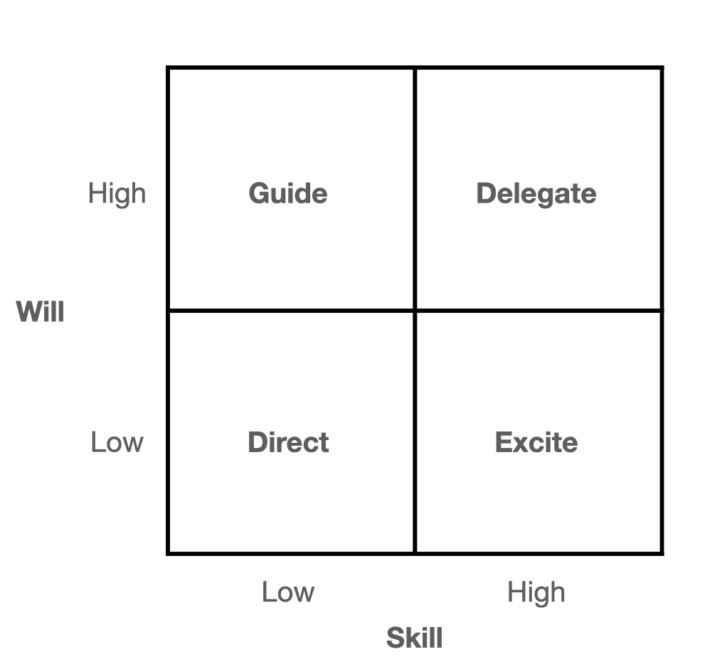
The skill-will matrix is a simple way to assess the right leadership style according to an individual or team’s level of will (motivation) or skill (competence). It is easily visualised as a two-by-two table with one axis being will (low and high) and the other axis being skill (low and high).
The matrix then proposes the best leadership style for a person, depending on where the subject falls in the four quadrants:
Low-will/low-skill: Direct
High-will/low-skill: Guide
Low-will/high-skill: Excite
High-will/high-skill: Delegate
You can see this illustrated in the picture below.
The Skill-Will Situational Leadership Matrix
Here is a further explanation of each of the four quadrants and the related leadership styles.
Low-will and low-skill: Direct
When someone has low levels of competence or motivation, then they fall into the low-will/low-skill quadrant. The leader needs to Direct team members in this category. In other words, the manager needs to explain tasks carefully and in detail, set clear deadlines and guidelines, and then monitor closely. Setting SMART or SMARTER tasks (specific, measurable, achievable, relevant, time-based, evaluated, and re-evaluated) is essential.
This type of leadership takes the most time and effort of any of the four quadrants and therefore is generally less preferable. A leader who remains in a directive mode of leadership also runs the risk of micro-managing employees if they apply this style in the wrong circumstances.
A classic example of someone in the low-will/low-skill section of the matrix would be someone new to the workplace. These employees need time and training so they can develop their skills. They also need support and encouragement so they can grow in confidence and motivation.
Though this most commonly applies to new workers, low performers generally also fall into this space. Over time a manager could have tried to help the team member progress beyond this quadrant, but it does not always work out. When this is the case, it can be best for the individual to move elsewhere. Sometimes there is a personality clash, so it is worth considering moving the person sideways to another role or team before moving that person out of the organisation completely. These kinds of moves can be hard, but a good leader seeks to find a place where an individual can thrive, even if it is outside their group.
High-will and low-skill: Guide
If someone is enthusiastic but does not necessarily have the right skills or experience, then they fall into the high-will/low-skill category. Here a leader needs to Guide the team member.
When a person is motivated, the role of the manager is to focus that energy and provide the information or instruction needed to complete a task. In this way the leader can be seen as a guide or mentor, supporting the worker by helping them fill in gaps in their knowledge.
Subjects who fall into this quadrant have great growth opportunities and so a manager can use tools such as Kolb’s learning styles and the GROW model to help identify approaches and tasks to develop the individual.
A typical example of someone in this scenario would be a new graduate who might be very intelligent with high energy levels but lacking some experience and specific industry know-how. The trick here is to help the person develop their skills without them losing their motivation.
There is also a potential win-win opportunity here to develop people from two different quadrants. Someone from the high-skill but low-will zone might prove to be a good mentor for those in the high-will/low-skill area. In this way, the experienced person can take on this coaching or mentoring role and hopefully, they will find this motivating, increasing their will while helping the other person to up-skill.
A person who lacks enthusiasm but has the necessary know-how falls into the low-will/high-skill bracket. Here the leader needs to Excite the team member by finding ways to increase their will and energy levels.
Long-term team members can sometimes fall into this category. They have all the skills they need to do their job but have lost some of their mojo. If work starts to feel stale or dull, then they lose their enthusiasm. The danger here is that this lack of drive can be infectious and impact other members of the team, particularly new ones who might look up to these experienced team members.
In this situation, a manager must find what is going to motivate that person. What are their drivers? A conversation about personal values could illuminate their passions. Exploring their work-life balance, using a tool such as the Wheel of Life, could also be helpful. This can unearth new goals or areas of growth to help motivate the individual.
As mentioned in the high-will/low-skill section, there is an opportunity to team up with more experienced (but less motivated) employees with energetic (but less competent) team members. This can help both parties move up to the high-will/high-skill zone, while also sharing out some of the management burden of the team leader.
High-will and high-skill: Delegate
If people are both able and willing then they fall into the top right quadrant, that of high-will and high-skill personnel. Leaders can Delegate to these individuals, trusting that they can do the job.
This is the ideal quadrant for managers and team members alike. Being able to delegate effectively empowers the individual and allows the leader to think of longer-term issues, such as business development or the further career development of individuals.
Career development becomes an even more important question for team members in this quadrant as they are the most likely people to be promoted, or who get poached by other teams or organisations. One of the biggest frustrations – but equally the most satisfying aspects of leadership – is seeing one’s best people outgrow the team.
Therefore, it is vital that the leader continues to find new challenges and growth opportunities for the people who fall into this zone. A boss can take on more of a coaching leadership style with a light-touch management approach. A manager needs to create space for creativity and should be comfortable with taking more risks with the individual.
Video of the Skill Will approach to situational leadership and delegation
An example of the potential pitfalls of the Skill-Will matrix
I once had an excellent employee who sat in the top, high-will/high-skill quadrant of the matrix. They were experienced, an old hand at the job, but still maintained high energy levels that bolstered the team as a whole. They were a good mentor for new team members, and I often delegated leadership responsibility to them in my absence.
So, when I asked this person to organise a team social, I thought nothing of it, I expected a great result. The problem was that the event was a disaster. The timing, location and expense of the event meant that it would not have got the participation I wanted and therefore I had to intervene and organise the event myself. This was largely a failure on my part.
I was lulled by the Halo Effect, a cognitive bias where I assumed that because this person was good at one thing, then they would be good at another. Here, the person in question was excellent at technical work, and in these circumstances, they were high-will/high-skill. But when I gave them a team-building task this pushed them into a high-will/low-skill situation. Because I did not realise this, I had to take their task away and this damaged their motivation, pushing them into the high-skill/low-will area for a while. It took some coaching from me to get them back on track again.
The point of this example is that don’t assume that people remain static in these quadrants. A change in role, task or situation can easily push people out of their zone – for better or worse – and therefore the leader needs to have good situational awareness and be constantly assessing their people to keep applying the best managerial tactic.
How to use the skill-will matrix
I like the Skill-Will matrix as a leadership approach and management tool as it is so easy to remember and apply. I also like the fact that it was developed from a coaching perspective and forces the leader to think about the way to get the best out of each team member.
If you want to assess someone in your team and modify your leadership style to suit them, then use the Skill-Will matrix. Think of the matrix as a graph and then score the person against each axis to help quantify your thoughts by following these steps:
First, think of their skill level. What is their training, competency, or experience for the task at hand? Give them a rating of 1-10.
Then think of their will. What are their motivation levels? How energised are they to take on the project? Give this a rating of 1-10
Now plot these scores onto the Skill-Will table with 1-5 being low and 6-10 being high on each axis.
Pick the appropriate style accordingly.
And remember, we all have our preferred style of leading so it might feel uncomfortable to change that style at first. But, as with fitness, the more you work on your flexibility, the easier that stretching of approaches becomes.
If you are interested in other leadership approaches then you can read:
If you want the right answers you have to start with the right questions
About The Right Questions
The Right Questions is for people who want to lead better and make better decisions. We are all leaders as we all have influence, no matter how much or how little. So, how are you maximising your influence?
If you are unsure, just drop me a line. I would love to help!
Do you want to lead better? Would you like to make better decisions? Want support in achieving your goals? Get in touch and let me know how I can help!
The 7 Questions You Need to Answer for Any Successful Meeting
What is the one thing that wastes most of your time at work?
You might have said ‘emails’, you might even have said ‘that annoying colleague who always hangs around my desk’, but most likely you will have said ‘meetings’.
That is because most employees face meetings overload in their workplace, and arguably it is worst for executives who (according to the Harvard Business Review) spend an average of nearly 23 hours per week in meetings.
But crazy meeting schedules impact everyone in an organisation, and bad meetings are not just wasting people’s time, they are also losing money. Professor Steven Rogelberg conducted research showing that for a company of 5000+ employees, time misspent in meetings equated to around $25,000 per employee annually; that’s over $100 million per year in large companies.
So why do we have so many unproductive and ineffective meetings?
The secret (or common sense) behind running effective meetings
The problem is that most meetings just exist. Someone set them up, way back in the distant past, they entered a schedule and then people just attend them. No one stops to ask the right questions; those that will ensure a good meeting.
I have seen and continue to see this first-hand in the public, private and voluntary sectors. I have worked as a leader, managing things directly for organisations, and as a coach and facilitator, consulting back into these various spheres. Over the years, I have organised and attended countless meetings, from the very good to the very bad, and yes, sometimes I have been guilty of holding unnecessary meetings too.
Whether you are organising, facilitating, or attending a meeting, for it to be productive, you need to know the why, what, where, which, who, how and when of the meeting. Let’s explore that further by expanding these interrogatives and asking the essential questions.
Why do you need the meeting?
The first and most important thing you must ascertain is why you need a meeting.
Think about the meetings you attend. For each one, what is the reason for the meeting? Why does that meeting exist? If you cannot answer that question, I would suggest you either find a ‘why’ for going along, or you should remove yourself from the invitation list.
Every meeting should have a defined purpose. If you are planning a meeting, you must know clearly why the meeting needs to take place and then properly communicate that to the relevant stakeholders.
And that ‘why’ should not just be ‘to get the team together’ or ‘to help communication’. These reasons are too vague. The purpose needs to fulfil some need or solve a problem that you are facing. Don’t move on to the other questions until you have answered this question (or don’t have the meeting).
What does success look like for the meeting?
Once you know why you want to hold a meeting, the next task is to define what success looks like; in other words, what do you want to achieve by the end of the meeting?
The why and the what are related but subtly different. For example, the reason for the meeting could be that it is a kick-off meeting, the first time everyone is getting together. That is the why. Success in this instance might be that everyone leaves the meeting having met all the team members and understanding everyone’s roles. That is the what.
How you define the outcome of the meeting then shapes the agenda. The agenda can be thought of as a mini action plan with the agenda items being the tasks required to get to the desired end-state.
Where is the best place for the meeting to take place?
Location is important. Where you hold the meeting and how that space is set up will have a large impact on the feel and flow of the gathering.
For example, if you meet in a large boardroom, with someone at the head of a huge table, people will naturally defer to that person. This is good for giving direction, but less good if you are wanting participation and creativity. For the latter, you might want to find a more neutral space with a variety of break-out areas and no imposed feeling of hierarchy.
Be creative with your meeting space. Sometimes even changing the location of a regular gathering can help breathe new life into it. I am a great fan of getting outside whenever possible. For example, my favourite one-to-one meetings are walking meetings but I also run workshops and other types of meetings outdoors.
Which type of meeting will create the right outcome?
The idea of a specific type of meeting is linked to the purpose and success of the meeting. Therefore, defining the kind of meeting will refine the why and the what, as well as inform your choice of location. Identifying the nature of the meeting with also help to scope the following questions covering the who, what and when of the meeting.
There are lots of types of meetings but most fall into the following categories:
Briefing, information sharing or presenting. This is usually biased towards one-way communication of key data.
Decision-making. Here the purpose and outcome of the meeting are shaped by a specific decision or set of choices.
Problem-solving. In this case, it is a problem that is the focus of the meeting.
Team building. Every team requires proactive effort to build them up, but the approach depends upon where they are in terms of team development.
Kick-off or project start. Any new initiative should have a proper kick-off.
Catch-up, check-in or status update. Most teams have these sorts of meetings, but these need to be well-disciplined to be effective.
Planning, progress, and performance. This covers many management functions such as event planning meetings, quarterly reports, and project progress updates.
One-to-one. Person-to-person meetings can include interviews, coaching, mentoring, and performance meetings. These are just as important to plan as a large gathering.
Whom do you need at the meeting?
There is an art to identifying who you need in any given meeting. Too few people and you might not have the cognitive diversity, experience, or decision-making power to achieve your aim. Too many people and meetings can become bloated, over-long, and it will be hard to achieve consensus.
Meetings take up people’s time, their most precious resource, so be ruthless. Only invite the people who really need to be there. And if that means people only attend certain agenda items and then leave, that’s fine. Don’t make people sit through things that are not relevant to them; they will not thank you for it.
A good rule of thumb is the cocktail party rule. If you watch a room at a party, groups will rarely exceed eight people because this becomes a natural limit to inclusive conversations. Therefore meetings, particularly if you want to get a decision, should generally consist of fewer than eight people.
If you want to brainstorm something you could push attendance closer to twenty people, although you will want chances to work in smaller groups during the workshop. And if you are just communicating information didactically then there is no real limit (it could be thousands). This approach can be remembered as the 8-18-1800 rule. In other words, 8 people for decisions, 18 for brainstorming, and 1800 for one-way communications.
How should you best run the meeting?
Effective meetings require leadership. The management style that you adopt depends upon the type of meeting and what you want to achieve. For example, if the aim is to pass on information, then the leadership style is likely to be more directive, as you tell people what to do. If you want new ideas, then your approach will be more facilitative, ensuring that everyone contributes and has a voice.
How you craft the agenda can also support the leadership approach you adopt, particularly if people see the agenda before the meeting (which should be the case in most instances). For example, if you want contributions from the team you can craft each section of the agenda accordingly. The first item might be a check-in where everyone has a few seconds to say how they are feeling and what they are thinking. The next item might break down the team into smaller discussion groups before bringing back the key points to the full group. The important thing is to consider the best format for achieving each element of the agenda and how it builds towards the aim you set in question two (the what).
When should the meeting take place, and for how long?
The answer to this question very much depends on the type of meeting you are planning and the exact end-state you want to achieve.
In terms of length, think about what you want to achieve. Meetings span everything from the 5-10 minute standing team meeting that might happen at the beginning of a day, to the whole day creative workshop which is designed to come up with new ideas.
The scheduling of the meeting is then largely dependent upon the length. The longer the meeting, the longer the lead time you will need to give. The more people outside your immediate team that you want to have involved, and the more senior those people are, the further into the future you are going to need to plan. Going back to the previous example, you can call a quick stand-up meeting with only a few hours notice (if that), but an all-day workshop happening offsite is likely to need weeks (if not months) to schedule.
Before you have a meeting, ask these essential questions
In our work, we are inevitably going to spend many hours in meetings. Therefore, to ensure these are productive it is worth spending a few minutes answering these questions for each gathering you organise or attend:
Why do you need the meeting?
What does success look like for the meeting?
Where is the best place for the meeting to take place?
Which type of meeting will create the right outcome?
Whom do you need at the meeting?
How should you best run the meeting?
When should the meeting take place, and for how long?
And don’t stop asking these questions. What is true one week may not be true another week. Do not become a slave to a meeting schedule or make the meeting a habit you forget to challenge.
Leadership is an opportunity to bring positive change, no matter where you are in an organisation. So, how can you improve your organisational culture today? This might require challenging the status quo – which can be difficult – but if you can find more effective, productive and time-efficient ways to meet, you will win friends in the end!
If you want the right answers you have to start with the right questions
About The Right Questions
The Right Questions is for people who want to lead better and make better decisions. We are all leaders as we all have influence, no matter how much or how little. So, how are you maximising your influence?
If you are unsure, just drop me a line. I would love to help!
Do you want to lead better? Would you like to make better decisions? Want support in achieving your goals? Get in touch and let me know how I can help!